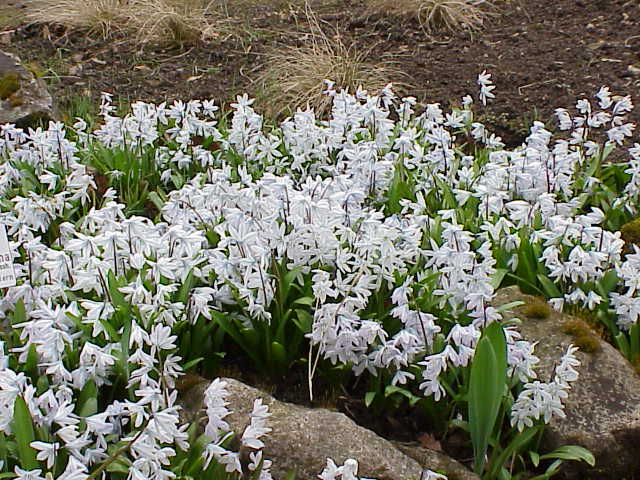
Photo: Kurt Stüber [1], CC BY-SA 3.0 · source

Bulb or tuber · Asparagaceae
Scilla mischtschenkoana
Scilla mischtschenkoana is a small spring bulb from the Caucasus and northern Iran. It is one of the very first to flower: as early as February and March it opens pale blue, almost white stars with a dark blue stripe down each petal. The flowers are carried several at a time on short stems of about 12 cm. The leaves only grow on properly after flowering and vanish again in late spring. In the trade it is often sold as ‘Tubergeniana’, the plant’s old name. Gardeners value it as a soft, fresh start to the gardening year, lovely among snowdrops and winter aconites.
Caution: All parts are poisonous, especially the bulbs. Dangerous to children, dogs and cats if eaten; keep loose bulbs out of their reach and plant them where pets do not dig.
Light
Sun or partial shade
preferably some sun
Moisture
Normal
no wet feet
Legal basis
Sand, loam or clay
neutral to chalky
Hardiness
Fully hardy
down to -25 °C
Size
0.12 m
tall, 0.05 m wide
Flowering
February–March
| Height | 0.12 m |
|---|---|
| Native to Belgium | No, planted |
| Good for bees, butterflies and birds | Yes, for bees |
| Poisonous to people and pets | Yes, take care with children and pets |
| Flowering | February–March |
Identify
Scilla mischtschenkoana: how do you recognise it?
- Habit
- Small bulb about 12 cm tall, with several short flower stems per bulb.
- Leaves
- Broad and strap-like, fresh green; they appear with the flowers and grow to 15–20 cm after flowering. They die back in May–June.
- Flower
- Wide open stars of 2–3 cm, several per stem, in February and March. Pale blue to almost white with a dark blue stripe on each petal.
- Bulb
- Egg-shaped, about 3 cm, with a light brown tunic. Forms offsets over time.
- Opening
- The flowers only open in the sun; in cold or grey weather they stay half closed.
Flowering: February–March · Plants: September–November
In your garden
Why grow it?
- Flowers as early as February and March, sometimes among the last snow, when almost nothing else is in bloom.
- An early source of food for bees and bumblebees on mild, sunny days.
- The soft pale blue with its dark stripe is more refined than the vivid blue of other squills.
- Ideal under deciduous shrubs and trees and among other early bulbs.
- Small and easy: once planted it comes back every year without any work.
Scilla mischtschenkoana: where does it grow best?
- Sun or part shade; under deciduous trees and shrubs it gets plenty of light in February.
- Well-drained garden soil: sand, loam or clay, neutral to chalky.
- Normally moist in spring; in summer it may be dry. Not in a spot where water stands.
- Plant in groups of at least 10–25 bulbs, 5–8 cm apart: in a border, in grass, in a rock garden or in a pot.
- Light
- Sun and partial shade
- Soil type
- Sand, loam or clay
- Acidity
- Neutral or chalky
- Moisture
- Normal
- Size
- 0.12 m tall, 0.05 m wide
- Hardiness
- Hardy (to -25 °C)
Goes well with
- Snowdrop: Flowers at the same time and naturalises in the same spots; white and pale blue go well together.
- Winter aconite: Its yellow flowers make a fresh contrast with the pale blue.
- Crocus: Purple and yellow crocuses flower in the same weeks.
- Lenten rose: Large flowers in the same part shade, with the squill as a carpet at their feet.
- Hosta: The young leaves take over the spot when the squill disappears.
Maintenance
Scilla mischtschenkoana: when and how to plant it?
Plant in September–November.
- Plant the bulbs from September to November, as early as possible: they dry out quickly.
- Plant them about 8 cm deep, pointed end up.
- Space them 5–8 cm apart, in loose groups, among other early bulbs.
- Firm the soil well and water if it is dry.
- In a pot or trough: use a loose compost with some sand for good drainage.
Care
- Water
- Usually not needed: autumn and spring rain is enough. Keep the compost in a pot lightly moist.
- Feeding
- Not needed in ordinary garden soil. On poor soil spread a little compost after flowering.
- Foliage
- Let the leaves turn yellow after flowering: this lets the bulb build up reserves for next year.
- Mowing
- Do not mow the grass around the bulbs until the leaves are yellow, usually from mid-May.
- Dividing
- If clumps get too crowded, divide them every few years for more flowers.
Tip: Give it a spot with spring sun: the flowers only open in the sun, so that is where they look their best. Plant them in a group among snowdrops and let the leaves die back.
Scilla mischtschenkoana: when to prune it?
When: This squill is not pruned. After flowering you simply leave it alone.
How:
- Let the leaves die back completely and clear them away only when they come away by themselves.
- Cut off spent stems only if you do not want seed; leave the leaves.
- Never cut off green leaves: the bulb needs them for next year’s flowers.
Caution: Do not mow or cut the leaves while they are green, or it will flower less well next year.
Propagation
- Division
- Lift dense clumps in June, when the leaves have died back, or in September. Separate the offsets and replant them straight away.
- Seed
- Sow ripe seed in June in a pot left outdoors. It takes several years before the seedlings flower.
Scilla mischtschenkoana: how does it get through the winter?
Hardy to −25 °C.
- Fully hardy down to about −25 °C: no protection is needed in Belgium.
- The flowers close in frost or dull weather and open again when it turns milder; late frost does them little harm.
- In a pot or trough: stand it outdoors in a sheltered spot and make sure the compost does not become waterlogged.
Diseases and pests
- No flowers: The leaves were mown off too early, or the bulbs are too crowded, in too much shade or dried out. Let the leaves die back and divide crowded clumps.
- Closed flowers: In cold or grey weather the stars stay closed. That is normal: they open again in the sun.
- Bulb rot: Bulbs in wet, heavy clay can rot. Mix sand into the soil or choose a higher spot.
- Slugs: They sometimes nibble young leaves in a wet spring. Pick them off in the evening.
Through the year
- January: The first leaf tips sometimes appear already.
- February: Flowering begins. Bees visit on mild days.
- March: Full flower, among snowdrops and crocuses.
- April: The leaves grow on. Leave them in place.
- May: Let the leaves die back. Do not mow the grass around the bulbs yet.
- June: Leaves have died back: you may mow now. Divide dense clumps.
- September: Plant new bulbs, 8 cm deep.
- October: Plant under shrubs, in grass or in the border.
- November: Last chance to plant.
Use
Edible and useful
Not edible. All parts of squills and glory-of-the-snow (Chionodoxa, now included in Scilla) are poisonous, especially the small bulbs: they can cause vomiting, stomach ache and diarrhoea, in children as well as in dogs and cats. The bulbs look like little onions: never store them with the vegetables or the kitchen onions, and keep loose bulbs out of reach of children and pets. They seed themselves freely, in borders, under shrubs and in the lawn: do not plant them where your dog digs, and do not let horses, sheep or goats graze where they grow in large drifts. Wash your hands after planting. If any is swallowed, call a poison centre (in Belgium 070 245 245) or your doctor at once.
Good for wildlife
- Bees
- Nectar and pollen for honeybees and wild bees.
You and this species
Did you know?
- The old name Scilla tubergeniana refers to the Dutch bulb grower Van Tubergen of Haarlem; that is why ‘Tubergeniana’ still appears on many packets.
- It often flowers as early as February, before most other squills, and opens its blue stars even through snow.
- The flowers only open in the sun: on a grey day the patch of bulbs can look empty.