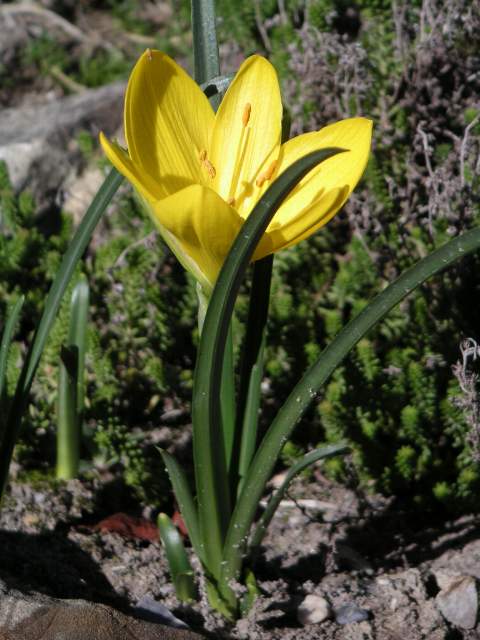
Photo: Wikimedia Commons, CC BY-SA 3.0 · source

Bulb or tuber · Amaryllidaceae
Winter daffodil
Sternbergia lutea
In other languages: Sternbergia (Nederlands) · Sternbergie jaune (Français)
Sternbergia lutea comes from the Mediterranean region and the Middle East, where it grows on dry, rocky slopes. In September and October it opens golden yellow flowers that look very much like a large crocus, although it belongs to the daffodil family. The dark green, strap-like leaves appear with the flowers, stay all winter and die back in late spring. The plant needs a hot, dry summer rest to flower well, so it does best in a warm, sunny spot against a wall. Gardeners value it as a bright yellow autumn flower where little else is in bloom.
Caution: All parts are poisonous, especially the bulb. Dangerous to children, dogs and cats if eaten; the bulbs look like onions and can be mistaken for them, so store them separately and out of reach. Wash your hands after planting.
Light
Full sun
warm and bright
Moisture
Dry
tolerates drought
Legal basis
Sand, loam or clay
neutral to chalky
Hardiness
down to -15 °C
protect young plants
Size
0.15 m
tall, 0.1 m wide
Flowering
September–October
| Height | 0.15 m |
|---|---|
| Native to Belgium | No, planted |
| Poisonous to people and pets | Yes, take care with children and pets |
| Flowering | September–October |
Identify
Winter daffodil: how do you recognise it?
- Habit
- Small bulb about 15 cm tall, slowly forming small clumps.
- Leaves
- Four to six dark green, strap-like leaves, 20–30 cm long. They appear with the flowers, stay through winter and die back in May–June.
- Flower
- Golden yellow, cup-shaped flowers of about 4–6 cm, resembling a crocus. They flower in September and October.
- Bulb
- Egg-shaped, a few centimetres across, with a dark brown to black tunic.
- Summer rest
- In summer the bulb rests and wants to stay dry and warm.
Flowering: September–October · Plants: July–September
In your garden
Why grow it?
- Flowers in September and October with golden yellow, cup-shaped flowers, when most borders are starting to fade.
- The dark green leaves stay fresh all winter and bring welcome colour in the cold months.
- Very drought tolerant: a good choice for a dry, sunny border or rock garden.
- A late source of food for bees and other insects in autumn.
- Small and tough once settled; it can grow undisturbed for years.
Winter daffodil: where does it grow best?
- Full sun in a warm, sheltered spot, for example against a south-facing wall.
- Well-drained sandy, loamy or clay soil, neutral to chalky. On heavy soil mix in coarse sand or grit.
- Dry to normally moist; in summer the soil must not be wet.
- Leave 10–15 cm between the bulbs; plant them in groups of at least five or ten.
- Light
- Sun
- Soil type
- Sand, loam or clay
- Acidity
- Neutral or chalky
- Moisture
- Dry
- Size
- 0.15 m tall, 0.1 m wide
- Hardiness
- Hardy (to -15 °C)
Goes well with
- Autumn crocus: Flowers in the same weeks; yellow and purple make a lovely contrast.
- Stonecrop: Pink and brown flower heads in autumn, in the same sunny, dry soil.
- Lavender: The same warmth and dryness; its grey leaves give a calm backdrop.
- Ornamental grasses: A fine grass such as feather grass makes the yellow stand out even more.
Maintenance
Winter daffodil: when and how to plant it?
Plant in July–September.
- Plant in July, August or September, as soon as you can buy the bulbs: they often flower the same autumn.
- Choose the warmest, sunniest and driest spot in the garden, preferably against a south-facing wall.
- Plant them about 15 cm deep, pointed end up, in well-drained soil.
- Space the bulbs 10–15 cm apart and water once generously after planting.
- Do not use mulch in summer: the bulb must stay warm and dry.
Care
- Water
- No water in summer. In autumn and winter water only during a long dry spell.
- Feeding
- Not much needed. After flowering you can give a little compost or a fertiliser for bulbs.
- Foliage
- Leave the leaves until they die back by themselves in late spring: this lets the bulb build up reserves.
- Leave undisturbed
- Leave the bulbs alone for years: after moving, it often does not flower for a year or two.
- Shelter
- A sheltered spot against a wall protects the winter leaves from hard frost.
Tip: Plant it 15 cm deep in the warmest, driest spot against a sunny wall and do not move it: after a few years it flowers most generously. Keep it dry in summer.
Winter daffodil: when to prune it?
When: Sternbergia is not pruned. You only clear away dead leaves.
How:
- Cut off spent flower stems just below the flower if you do not want seed.
- Leave the green leaves and clear them away only when they yellow and come away by themselves in May–June.
- Remove only frosted, brown leaf tips in spring.
Caution: Do not cut off the green leaves: the bulb needs them in winter and spring to flower.
Propagation
- Division
- Lift dense clumps in July, when the leaves have died back and the bulb is resting. Detach the offsets and replant them straight away, 15 cm deep.
- Seed
- Sow fresh seed in autumn in a pot of sandy compost, outdoors or in a cold frame. It takes several years before the seedlings flower.
Winter daffodil: how does it get through the winter?
Hardy to −15 °C: protect young plants.
- Hardy down to about −15 °C: in most of Belgium it can stay outdoors.
- The leaves may get brown tips in severe frost; the bulb itself usually survives. A sheltered spot against a wall helps.
- In a pot: stand it in a sheltered spot in winter, protected from rain, so the compost does not become waterlogged.
Diseases and pests
- No flowers: Too little sun, planted too shallow, a cool or wet summer, or recently moved. Choose a warm, dry spot, plant 15 cm deep and leave the bulb alone.
- Bulb rot: Bulbs turn soft in wet soil, especially in summer. Plant in free-draining soil and avoid water during the rest period.
- Frost damage to leaves: Brown leaf tips after severe frost. Cut them off in spring; the bulb simply grows again.
- Slugs: They sometimes nibble young leaves and flowers in autumn. Pick them off in the evening.
Through the year
- January: The leaves stay green. Shelter in hard frost if needed.
- March: The leaves grow on. A little feed or compost if needed.
- May: The leaves turn yellow. Let them die back by themselves.
- June: Summer rest begins. Keep dry and warm.
- July: Plant or divide dense clumps.
- August: Plant, 15 cm deep.
- September: Flowering begins. Last chance to plant.
- October: Full flower. New leaves come up.
- November: The leaves grow. Water only in a dry spell.
Use
Edible and useful
Not edible. Belladonna lily, crinum, nerine, Aztec lily (sprekelia) and winter daffodil (sternbergia) belong to the daffodil family and, like daffodils, are poisonous in all their parts, especially the bulbs: they contain alkaloids such as lycorine, which cause vomiting, drooling, stomach ache and diarrhoea, in children as well as in dogs, cats and grazing animals. The bulbs look like onions or shallots but do not smell of onion when cut: never store them with the kitchen onions, not even the bulbs you keep dry over winter, such as sprekelia, and label them. The sap can irritate the skin: wear gloves when planting, dividing and cutting flower stems, and wash your hands afterwards. Keep a vase of nerines or belladonna lilies out of reach of cats, and call your vet if your dog or cat has chewed a bulb. If any is swallowed, call a poison centre (in Belgium 070 245 245) or your doctor at once.
You and this species
Did you know?
- The name Sternbergia honours Count Kaspar Maria von Sternberg, a Bohemian naturalist and botanist of the 18th and 19th centuries.
- It looks like a crocus but is not related to it: it belongs to the daffodil family (Amaryllidaceae).
- The English name winter daffodil is misleading: the flowers appear as early as September and October, in autumn.