Photo: Kurt Stüber [1], CC BY-SA 3.0 · source

Perennial · Asteraceae
Stokes' aster
Stokesia laevis
In other languages: Korenbloemaster (Nederlands) · Stokésia (Français)
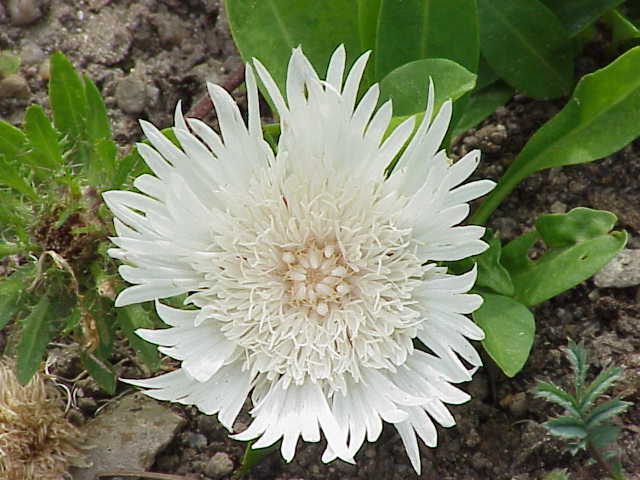
Stokes’ aster comes from the south-eastern United States, where it grows in open, damp, sandy places. It is a compact perennial with a rosette of lance-shaped leaves and, from July to September, large flowers 5–10 cm across in blue to lavender. The larger, fringed outer ray florets make it look like a cornflower or a big aster. Well-known cultivars include the blue ‘Blue Danube’ and ‘Klaus Jelitto’ and the pale yellow ‘Mary Gregory’, and white forms exist too. It is an excellent cut flower and gives bees and butterflies nectar in late summer. It dislikes wet winters, so well-drained soil is essential.
Light
Full sun
warm and bright
Moisture
Normal
no wet feet
Legal basis
Sand or loam
acid to neutral
Hardiness
Fully hardy
down to -20 °C
Size
0.4 m
tall, 0.45 m wide
Flowering
July–September
| Pruning months | March |
|---|---|
| Height | 0.4 m |
| Native to Belgium | No, planted |
| Good for bees, butterflies and birds | Yes, for bees and butterflies |
| Poisonous to people and pets | Not known to be poisonous |
| Flowering | July–September |
Identify
Stokes' aster: how do you recognise it?
- Habit
- Compact, loose clump 30–50 cm tall and 40–45 cm wide, with upright, branching flower stems.
- Foliage
- Lance-shaped, 10–20 cm long, dark green and slightly glossy, with a striking white midrib; partly evergreen in mild winters.
- Flower
- Flower heads 5–10 cm across, from July to September. The outer ray florets are large and fringed.
- Colour
- Mostly blue to lavender; there are also white and pale yellow cultivars.
- Roots
- Fibrous root system that rots quickly in wet winter soil, so good drainage is needed.
Flowering: July–September · Plants: April–May · Pruning: March
In your garden
Why grow it?
- Flowers from July to September, at a time when many borders are looking tired.
- Large blue flowers bring the colour of cornflowers into the border; there are also white and pale yellow cultivars.
- Bees and butterflies visit the flowers in late summer.
- A good cut flower: pick half-open blooms for a bouquet.
- A neat, compact clump of about 40 cm that needs little maintenance.
Stokes' aster: where does it grow best?
- Full sun; in shade it flowers far less.
- Well-drained soil: sand or loam, acid to neutral. A moderately fertile soil is ideal.
- Reasonably moist in summer, but never wet in winter. On heavy soil, mix sand or fine grit into the planting hole.
- Allow 40–45 cm between plants.
- A sheltered spot stops the heavy flowers from flopping.
- Light
- Sun
- Soil type
- Sand or loam
- Acidity
- Acid or neutral
- Moisture
- Normal
- Size
- 0.4 m tall, 0.45 m wide
- Hardiness
- Hardy (to -20 °C)
Goes well with
- Coneflower: Purple-pink flowers in the same sunny spot and at the same time.
- Black-eyed Susan: Yellow flowers make a lovely contrast with the blue.
- Woodland sage: Blue spikes in the first half of summer, in the same dry, sunny place.
- Fountain grass: A light ornamental grass that softly frames the flowers.
Maintenance
Stokes' aster: when and how to plant it?
Plant in April–May.
- Plant in April–May so the plant has time to root before its first wet winter.
- Dig a hole twice as wide as the root ball and, on heavy soil, mix in a few handfuls of sand or grit and some compost.
- Set the plant at the same depth as in its pot, with the top of the root ball level with the soil. No deeper: the crown rots easily.
- Leave 40–45 cm between plants.
- Water thoroughly straight away and keep the soil lightly moist through the first season.
- Spread a thin layer of compost or fine grit around the plant, keeping the crown clear.
Care
- Water
- In the first year water weekly in dry weather. After that it copes in normal summers; in a long drought water at the base.
- Feeding
- A handful of compost or organic fertiliser in March. Do not overfeed: the stems turn floppy.
- Deadheading
- Cut off faded flower heads: it extends flowering by several weeks.
- Support
- Usually not needed. In windy spots or rich soil, twiggy sticks help.
- Dividing
- Dividing the clump every 3–4 years in spring keeps the plant vigorous and flowering well.
Tip: Give it dry feet in winter: plant on a slight mound or mix sand into the soil. Deadhead consistently and it will flower for weeks longer.
Stokes' aster: when to prune it?
Pruning months: March.
When: In March, before the new leaves come through. In summer, remove faded flowers.
How:
- In March, cut dead leaves and old flower stems back to just above the leaf rosette.
- In summer, cut faded flowers off with a short piece of stem, down to a side bud.
- Leave the green foliage in place: it protects the crown in winter.
Caution: Do not cut back in autumn: the foliage protects the crown from wet winter cold.
Propagation
- Division
- In April, when the plant is growing again: cut the clump with a spade into pieces with roots and shoots and replant at once. Do this every 3–4 years.
- Seed
- Sow in spring in seed trays indoors in a bright, warm spot. Plant the young plants out after the last frosts in mid-May. Cultivars do not always come true from seed.
Stokes' aster: how does it get through the winter?
Hardy to −20 °C.
- Hardy down to about −20 °C: frost is rarely the problem, wet soil in the Belgian winter is.
- Make sure drainage is good. On heavy clay, plant on a slight mound or mix sand into the planting hole.
- Leave the foliage in place over winter and do not cover the crown with wet leaves or a thick layer of mulch.
- In a pot: put it under the eaves so rain does not soak the root ball, and wrap the pot in hessian in severe frost.
Diseases and pests
- Root rot: After a wet winter the plant does not reappear, or the leaves turn yellow and the crown goes soft. Prevent it with free-draining soil and a slight mound.
- Slugs: They eat young shoots in spring. Collect them in the evening and protect young plants with a barrier or grit.
- Aphids: On young buds and shoots in summer. Spray off with water; ladybirds help.
- Flopping stems: On over-rich soil or in wind. Feed less and support with twigs if needed.
Through the year
- March: Cut off dead leaves and old stems. Add compost.
- April: Plant or divide. Watch for slugs.
- May: Plant. Spread a thin layer of compost or grit around the base.
- June: Buds form. Water in dry weather.
- July: Flowering begins. Remove faded flowers; cut flowers for a bouquet.
- August: Full flower. Remove faded flowers. Water in dry weather.
- September: Last flowers. Bees and butterflies still enjoy them.
- October: Leave the foliage. Check that the soil drains well.
- November: Dormant. Keep the crown dry.
Use
Good for wildlife
- Bees
- Nectar and pollen for honeybees and wild bees.
- Butterflies
- Nectar for butterflies.
You and this species
Did you know?
- The genus name Stokesia honours the English physician and botanist Jonathan Stokes (1755–1831).
- Stokesia is a genus with only one species: Stokesia laevis.
- What looks like a single flower is a flower head of dozens of tiny florets, as in all members of the daisy family.