Photo: Kurt Stüber [1], CC BY-SA 3.0 · source

Shrub · Oleaceae
Meyer lilac
Syringa meyeri
In other languages: Dwergsering (Nederlands) · Lilas de Meyer (Français)
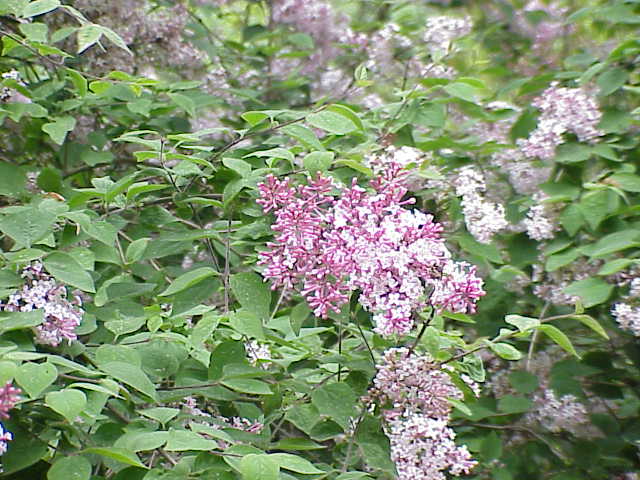
Meyer lilac comes from northern China and is known only from gardens. It is a dense, rounded shrub of 1–1.5 m, sometimes up to 2 m, with small, round leaves. In May it is covered in short panicles of lilac to pinkish-lilac flowers with the typical sweet lilac scent. A second, smaller flush often follows in late summer or autumn. The best-known cultivar is ‘Palibin’, which is often sold as a small standard and does very well in a large pot.
Light
Sun or partial shade
preferably some sun
Moisture
Normal
no wet feet
Legal basis
Sand, loam or clay
any pH
Hardiness
Fully hardy
down to -30 °C
Size
1.5 m
tall, 1.5 m wide
Flowering
May–June and September
| Pruning months | June |
|---|---|
| Height | 1.5 m |
| Native to Belgium | No, planted |
| Good for bees, butterflies and birds | Yes, for bees and butterflies |
| Poisonous to people and pets | Not known to be poisonous |
| Flowering | May–June and September |
Identify
Meyer lilac: how do you recognise it?
- Habit
- Dense, rounded shrub 1–1.5 m tall and as wide, with many fine twigs.
- Leaves
- Small, round to oval, 2–4 cm, dark green and opposite. No notable autumn colour.
- Flowers
- Short, upright panicles of 5–10 cm with small tubular flowers, in May and often again in September.
- Colour
- Lilac to pinkish lilac; the buds are darker than the open flowers.
- Scent
- Sweet and strong, the classic lilac fragrance.
Flowering: May–June and September · Plants: March–April and October–November · Pruning: June
In your garden
Why grow it?
- The scent and flowers of a lilac in a compact size: it also fits a small garden or a patio.
- Flowers profusely in May and often a second time in autumn.
- Bees and butterflies love the scented flowers.
- Very hardy and happy on chalky soil.
- Suitable for a large pot, a low flowering hedge or as a standard.
Meyer lilac: where does it grow best?
- Sun is ideal; in partial shade it flowers less freely.
- Well-drained soil: sandy, loamy or clay, neutral to chalky.
- Average soil that does not dry out and where water does not stand.
- Place it near a patio, path or window so you can enjoy the scent.
- Allow 1–1.5 m per plant; as a low hedge, 60–80 cm apart.
- Light
- Sun and partial shade
- Soil type
- Sand, loam or clay
- Acidity
- Not fussy
- Moisture
- Normal
- Size
- 1.5 m tall, 1.5 m wide
- Hardiness
- Hardy (to -30 °C)
Goes well with
- Tulips: Flower just before the lilac and fill the ground beneath it in spring.
- Ornamental onion: Purple globes in May–June, at the same time as the lilac panicles.
- Catmint: A low blue edging that also likes sun and chalk.
- Peony: Large flowers in May–June, in the same sunny border.
- Lady’s mantle: Soft yellow flowers at the front, covering the base.
Maintenance
Meyer lilac: when and how to plant it?
Plant in March–April and October–November.
- Plant in March–April or October–November, when the soil is neither frozen nor waterlogged.
- Dig a hole twice as wide as the root ball and mix in a few spadefuls of compost.
- Set the plant at the same depth as it was in the pot and firm the soil well. For a standard: put in a stake at the same time and tie the stem loosely.
- Keep 1–1.5 m from other shrubs.
- Water in thoroughly straight away, even if it is raining.
- Spread a layer of compost or wood chips around the base.
Care
- Watering
- Weekly in dry spells in the first year. After that only in long dry periods; regularly in a pot.
- Feeding
- In March–April, compost or an organic feed for flowering shrubs.
- Spent flowers
- Cut off the spent panicles in June; this keeps the shrub tidy and can encourage autumn flowering.
- Suckers
- On a standard or grafted plant: remove shoots from the rootstock below the graft straight away.
- In a pot
- A pot of at least 40–50 cm with a loam-based compost and drainage holes. In summer, water almost daily.
Tip: Cut off the spent panicles in June and give it a light trim at the same time. This keeps it compact and often brings a second flush of flowers in autumn.
Meyer lilac: when to prune it?
Pruning months: June.
When: In June, straight after the first flush of flowers.
How:
- Cut off the spent panicles just above a few leaves.
- Shorten over-long stems to keep the rounded shape.
- Remove dead, weak and crossing stems.
- For a standard: lightly trim the head into a neat ball.
Caution: Do not prune in winter or spring: the flower buds for May are already on the stems by then.
Propagation
- Softwood cuttings
- In June: 8–10 cm cuttings from young, non-flowering shoots, in moist cutting compost under plastic. Roots after a few weeks.
- Layering
- In spring, bend a low stem to the ground, lightly wound the bark and peg it down under some soil. Sever after a year.
Meyer lilac: how does it get through the winter?
Hardy to −30 °C.
- Very hardy, to about −30 °C: no protection needed in Belgian gardens.
- In a pot: stand it against a wall and wrap the pot in hessian or bubble wrap so the roots do not freeze.
- A standard in a pot can blow over; stand the pot in a sheltered spot or secure it.
Diseases and pests
- No flowers: Usually pruned too late or too much shade. Only prune in June and choose a sunny spot.
- Suckers: On grafted plants, shoots from the rootstock appear with different, larger leaves. Cut or pull them off as low as possible.
- Lilac leaf miner: Brown blotches and rolled leaves caused by small caterpillars in summer. Pick off affected leaves; the damage is usually limited.
- Powdery mildew: White powder on the leaves in late summer. It is less prone to it than common lilac; give it an airy spot and water at the base.
Through the year
- March: Plant. Give compost or feed.
- April: Plant. Remove suckers.
- May: Full flower with a strong scent. Bees and butterflies.
- June: Last flowers. Cut off spent panicles and prune lightly. Take softwood cuttings.
- July: Water pots regularly.
- August: Water in dry spells.
- September: Often a second, smaller flush of flowers.
- October: Plant.
- November: Plant. Protect pots for winter.
Use
Good for wildlife
- Bees
- Nectar and pollen for honeybees and wild bees.
- Butterflies
- Nectar for butterflies.
You and this species
Did you know?
- The American plant collector Frank Meyer found it in 1908 in a garden near Beijing; it has never been found in the wild.
- Lilac belongs to the olive family, together with olive, ash, privet and jasmine.
- It is much less prone to powdery mildew than common lilac.