Photo: Wikimedia Commons, CC BY-SA 3.0 · source

Annual · Asteraceae
African marigold
Tagetes erecta
In other languages: Afrikaan (Nederlands) · Rose d’Inde (Français)
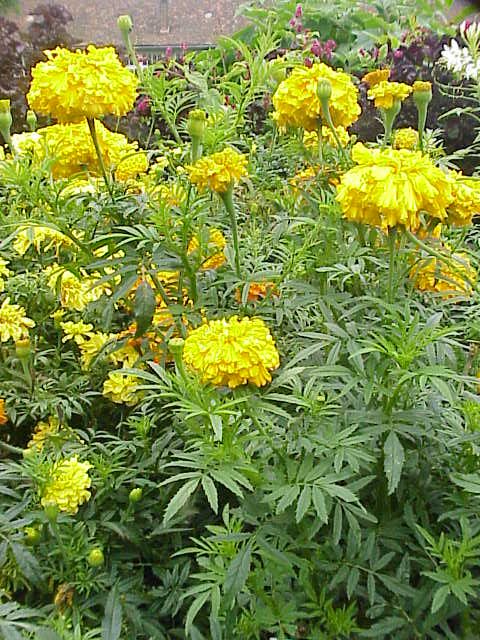
Despite its name, the African marigold comes from Mexico and Central America. It is a sturdy, upright annual with finely divided, strongly scented leaves and large, often fully double flower heads in yellow, gold, orange or cream. Depending on the variety it grows 30–100 cm tall, and it flowers from June until the first frost. The tall varieties make excellent cut flowers. Because it takes a long time to grow, it is best sown indoors in March–April.
Light
Full sun
warm and bright
Moisture
Dry to normal
no wet feet
Legal basis
Sand, loam or clay
any pH
Hardiness
down to 0 °C
protect in harsh winters
Size
0.7 m
tall, 0.4 m wide
Flowering
June–October
| Height | 0.7 m |
|---|---|
| Native to Belgium | No, planted |
| Poisonous to people and pets | Not known to be poisonous |
| Flowering | June–October |
Identify
African marigold: how do you recognise it?
- Habit
- Upright, branching annual 30–100 cm tall depending on the variety; sturdy stems.
- Leaves
- Pinnate and finely divided, dark green, with a strong, spicy smell when touched.
- Flowers
- Large, domed flower heads 5–12 cm across, usually fully double, on long stems.
- Colour
- Lemon yellow, golden yellow, orange and cream.
- Seed
- Long, slender black seeds in the faded head; easy to save from varieties that are not F1 hybrids.
Flowering: June–October · Sowing: March–May · Plants: May–June
In your garden
Why grow it?
- A long, generous display, from June until the first frost.
- Bright, warm colours that stand out in a border, a pot or the vegetable garden.
- Sturdy, long-lasting cut flowers for a cheerful bunch.
- Easy to grow from seed, even for beginners.
- Copes well with sun, heat and some drought.
African marigold: where does it grow best?
- Full sun: in shade it hardly flowers.
- Any free-draining garden soil, from sand to clay; not too rich, or you get mostly leaves.
- Dry to normally moist: no waterlogging, but water during long dry spells.
- A sheltered spot for the tall varieties, as wind and rain can knock them over.
- Plant 30–40 cm apart, dwarf varieties 25 cm.
- Light
- Sun
- Soil type
- Sand, loam or clay
- Acidity
- Not fussy
- Moisture
- Dry or normal
- Size
- 0.7 m tall, 0.4 m wide
- Hardiness
- Frost tender: plant out after the last frost (mid-May)
Goes well with
- Mealy sage: Blue spikes as a contrast to the yellow and orange pompons.
- Zinnia: Just as sun-loving, for a colourful row of cut flowers.
- Cosmos: Airy pink or white flowers beside the compact marigold.
- Tomato: In the vegetable garden it adds colour among the crops.
- Floss flower: Low blue flowers at the front, before the tall marigolds.
Maintenance
African marigold: when and how to plant it?
Plant in May–June.
- Sow indoors in March–April at 18–20 °C; the seeds germinate in about a week.
- Prick out the seedlings into individual pots once they have two true leaves.
- From early May, harden them off outside during the day for a week.
- Plant out after mid-May or in June, when there is no more risk of frost, 30–40 cm apart.
- Set them slightly deeper than in the pot and water well.
- Protect young plants from slugs for the first few weeks.
Care
- Watering
- In dry weather water at the base, not over the flowers: wet double flowers soon rot.
- Feeding
- A little compost at planting is enough. In pots, a feed for flowering plants every two weeks.
- Deadheading
- Remove faded flowers regularly: it then keeps making new buds into autumn.
- Support
- Give tall varieties a cane or plant support, especially in an exposed spot.
- Slugs
- Young plants are a favourite of slugs: check in the evening or use a slug collar.
Tip: For a windy spot choose a dwarf variety, and save the tall ones for a sheltered corner or the cutting garden.
African marigold: when to prune it?
When: An annual: no pruning is needed. The main job is removing faded flowers from June to October.
How:
- Cut off faded flowers just above a leaf or side bud.
- Cut flowers for a vase in the morning, when they have just fully opened, with a long stem.
- At the end of the season, let a few good flowers ripen and dry if you want to save seed.
Propagation
- Sowing indoors
- In March–April in seed compost, just covered, at 18–20 °C. They germinate within a week; prick out and plant out after mid-May.
- Sowing outdoors
- In May, sow directly where they are to flower in fine, warm soil and thin to 30 cm. They then flower later in summer.
- Saving seed
- In September–October, pick dry, brown flower heads and store the black seeds somewhere dry. Seed from F1 varieties does not come true.
African marigold: how does it get through the winter?
Hardy to 0 °C: protect in harsh winters.
- An annual that dies at the first frost; it cannot be overwintered.
- Collect seed for next year before the first frost.
- Put the dead plants on the compost heap.
Diseases and pests
- Slugs: Young plants can be stripped in a single night. Pick slugs off in the evening, use a slug collar or plant out larger plants.
- Grey mould: Brown, rotting centres covered in grey mould after wet days. Remove faded and affected flowers, do not water over the flowers and space plants well.
- Red spider mite: Fine yellow speckling and webbing on the leaves in hot, dry weather. Spray the leaves and water during dry spells.
- Flopping: Tall varieties collapse after rain or wind. Give them support and plant them in a sheltered spot.
- Damping off: Seedlings collapse and rot at the base. Sow in clean seed compost, do not overwater and give fresh air.
Through the year
- March: Sow indoors at 18–20 °C.
- April: Sow indoors. Prick out seedlings.
- May: Harden off. After mid-May, plant out or sow outdoors. Watch for slugs.
- June: Plant out. First flowers. Support tall varieties.
- July: Full flower. Deadhead. Water in dry spells.
- August: Flowering. Cut flowers for the vase.
- September: Flowering. Save seed.
- October: Last flowers until the first frost. Plants onto the compost heap.
You and this species
Did you know?
- In Mexico it is called cempasúchil; its orange flowers decorate altars and graves during the Day of the Dead in early November.
- The yellow pigment from the flowers (lutein) is used in animal feed, for instance to give egg yolks a deeper yellow.
- Its roots release substances that hold back certain soil nematodes, which is why some growers sow marigolds as a green manure.