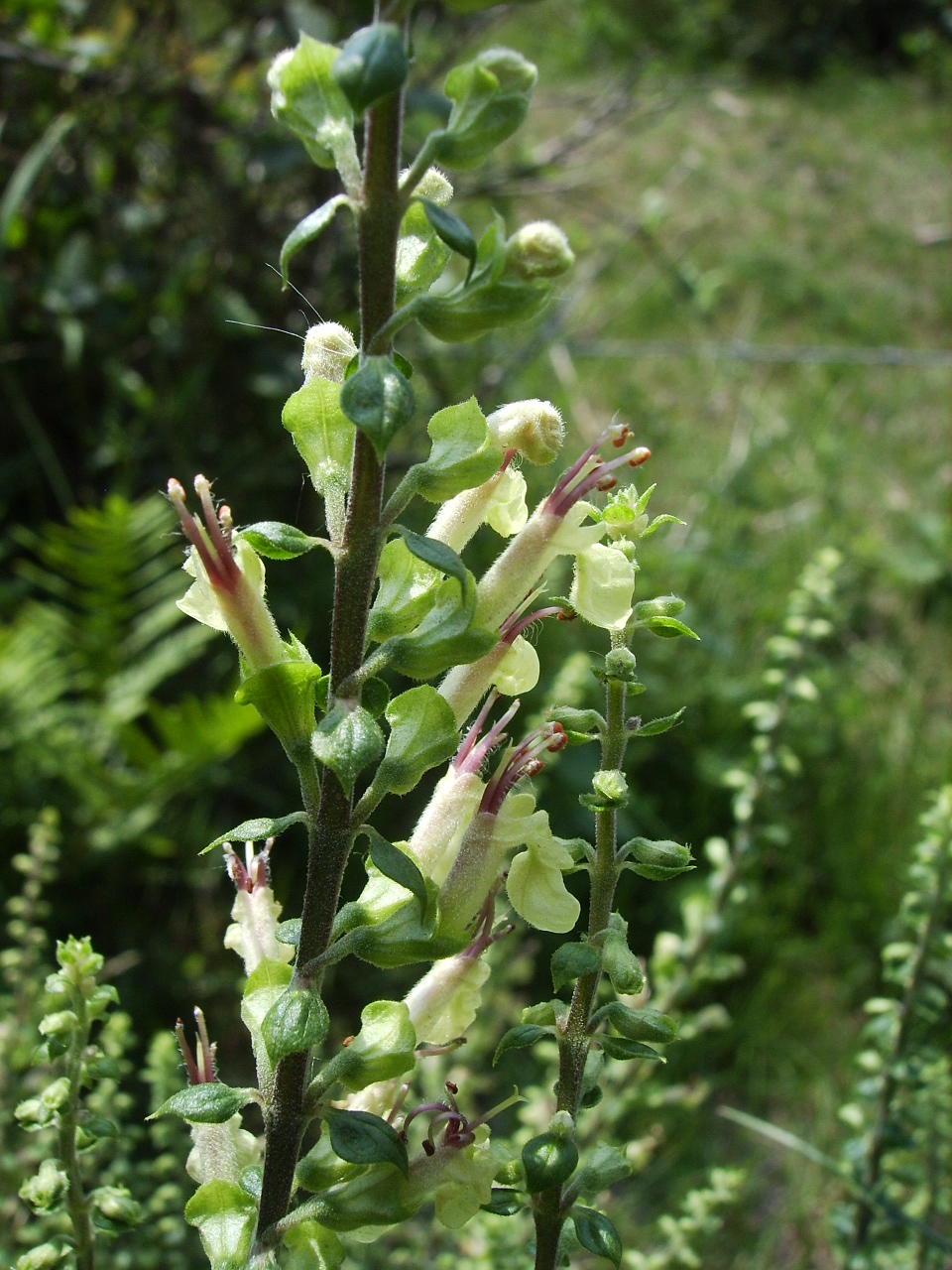
Photo: Teun Spaans, CC BY 2.5 · source

Perennial · Lamiaceae
Wood sage
Teucrium scorodonia
In other languages: Valse salie (Nederlands) · Germandrée scorodoine (Français)
Wood sage is a native perennial of dry heaths, sandy woodland edges, dunes and rocky slopes in western and central Europe. It forms a loose clump 30–40 cm tall with wrinkled, softly hairy leaves that look like sage, although it is not a true sage but a germander. From July to September it carries slender spikes of small, greenish-yellow lipped flowers that attract bumblebees and other bees in particular. On poor, acid, sandy soil where little else will grow, it is tough and drought-tolerant. The variety ‘Crispum’ has strikingly crinkled leaves, and ‘Crispum Marginatum’ adds a creamy edge.
Light
Sun or partial shade
preferably some sun
Moisture
Dry
tolerates drought
Legal basis
Sand or loam
acid to neutral
Hardiness
Fully hardy
down to -25 °C
Size
0.4 m
tall, 0.4 m wide
Flowering
July–September
| Pruning months | March |
|---|---|
| Height | 0.4 m |
| Native to Belgium | Yes |
| Good for bees, butterflies and birds | Yes, for bees |
| Poisonous to people and pets | Not known to be poisonous |
| Flowering | July–September |
Identify
Wood sage: how do you recognise it?
- Habit
- Loose, upright clump 30–40 cm tall and about as wide, slightly woody at the base, spreading by short rhizomes.
- Leaves
- Oval to heart-shaped, 3–7 cm, wrinkled and softly hairy with a scalloped edge, in opposite pairs. They smell slightly aromatic when rubbed.
- Flower
- Small greenish-yellow flowers in pairs, in slender one-sided spikes, from July to September. They have only a lower lip; the stamens stick out above the flower.
- Fruit
- Four small nutlets in the persistent calyx.
- Roots
- Finely branched, with short rhizomes; it copes well with drought.
Flowering: July–September · Plants: March–May and September–October · Pruning: March
In your garden
Why grow it?
- One of the few flowering perennials that thrive on dry, acid, poor sandy soil.
- Flowers from July to September, when many spring flowers in the heather garden have finished.
- A good bee plant: bumblebees and other bees visit the flowers throughout late summer.
- Native and drought-tolerant: after the first year you hardly ever need to water.
- The soft, wrinkled leaves stay fresh and decorative, especially on the crinkled form ‘Crispum’.
Wood sage: where does it grow best?
- Sun to partial shade; in sun it stays more compact and flowers more freely.
- Sandy or loamy soil, acid to neutral and preferably poor. It grows less well on chalky soil.
- Dry, free-draining soil. It dislikes heavy, wet clay in winter.
- Plant 30–40 cm apart, in groups among heathers or on a dry woodland edge.
- Light
- Sun and partial shade
- Soil type
- Sand or loam
- Acidity
- Acid or neutral
- Moisture
- Dry
- Size
- 0.4 m tall, 0.4 m wide
- Hardiness
- Hardy (to -25 °C)
Goes well with
- Heather: Purple flowers in the same late summer, on the same acid, dry, sandy soil.
- Harebell: Pale blue bells among the greenish-yellow spikes.
- Sheep’s-bit: Blue pompons, another bee plant of poor sandy soil.
- Wavy hair-grass: A fine, swaying grass as a loose background.
- Foxglove: Tall pink spikes on the woodland edge, earlier in summer.
Maintenance
Wood sage: when and how to plant it?
Plant in March–May and September–October.
- Plant from March to May or in September–October.
- Loosen the soil and, on heavy ground, mix in coarse sand for good drainage. Do not add fertiliser or potting compost.
- Dig a hole slightly larger than the pot and set the plant at the same depth as in the pot.
- Leave 30–40 cm between plants.
- Firm in and water well. In the first year water weekly in dry spells, after that hardly at all.
Care
- Water
- Only in the first year during dry spells. After that it looks after itself, even in dry summers.
- Feeding
- Not needed. On rich soil it becomes floppy and falls open.
- Mulching
- Avoid a thick layer of compost; a little sand or fine gravel around the base keeps the stem bases dry.
- Spent flowers
- Leave them over winter for structure and for insects that overwinter in the stems.
- Rejuvenating
- Divide every three to four years when the centre of the clump becomes bare.
Tip: Plant it on dry, sandy, slightly acid soil and do not feed: the poorer the soil, the sturdier it stays. The variety ‘Crispum’ has crinkled leaves and looks good outside the flowering season too.
Wood sage: when to prune it?
Pruning months: March.
When: From late February to late March, before the new growth gets going.
How:
- Cut the old flower stems and the winter foliage back to a few centimetres above the ground or to just above the new shoots at the base.
- If you want fewer seedlings, cut off the spent spikes as early as September.
- Do not cut back in autumn: the old stems protect the base in winter.
Propagation
- Division
- In March–April: lift the clump, cut it into pieces that each have roots and shoots, and replant at once.
- Cuttings
- In May–June: take 5–8 cm cuttings from non-flowering shoots and insert them in a sandy cutting mix. This keeps ‘Crispum’ true to type.
- Seed
- The species self-seeds on open sandy soil. Move seedlings in spring.
Wood sage: how does it get through the winter?
Hardy to −25 °C.
- Hardy to about −25 °C: in Belgium protection is usually not needed.
- Wet feet are a greater danger than frost. Make sure the soil drains freely.
- Leave the old stems until March: they protect the base and give insects shelter.
Diseases and pests
- Wet feet: On wet, heavy soil the roots rot in winter. Plant on sand or raise the spot with sand and gravel.
- Floppy growth: On rich soil or in too much shade the stems grow long and fall over. Do not feed, and choose a sunnier spot.
- Spreading too much: On loose sandy soil it spreads by rhizomes and seed. Cut off runners and pull out seedlings.
- Bare centre: After a few years the middle opens up. Dividing in spring rejuvenates the plant.
Through the year
- March: Cut back old stems. Plant or divide.
- April: Plant. New shoots appear.
- May: Take cuttings from non-flowering shoots.
- July: Flowering starts. Bumblebees on the spikes.
- August: Full flower. No watering needed.
- September: Last flowers. Cut off spent spikes if you like.
- October: Plant. Leave the stems standing for winter.
- December: Rest. The old spikes give structure in the heather garden.
Use
Good for wildlife
- Bees
- Nectar and pollen for honeybees and wild bees.
You and this species
Did you know?
- Despite its name it is not a true sage: it belongs to the germanders, the genus Teucrium, within the same mint family.
- The flowers have no upper lip, only a large lower lip, so the stamens stick out freely above the flower.
- In the past the leaves were used in some places, such as Jersey, instead of hops to brew beer.