Photo: Kurt Stüber [1], CC BY-SA 3.0 · source

Bulb or tuber · Liliaceae
Leather-bulb tulip
Tulipa praestans
In other languages: Tulipa praestans (Nederlands) · Tulipe praestans (Français)
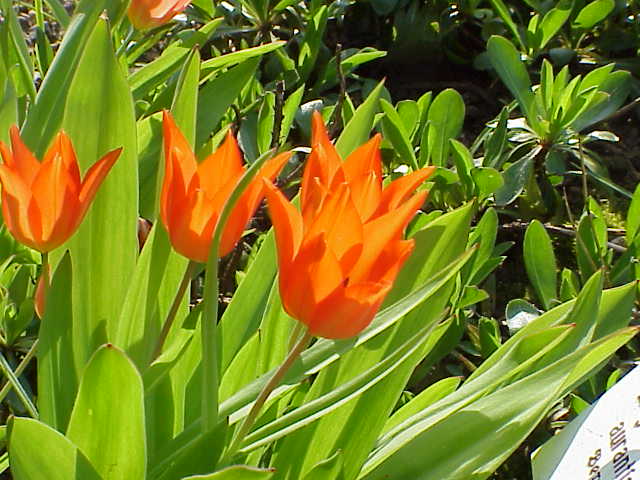
Tulipa praestans comes from the mountains of Central Asia and is a botanical tulip that carries several flowers per stem. In April, two to five bright orange-red flowers appear on slightly hairy stems 25–35 cm tall, above broad, grey-green leaves. The name means ‘outstanding’ in Latin. Well-known cultivars are ‘Fusilier’, with fiery orange-red flowers, and ‘Unicum’, with leaves edged in creamy white. It is tough, good in a border and often returns for years on a sunny, dry spot.
Caution: Tulips are poisonous, especially the bulb. Children, cats, dogs and horses must not eat them. Keep bulbs out of reach and wear gloves if you handle them often.
Light
Full sun
warm and bright
Moisture
Dry to normal
no wet feet
Legal basis
Sand or loam
neutral to chalky
Hardiness
Fully hardy
down to -25 °C
Size
0.3 m
tall, 0.1 m wide
Flowering
April
| Height | 0.3 m |
|---|---|
| Native to Belgium | No, planted |
| Poisonous to people and pets | Yes, take care with children and pets |
| Flowering | April |
Identify
Leather-bulb tulip: how do you recognise it?
- Habit
- Bulb plant 25–35 cm tall and about 10 cm wide, with upright stems.
- Leaves
- Broadly lance-shaped, grey-green, slightly hairy; two to four leaves per bulb.
- Flower
- Two to five cup-shaped flowers per stem in bright orange-red, wide open in the sun.
- Flowering time
- April, at about the same time as ordinary early garden tulips.
- Bulb
- Medium-sized bulb with a brown, papery skin; it forms offset bulbs over time.
Flowering: April · Plants: October–November
In your garden
Why grow it?
- Several flowers per stem give a rich show of colour, even with only a few bulbs.
- Early, bright colour in April, when most perennials are not yet in flower.
- Strong stems that do not flop easily; also suitable as a cut flower for small bouquets.
- As a botanical tulip it often returns for years, more reliably than large hybrid tulips.
- Bees and bumblebees visit the open flowers on sunny spring days.
Leather-bulb tulip: where does it grow best?
- Full sun; this is where it flowers most generously.
- Free-draining soil: sandy or loamy, neutral to chalky. On heavy clay, mix in plenty of coarse sand or grit.
- Dry to moderately moist; preferably dry in summer, because wet soil makes the bulb rot.
- Plant in groups of 7–15 bulbs, 10–15 cm apart.
- Light
- Sun
- Soil type
- Sand or loam
- Acidity
- Neutral or chalky
- Moisture
- Dry or normal
- Size
- 0.3 m tall, 0.1 m wide
- Hardiness
- Hardy (to -25 °C)
Goes well with
- Forget-me-not: Blue clouds that contrast beautifully with the orange-red.
- Daffodil: Yellow daffodils flower at the same time and make a fresh spring combination.
- Ornamental onion: Flowers later and takes over when the tulips have finished.
- Lady’s mantle: Its frothy yellow-green flowers hide the fading tulip foliage.
- Cranesbill: Fills the space in summer and covers the dying foliage.
Maintenance
Leather-bulb tulip: when and how to plant it?
Plant in October–November.
- Plant in October–November, when the soil is cooling but not yet frozen.
- Dig a hole 15 cm deep. On heavy soil, put 2–3 cm of coarse sand at the bottom.
- Set the bulbs pointed end up, 10–15 cm apart, in groups.
- Cover with soil and firm lightly. Water in dry weather so the roots can develop.
- Mark the spot or plant perennials between them, so you do not dig there in summer.
Care
- Water
- Water lightly after planting in dry weather; in spring only in long dry spells. No water during the summer rest.
- Feeding
- Not needed on average soil. On poor soil a light dose of bulb fertiliser after flowering can help.
- Foliage
- Leave the leaves until they turn yellow and die back by themselves (six to eight weeks): the bulb is then storing energy for next year.
- Faded flowers
- Remove faded flowers if you do not want seed; leave the stem and leaves.
- Cut flowers
- Cut a few stems when the buds show colour; leave enough foliage for the bulb.
Tip: Plant 15 cm deep in full sun and let the leaves die back by themselves after flowering: this lets the bulb build up strength for next year.
Leather-bulb tulip: when to prune it?
When: Pruning is not needed. Cut off the flower stems once they have faded; cut the leaves only when they are yellow and limp, usually in June.
How:
- Snip off the faded flowers with a short piece of stem; leave the leaves.
- Let the foliage die back completely before clearing it away.
- Pull off yellow, dry leaves by hand.
- Push a small cane in at the spot so you do not dig there in summer.
Caution: Never cut off green leaves or tie them in knots: the bulb uses them to build next year’s flowers.
Propagation
- Offsets
- Lift the bulbs in June–July when the leaves have died back, remove the small bulbs and replant them in October. They take a few years to flower.
- Seed
- Sow fresh seed in autumn in a tray of sandy compost and leave it outdoors over winter. A seedling only flowers after four to six years.
Leather-bulb tulip: how does it get through the winter?
Hardy to −25 °C.
- Fully hardy to about −25 °C: no protection is needed in Belgium.
- Make sure drainage is good: in waterlogged winter soil the bulbs rot faster than they freeze.
- In a pot: use a frost-proof pot with holes and stand it against a wall, under the eaves or on pot feet.
Diseases and pests
- Bulb rot: In cold, wet soil the bulbs turn soft and mouldy. Remove them and replant on a drier spot with grit or coarse sand.
- Tulip fire: Brown spots on the leaves, distorted shoots and grey mould. Remove affected plants together with the bulb and do not plant tulips in the same place for several years.
- Rodents: Mice and squirrels eat the bulbs. Plant in a wire-mesh basket or lay mesh over the spot.
- Slugs: They eat young shoots in a mild spring. Collect them in the evening or put sharp grit around the plant.
- Fewer flowers: After a few years the bulb flowers less if the leaves were cut off too early or the spot is too shady or too wet. Choose a dry, sunny place and leave the foliage.
Through the year
- March: The green shoots appear above ground. No watering needed yet.
- April: In flower: two to five orange-red flowers per stem. Cut a few stems if you like.
- May: Remove faded flowers; let the foliage die back. No more watering.
- June: Clear the dead leaves and mark the spot.
- July: Summer rest. Keep dry; lift bulbs if needed.
- August: Rest. Choose new bulbs.
- September: Buy or order bulbs.
- October: Plant 15 cm deep, in groups.
- November: Last planting month before frost.
- December: Rest. Check that no water stands on the spot.
Use
Edible and useful
Not edible. Tulips are poisonous, especially the bulbs: they cause vomiting and diarrhoea, in horses too, and in cats and dogs that dig up or chew the bulbs. A tulip bulb looks like an onion or shallot but does not smell of onion when cut. So never store bulbs you lift after flowering with the vegetables in the kitchen, cellar or shed, and label them. Handling lots of bulbs can cause a skin rash (tulip fingers): wear gloves when planting. If any is swallowed, call a poison centre (in Belgium 070 245 245) or your doctor at once.
You and this species
Did you know?
- The species name praestans is Latin for ‘outstanding’ or ‘excellent’.
- Unlike most garden tulips, this species carries several flowers per stem.
- The stems and leaves are slightly hairy, which is uncommon in tulips.