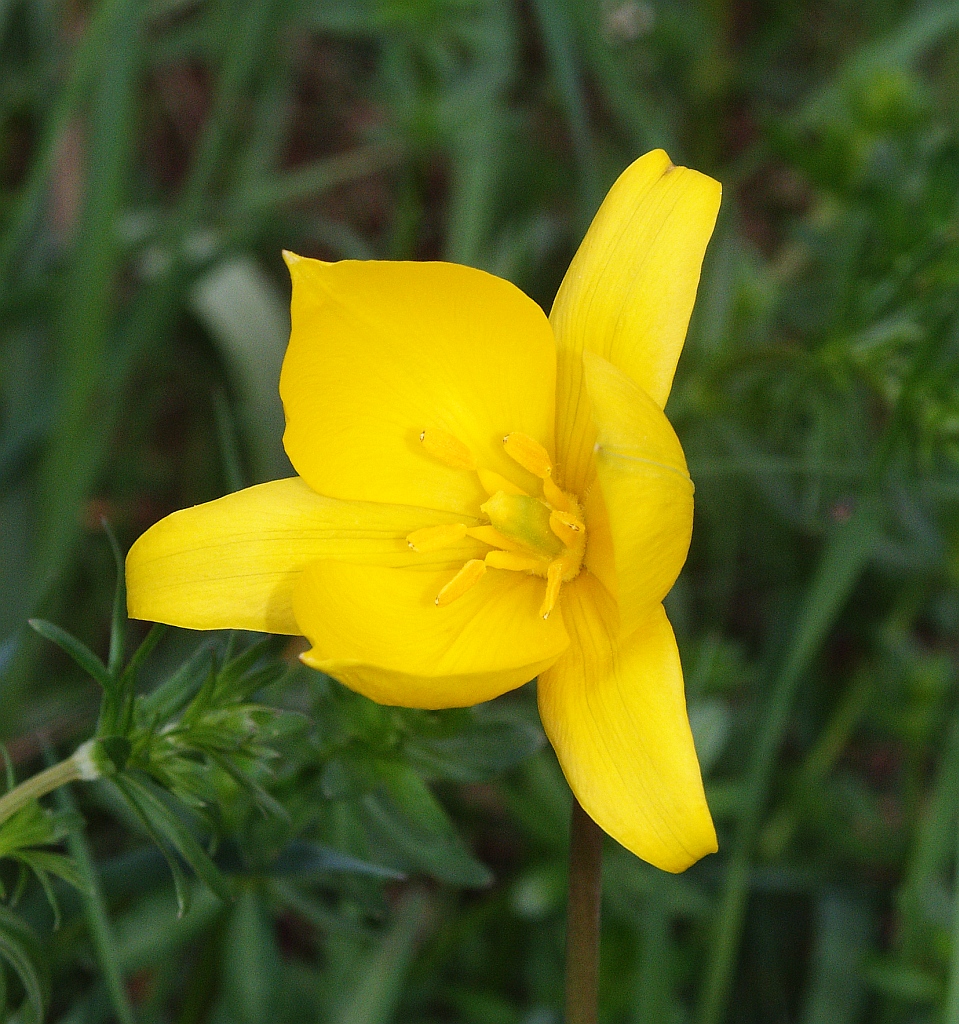
Photo: Bernd Haynold, CC BY 2.5 · source

Bulb or tuber · Liliaceae
Wild tulip
Tulipa sylvestris
In other languages: Bostulp (Nederlands) · Tulipe sauvage (Français)
The wild tulip has grown in Europe for centuries and has naturalised in old parks, orchards and castle gardens. Its exact origin is uncertain; it probably comes from the Mediterranean region. In April–May it bears graceful, yellow, star-shaped flowers with a sweet scent. The buds nod at first and straighten as they open; the outer petals often have a greenish back. Unlike many large garden tulips, it returns year after year and spreads by underground runners, which makes it ideal for naturalising in grass or under trees.
Caution: All parts are poisonous, especially the bulb. Cats and dogs can become ill if they chew or dig up bulbs, and children should not put the bulbs in their mouths. Wear gloves when planting if you have sensitive skin.
Light
Sun or partial shade
preferably some sun
Moisture
Normal
no wet feet
Legal basis
Sand, loam or clay
neutral to chalky
Hardiness
Fully hardy
down to -25 °C
Size
0.35 m
tall, 0.1 m wide
Flowering
April–May
| Height | 0.35 m |
|---|---|
| Native to Belgium | No, planted |
| Poisonous to people and pets | Yes, take care with children and pets |
| Flowering | April–May |
Identify
Wild tulip: how do you recognise it?
- Habit
- Slender bulb 25–35 cm tall with one, sometimes two flowers per stem; forms loose groups through its runners.
- Leaves
- Narrow and linear, greyish green, usually two or three per plant; dies back around June.
- Flower
- Star-shaped, with pointed petals; the bud nods at first and straightens as it opens. Closes in the evening and in dull weather.
- Colour
- Bright yellow, the outer petals flushed green or reddish on the back.
- Scent
- Sweet and fresh, most noticeable in sunny weather.
- Bulb
- Small bulb that forms underground runners, with a new bulb developing at the end of each.
Flowering: April–May · Plants: September–November
In your garden
Why grow it?
- Naturalises on its own in grass, under trees and in borders, and returns every year.
- Sweetly scented, bright yellow flowers in April–May.
- A classic plant of old estates that fits beautifully in a natural garden.
- No need to lift it: plant once and let it get on with it.
- Graceful in a small vase, with nodding buds and open stars.
Wild tulip: where does it grow best?
- Sun to partial shade: under deciduous trees it gets enough light in spring. In deep shade it makes lots of leaves and few flowers.
- Sand, loam or clay, neutral to chalky, as long as the soil does not stay wet for long.
- Moderately moist soil; in summer the dormant bulb copes with drought.
- Plant in groups, 8–10 cm apart; after that it fills the space by itself.
- Light
- Sun and partial shade
- Soil type
- Sand, loam or clay
- Acidity
- Neutral or chalky
- Moisture
- Normal
- Size
- 0.35 m tall, 0.1 m wide
- Hardiness
- Hardy (to -25 °C)
Goes well with
- Wood anemone: A white carpet under trees in March–April, in the same spot.
- Snake’s head fritillary: Chequered bells in April, also for naturalising in grass.
- Grape hyacinth: Blue beside the yellow, at the same time.
- Bluebell: Blue bells under trees in April–May, ideal for a natural woodland edge.
Maintenance
Wild tulip: when and how to plant it?
Plant in September–November.
- Plant in September–November, once the soil has cooled down.
- Make planting holes or a wide pit and, on heavy soil, mix in some coarse sand.
- Set the bulbs 10 cm deep, pointed end up.
- Leave 8–10 cm between bulbs and plant in loose, natural groups of at least ten.
- In grass: lift a piece of turf, place the bulbs in the hole and put the turf back.
- Firm the soil and water if the ground is dry.
Care
- Water
- Usually not needed; only water during growth in a very dry spring.
- Feeding
- Not needed. On poor soil you can spread a thin layer of compost in spring.
- Mowing
- Only mow once the leaves have died back, around June.
- Spent flowers
- Leave them if you want it to self-seed. For strong bulbs, remove just the flower and leave the stem and leaves.
Tip: Plant the bulbs in loose groups under trees or in grass and leave them undisturbed. Only mow once the leaves have died back, around June, and it will naturalise by itself through its runners.
Wild tulip: when to prune it?
When: The wild tulip needs no pruning. Simply clear away the dead leaves in June.
How:
- Leave the leaves until they turn yellow and come away easily.
- In grass, only mow once the leaves have died back, around June.
- Remove faded flowers if you would rather have strong bulbs than seed; leave the stem.
Caution: Never cut or mow green leaves: it will flower less the following year.
Propagation
- Bulblets and runners
- In June–July, once the leaves have died back: dig up a group, separate the small bulbs and replant them straight away elsewhere, or store them dry until autumn.
- Seed
- Sow ripe seed in autumn in a pot left outdoors: the seed needs cold. It takes several years before seedlings flower.
Wild tulip: how does it get through the winter?
Hardy to −25 °C.
- Fully hardy, to about −25 °C: no protection needed in Belgium.
- It actually needs winter cold to flower well in spring.
- In a pot: stand the pot in a sheltered spot and make sure the compost does not get waterlogged in winter.
Diseases and pests
- Few flowers: Lots of leaves but few flowers: typical of a spot that is too shady. Give more light and a little patience; a well-established group flowers more freely.
- Mice: Voles and mice eat the bulbs. Plant in a wire basket if they cause a lot of damage in your garden.
- Tulip fire: Brown spots on leaves and flowers and distorted shoots, especially in wet weather. Remove affected plants bulb and all, not on the compost heap.
- Slugs: They eat young shoots and buds. Pick them off in the evening in a damp spring.
Through the year
- January: Rest. The bulbs need the winter cold.
- March: Leaves appear. Do not mow the grass around the bulbs yet.
- April: Flowering. Enjoy the scent in sunny weather.
- May: Last flowers. Leave the foliage.
- June: The leaves die back; after that you can mow.
- July: Dig up and divide overcrowded groups.
- September: Plant.
- October: Plant, also in grass.
- November: Last chance to plant before the ground freezes.
Use
Edible and useful
Not edible. Tulips are poisonous, especially the bulbs: they cause vomiting and diarrhoea, in horses too, and in cats and dogs that dig up or chew the bulbs. A tulip bulb looks like an onion or shallot but does not smell of onion when cut. So never store bulbs you lift after flowering with the vegetables in the kitchen, cellar or shed, and label them. Handling lots of bulbs can cause a skin rash (tulip fingers): wear gloves when planting. If any is swallowed, call a poison centre (in Belgium 070 245 245) or your doctor at once.
You and this species
Did you know?
- It is a classic plant of old estates: in the Low Countries it has grown wild for centuries in old castle parks and orchards.
- The flower buds nod downwards at first and only straighten when the flower opens.
- Tulip bulbs contain a substance that can cause a skin rash after frequent handling; among bulb growers this is known as ‘tulip fingers’.