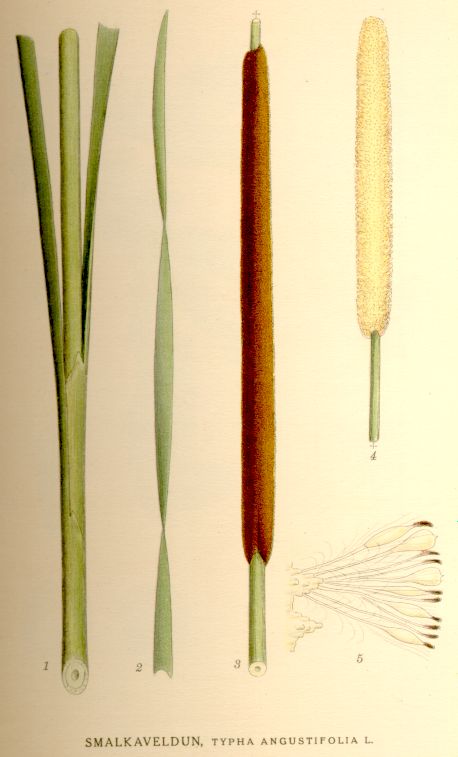
Photo: Carl Axel Magnus Lindman, Public domain · source

Water or marginal plant · Typhaceae
Lesser bulrush
Typha angustifolia
In other languages: Kleine lisdodde (Nederlands) · Massette à feuilles étroites (Français)
Lesser bulrush is a native marsh plant of banks, ditches and pools, also in Belgium. It looks like the familiar bulrush, but is slimmer, with narrow, grey-green leaves up to 1.8 m tall and thinner brown heads. From June to August it flowers with a spike in two parts: yellow male flowers at the top and, below them with a bare piece of stem in between, the brown female head. It grows at 10–50 cm water depth and forms dense stands with its rhizomes. Slim as it is, it spreads just as vigorously and belongs in a container or a large wildlife pond.
Caution: Lesser bulrush spreads rampantly by vigorous rhizomes and also by fluffy seeds; the sharp rhizome tips can damage a pond liner. In a smaller pond plant it in a rigid container, and never put plants, rhizomes or seeds into ditches, streams or ponds in the wild.
Light
Full sun
warm and bright
Moisture
Moist to wet
must not dry out
Legal basis
Loam, clay or peat
any pH
Hardiness
Fully hardy
down to -30 °C
Size
1.8 m
tall, 0.8 m wide
Flowering
June–August
| Pruning months | March |
|---|---|
| Height | 1.8 m |
| Native to Belgium | Yes |
| Good for bees, butterflies and birds | Yes, for birds |
| Poisonous to people and pets | Not known to be poisonous |
| Flowering | June–August |
Identify
Lesser bulrush: how do you recognise it?
- Habit
- Upright clumps up to 1.8 m tall, spreading by rhizomes into dense stands 80 cm across and more.
- Leaves
- Long, narrow and strap-shaped, 0.5–1 cm wide, grey-green, slightly rounded on the back.
- Flowers
- From June to August a straight spike: yellow male flowers at the top, the female head below, with a bare piece of stem in between. They are wind-pollinated.
- Seed head
- Slender, dark brown, cigar-shaped head of 10–20 cm that bursts in winter into white fluff full of seeds.
- Roots
- Vigorous creeping rhizomes with sharp tips.
- Pond zone
- Shallow to deeper margin: 10–50 cm below the water surface.
Flowering: June–August · Plants: April–June · Pruning: March
In your garden
Why grow it?
- Graceful narrow leaves and slender brown heads: elegant at the edge of a large pond.
- The heads stay standing into winter and look lovely in dried arrangements.
- Reed birds such as the reed warbler like to nest in large stands, and other birds take shelter there.
- Dragonflies and damselflies climb out of the water up the stems, and tadpoles and water insects live around the base.
- Takes up plenty of nutrients from the water and so helps to hold back algae.
- Native and fully hardy.
Lesser bulrush: where does it grow best?
- Full sun.
- A bottom of loam, clay or peat; acid, neutral or alkaline all suit it.
- Water depth 10–50 cm, in still or slow-moving water.
- Only in a large pond or on a natural bank; in a smaller pond always in a sturdy container.
- Allow at least 80 cm per plant.
- Light
- Sun
- Soil type
- Loam, clay or peat
- Acidity
- Not fussy
- Moisture
- Wet
- Size
- 1.8 m tall, 0.8 m wide
- Hardiness
- Hardy (to -30 °C)
Goes well with
- Yellow flag: Yellow flowers in May–June in the shallower zone in front.
- Flowering rush: Pink flower heads in shallow water, in the same summer months.
- Water lily: Round floating leaves and flowers in the deeper open water.
- Meadowsweet: Scented, creamy white plumes on the wet bank behind.
Maintenance
Lesser bulrush: when and how to plant it?
Plant in April–June.
- Plant from April to June, when the water warms up.
- Use a sturdy, rigid container of at least 20 litres filled with heavy clay soil, without potting compost or fertiliser; a soft basket will not hold the rhizomes back.
- Lay the rhizome about 5 cm deep and top with 2–3 cm of gravel.
- Stand the container at 10–20 cm depth first and lower it after a few weeks to 10–50 cm below the water surface.
- Keep at least 80 cm from other plants.
Care
- Water
- Not needed in the pond. In dry summers top up the pond with rainwater.
- Feeding
- Do not feed: it takes its nutrients from the water.
- Keeping in check
- Check every summer whether rhizomes are growing over the edge of the container and cut them off.
- Drying heads
- Cut heads for arrangements in July–August, when they have just turned brown: riper heads burst into fluff indoors.
- Dividing
- Every 2–3 years, when the container is full, divide in April–May.
Tip: Plant it in a rigid container, slim as it looks: its rhizomes are just as vigorous as those of the bulrush. Cut heads for arrangements when they have just turned brown.
Lesser bulrush: when to prune it?
Pruning months: March.
When: In March, before the new shoots appear. Leave leaves and heads standing over winter.
How:
- Cut the old, brown stems and leaves off above the water surface, not below it.
- Remove leaves that fall into the water in autumn earlier, so they do not rot on the bottom.
- Cut off the heads in autumn if you want to avoid the fluff spreading seeds everywhere.
Caution: Do not cut too late in March: the new shoots grow fast and break easily.
Propagation
- Division
- In April–May take the plant out of its container and cut the rhizome with a sharp spade into pieces with a few shoots each. Plant straight away in a new container.
Lesser bulrush: how does it get through the winter?
Hardy to −30 °C.
- Fully hardy, to about −30 °C: no protection is needed in Belgium.
- Leave leaves and heads until March: insects overwinter in the stems and birds shelter among them.
- In late winter the heads burst open and the fluff carries the seeds away.
Diseases and pests
- Spreading too much: New shoots far outside the container or along the whole bank. Dig out rhizomes and divide the container every few years.
- Damaged liner: The sharp rhizome tips can pierce a pond liner. Always plant in a rigid container and check the rim.
- Fluff indoors: Dried heads burst open inside. Harvest them earlier, when they have just turned brown.
- Fallen leaves: After storms, snow or ice the leaves lie in the water. Remove what hangs in the water and cut back in March.
Through the year
- March: Cut old stems and leaves off above the water surface.
- April: Plant or divide. New shoots appear.
- May: Plant. Set the container at the right depth.
- June: In flower. Cut off rhizomes outside the container.
- July: In flower. Cut heads for drying.
- August: Cut heads for drying. Top up the pond in dry spells.
- October: Take fallen leaves out of the water.
- December: Leave leaves and heads for birds and insects.
Use
Good for wildlife
- Birds
- Berries, seeds or insects as food, or a place to nest.
You and this species
Did you know?
- You can tell lesser bulrush by the bare piece of stem between the male and female parts of the spike; in the bulrush they touch.
- A single head holds tens of thousands of tiny fluffy seeds that the wind carries far away.
- Bulrush and lesser bulrush sometimes hybridise where they grow together.