Photo: Christian Fischer, CC BY-SA 3.0 · source

Annual · Scrophulariaceae
Dense-flowered mullein
Verbascum densiflorum
In other languages: Stalkaars (Nederlands) · Molène à fleurs denses (Français)
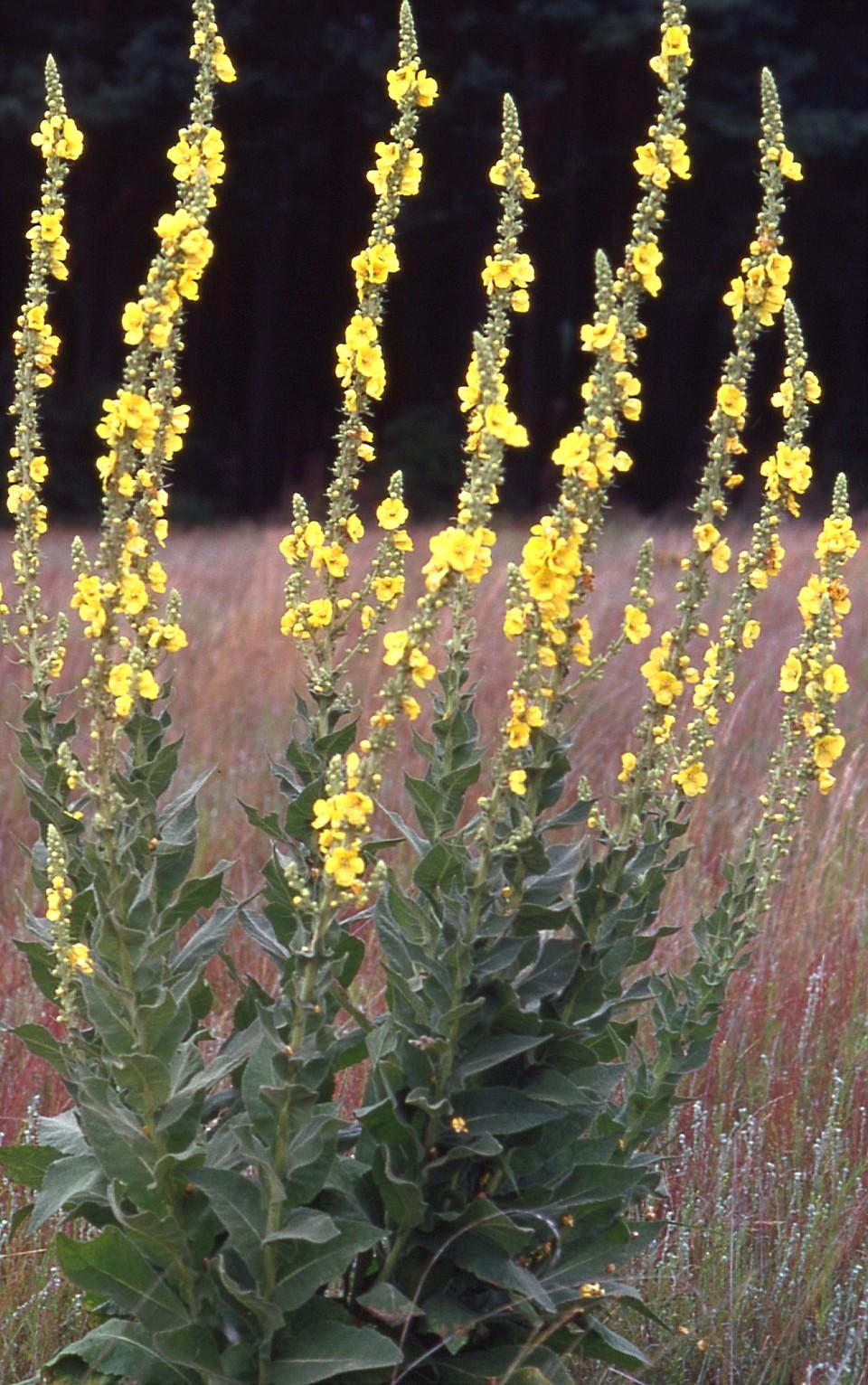
Dense-flowered mullein is a biennial from Europe and western Asia that grows naturally in dry, sunny and often chalky places. In its first year it forms a handsome rosette of large, grey-green, felted leaves. In its second year it sends up a sturdy, upright flower spike about 1.5 m tall, densely set with large yellow flowers. It flowers from June to September and is a fine bee plant. After flowering it dies, but it self-sows freely, so new plants appear every year.
Caution: It self-sows freely and can turn up uninvited on open, dry ground nearby. Cut the spikes before the seed ripens if you do not want that.
Light
Full sun
warm and bright
Moisture
Dry
tolerates drought
Legal basis
Sand or loam
any pH
Hardiness
Fully hardy
down to -25 °C
Size
1.5 m
tall, 0.5 m wide
Flowering
June–September
| Height | 1.5 m |
|---|---|
| Native to Belgium | Yes |
| Good for bees, butterflies and birds | Yes, for bees |
| Poisonous to people and pets | Not known to be poisonous |
| Flowering | June–September |
Identify
Dense-flowered mullein: how do you recognise it?
- Habit
- Biennial: a leaf rosette in the first year, an upright flower spike about 1.5 m tall in the second, 50 cm wide.
- Leaves
- Large, lance-shaped to oblong, grey-green and covered with a dense, woolly felt.
- Flower
- Large yellow flowers with five petals, packed close together on a long spike, from June to September.
- Roots
- Deep taproot: it tolerates drought well, but can only be moved while young.
- Seed
- Very many tiny seeds in capsules; they ripen in autumn and self-sow.
Flowering: June–September · Sowing: April–June · Plants: September–October
In your garden
Why grow it?
- Tall, striking flower spikes with large yellow flowers from June to September.
- Beautiful felted foliage in a rosette, attractive all through the first year and winter.
- Perfect for dry, sunny, poor spots where little else grows.
- Bees and bumblebees come for the pollen of the flowers.
- It self-sows and so stays in the garden year after year.
Dense-flowered mullein: where does it grow best?
- Full sun: the sunnier and drier, the better.
- Well-drained, poor sandy or loamy soil, neutral to chalky.
- Dry to normal moisture; wet winters and wet ground are its worst enemies.
- Plant 50 cm apart; it rarely falls over, but a stake may help in windy spots.
- Light
- Sun
- Soil type
- Sand or loam
- Acidity
- Not fussy
- Moisture
- Dry
- Size
- 1.5 m tall, 0.5 m wide
- Hardiness
- Hardy (to -25 °C)
Goes well with
- Yarrow: Yellow or white flat heads in the same dry, sunny soil.
- Globe thistle: Blue globes beside the yellow candles: a classic duo for dry soil.
- Viper’s bugloss: Blue flowers and a native bee plant for the same poor spot.
- Woodland sage: Violet spikes below the yellow candles.
- Lavender: A scented, low edge in full sun.
Maintenance
Dense-flowered mullein: when and how to plant it?
Plant in September–October.
- Sow outdoors in April–June, in a seedbed or where it is to grow, in full sun.
- Scatter the dust-fine seed on fine, loose soil and only press it in: it germinates in light.
- Keep the seedbed moist until the seedlings appear and thin them to 40–50 cm.
- Move the young rosettes in September–October to their final position, with as much root as possible.
- Dig a hole as deep and 1.5 times as wide as the rootball; do not add manure or compost.
- Water once after planting; after that it looks after itself.
Care
- Water
- In the first year a little water in long dry spells; after that almost never.
- Feeding
- Not needed. On rich soil it grows floppy and falls over more easily.
- Support
- Usually not needed; in windy spots a sturdy bamboo cane helps.
- Deadheading
- Cut the main spike after flowering: side spikes then appear and it flowers for longer.
- Tidying
- Leave a few spikes for seed and as winter interest; remove unwanted seedlings in spring.
Tip: Keep it poor and dry: on rich or wet soil it grows floppy and the rosette rots. Leave seedlings where you want them and move young rosettes in autumn.
Dense-flowered mullein: when to prune it?
When: It is not pruned, but cut the main spike after flowering for side spikes or to limit self-sowing.
How:
- Cut off the faded main spike just above a side shoot; the side spikes will flower on.
- If you do not want seedlings, cut all spikes before the seed ripens.
- After seeding, remove the dead biennial plant in autumn or late winter.
Caution: It self-sows freely. Cut the spikes before the seed ripens if you do not want seedlings, and remove unwanted young plants in spring.
Propagation
- Seed
- In April–June outdoors in a seedbed or where it is to grow, in a sunny spot. Scatter the seed on the soil and press in; it germinates in light. Move the rosettes in September–October.
- Self-sown seedlings
- Let a few spikes set seed; the young plants appear by themselves in spring. Move the rosettes or leave them where they come up.
Dense-flowered mullein: how does it get through the winter?
Hardy to −25 °C.
- Fully hardy, to about −25 °C. The rosette stays green or grey-green through winter.
- The only danger is wet soil in winter: the rosette may rot. Make sure the soil is well drained, for example with a little grit.
- In the second year the plant dies after flowering; the seed provides the next generation.
Diseases and pests
- Caterpillars: Moth caterpillars like to eat the leaves, especially in May–June. Pick them off or leave them: they seldom do real harm.
- Rot: The rosette rots in wet, cold winters. Make sure the soil is well drained and avoid places that are too wet.
- Slugs: Young seedlings are eaten. Sow slightly thicker and thin later, or use iron phosphate pellets.
- No flowers in the first year: That is normal: it is biennial. The flowers come in the second year.
- Falling spikes: On rich, wet soil it grows too fast and floppy. Do not feed and choose a poor, sunny spot.
Through the year
- April: Sow outdoors in a seedbed or in place.
- May: Finish sowing. Thin seedlings.
- June: First flowers on second-year plants. Sowing still possible.
- July: Full flower. Cut the main spike for side spikes.
- August: Flowering and seeding. Collect seed or cut spikes.
- September: Move young rosettes. Collect seed.
- October: Move young rosettes. Clear dead plants.
- November: Rosettes stay green. Do nothing.
- December: Rest.
Use
Good for wildlife
- Bees
- Nectar and pollen for honeybees and wild bees.
You and this species
Did you know?
- Each individual flower is short-lived, but the spike flowers for weeks because new buds keep opening.
- The plant is also called Verbascum thapsiforme and is known in English as large-flowered mullein.
- The dense, woolly hairs on the leaves protect against evaporation and sun, an adaptation to dry sites.