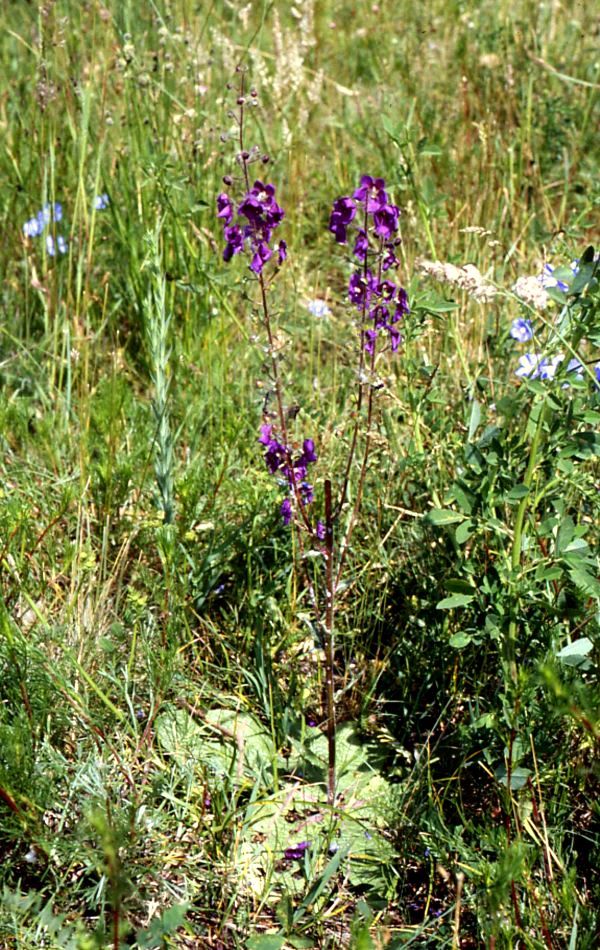
Photo: Franz Xaver, CC BY-SA 3.0 · source

Perennial · Scrophulariaceae
Purple mullein
Verbascum phoeniceum
In other languages: Paarse toorts (Nederlands) · Molène de Phénicie (Français)
The purple mullein originates from south-eastern Europe and western Asia, where it grows on dry, sunny slopes and steppes. It forms a flat rosette of dark green, slightly hairy leaves, from which slender, almost bare flower spikes of 60–80 cm rise from May to July. The flowers are purple, pink or white, with purple, hairy stamens. It is a short-lived perennial that often lasts only two or three years but seeds itself freely. It is ideal for a gravel garden, a rock garden or a sunny, dry border.
Caution: Self-seeds freely: cut off the faded spikes in good time if you do not want seedlings everywhere.
Light
Full sun
warm and bright
Moisture
Dry
tolerates drought
Legal basis
Sand or loam
any pH
Hardiness
Fully hardy
down to -25 °C
Size
0.8 m
tall, 0.3 m wide
Flowering
May–July
| Pruning months | July |
|---|---|
| Height | 0.8 m |
| Native to Belgium | No, planted |
| Good for bees, butterflies and birds | Yes, for bees |
| Poisonous to people and pets | Not known to be poisonous |
| Flowering | May–July |
Identify
Purple mullein: how do you recognise it?
- Habit
- Short-lived perennial or biennial 60–80 cm tall and 30 cm wide, with a flat leaf rosette and upright, almost unbranched flower spikes.
- Leaves
- Oval to oblong, 10–20 cm, dark green, slightly hairy, with a wavy or toothed edge; mainly in a basal rosette.
- Flowers
- Flowers 2–3 cm across in loose, slender spikes, from May to July.
- Colour
- Purple, pink or white, with purple, hairy stamens.
- Roots
- A deep taproot: it tolerates drought but does not move well.
Flowering: May–July · Sowing: March–June · Plants: March–May and September · Pruning: July
In your garden
Why grow it?
- Slender, flower-packed spikes in purple, pink or white from May to July: a light, airy presence.
- Drought-tolerant and suited to poor, dry soil where few other plants thrive.
- Bees and bumblebees visit the flowers for pollen.
- Seeds itself: new plants appear every year, even when the parent disappears.
- Low maintenance: no feeding and hardly any watering.
Purple mullein: where does it grow best?
- Full sun: the sunnier the spot, the sturdier the spikes.
- Well-drained, dry to normal-dry soil: sand or loam, poor to moderately rich; also chalky.
- It dislikes wet feet, especially in winter.
- Allow 30 cm per plant, on poor, gravelly soil.
- Light
- Sun
- Soil type
- Sand or loam
- Acidity
- Not fussy
- Moisture
- Dry
- Size
- 0.8 m tall, 0.3 m wide
- Hardiness
- Hardy (to -25 °C)
Goes well with
- Lavender: Fragrant, silver-grey bushes that tolerate the same dry sun.
- Yarrow: Flat heads in yellow or white against the upright spikes.
- Feather grass: Fine grasses create a natural, airy feel.
- Hollyhock: Also short-lived and self-seeding, with tall flower towers at the same time.
Maintenance
Purple mullein: when and how to plant it?
Plant in March–May and September.
- Plant in March–May or in September, when the soil is neither frozen nor waterlogged.
- Dig a hole as wide as the root ball; on heavy clay, improve with coarse sand or grit.
- Set the plant at the same depth as in its pot, with the rosette just above soil level.
- Space plants 30 cm apart.
- Water a little after planting, then only during long dry spells in the first year.
Care
- Water
- Rarely needed once established. Water only during long dry spells in the first year.
- Feeding
- Avoid it: on poor soil it stays compact and flowers more freely.
- Mulching
- A thin layer of grit or fine stone chippings keeps the rosette dry; keep the crown clear.
- Support
- In a sheltered, richer spot a tall spike can topple; a stake then gives support.
- Self-seeding
- Leave a few stems to set seed if you want new plants.
Tip: Let it self-seed in gravel or dry soil: a new group appears every year. After the first flowering, cut the spikes back for a second, smaller flush.
Purple mullein: when to prune it?
Pruning months: July.
When: After the first flowering, in July, with a tidy-up in February–March.
How:
- Cut the faded spikes back to just above the rosette or below the lowest flower; side shoots often flower again.
- Leave a few spikes standing if you want seed.
- Remove the dead stems in late spring.
Caution: It seeds itself freely and hybridises with other mulleins: cut off the spikes before the seed ripens if you do not want seedlings.
Propagation
- Sowing indoors
- In March–April in seed trays at 15–18 °C, covering the seed lightly; prick out and plant out after the last frosts (May). Usually flowers in the second year.
- Sowing outdoors
- In May–June where the plants are to grow, scattered thinly and pressed down lightly; thin out or carefully move the seedlings.
- Root cuttings
- In December–February lay 5 cm pieces of root horizontally in potting compost; new plants sprout in spring.
Purple mullein: how does it get through the winter?
Hardy to −25 °C.
- Hardy to about −25 °C: no protection is needed in Flanders.
- Wet winters on heavy clay are the main risk: provide good drainage and the rosette will survive.
- In a pot: use soil with plenty of coarse sand and do not stand the pot in a wet corner.
Diseases and pests
- Slugs: Nibbled rosettes in spring. Collect them in the evening and scatter coarse sand or grit around the plant.
- Root rot: A limp, brown rosette in wet soil, especially in winter. Plant in a dry spot or improve the drainage.
- Powdery mildew: White powder on the leaves in damp, muggy weather. Allow space and remove affected leaves.
- Caterpillars: Yellow caterpillars with black spots, those of a moth (Cucullia verbasci), can strip the leaves. Usually best tolerated; you can remove them by hand.
Through the year
- February: Tidy dead stems.
- March: Sow indoors. Plant.
- April: Sow indoors. Plant.
- May: Sow outdoors. Plant. Flowering begins.
- June: Full flower. Sow outdoors.
- July: Flowering. Cut back faded spikes.
- August: Possible second flowering. Collect seed.
- September: Plant. Move seedlings.
- October: The rosette stays green; do nothing.
- December: Take root cuttings (December–February).
Use
Good for wildlife
- Bees
- Nectar and pollen for honeybees and wild bees.
You and this species
Did you know?
- The species name phoeniceum means ‘purple-red’, after the colour of the flowers.
- Mulleins hybridise readily with each other, which is why seedlings often do not resemble the parent plant.
- The flowers on the spike open from the bottom upwards, so a single spike can stay in flower for weeks.