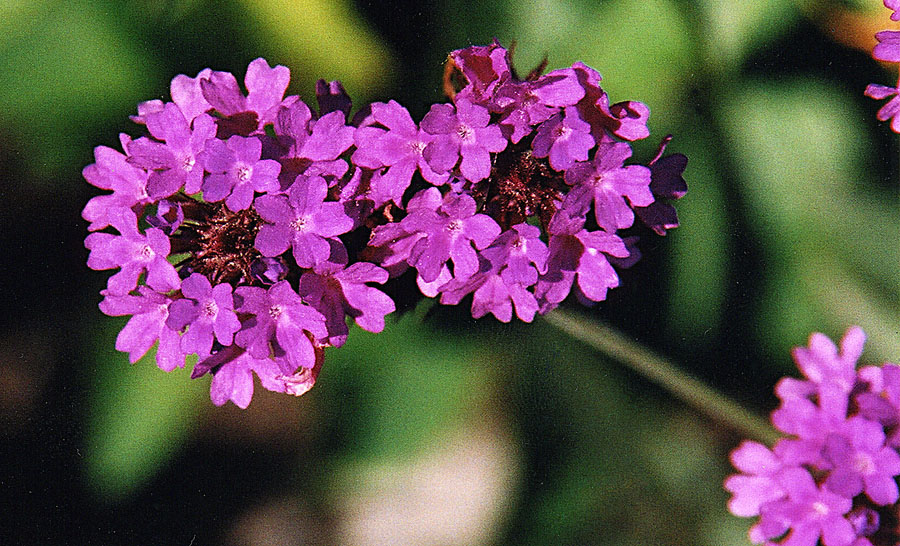
Photo: Dick Culbert from Gibsons, B.C., Canada, CC BY 2.0 · source

Perennial · Verbenaceae
Slender vervain
Verbena rigida
In other languages: IJzerhard (Nederlands) · Verveine rigide (Français)
Slender vervain comes from South America, including Brazil and Argentina. It is a low perennial, 30–50 cm tall, with stiff, rough, square stems and toothed leaves. From June until the first frosts it carries dense heads of small purple-violet flowers that butterflies and bees cannot resist. It spreads by underground runners into a loose mat, so it weaves attractively between other plants. The best-known cultivar is ‘Polaris’, with silvery pale blue flowers.
Light
Full sun
warm and bright
Moisture
Dry to normal
no wet feet
Legal basis
Sand or loam
any pH
Hardiness
down to -10 °C
protect in harsh winters
Size
0.4 m
tall, 0.4 m wide
Flowering
June–October
| Pruning months | April |
|---|---|
| Height | 0.4 m |
| Native to Belgium | No, planted |
| Good for bees, butterflies and birds | Yes, for bees and butterflies |
| Poisonous to people and pets | Not known to be poisonous |
| Flowering | June–October |
Identify
Slender vervain: how do you recognise it?
- Habit
- Upright to semi-trailing, 30–50 cm tall; spreads by underground runners.
- Leaves
- Oblong, stiff and rough, with toothed edges, stalkless and clasping the stem.
- Stem
- Stiff, square and roughly hairy.
- Flower
- Small tubular flowers in dense, short spikes, often in groups of three at the top.
- Colour
- Purple to violet; there are also lilac and silvery pale blue cultivars.
Flowering: June–October · Sowing: February–March · Plants: May–June · Pruning: April
In your garden
Why grow it?
- Flowers for months on end, from June until the frosts.
- One of the best butterfly plants for a sunny border.
- Copes well with heat and drought.
- Lovely at the front of the border, in pots and among ornamental grasses.
- Grows quickly from seed and flowers in its first year.
Slender vervain: where does it grow best?
- Full sun: the warmer the spot, the better it flowers.
- Well-drained soil: sand or light loam, acid to chalky.
- Dry to moist; wet soil in winter is fatal.
- A sheltered spot against a south-facing wall improves its chances of surviving the winter.
- Plant 30 cm apart.
- Light
- Sun
- Soil type
- Sand or loam
- Acidity
- Not fussy
- Moisture
- Dry or normal
- Size
- 0.4 m tall, 0.4 m wide
- Hardiness
- Half hardy (to -10 °C): protect it in harsh winters
Goes well with
- Purpletop vervain: Its tall cousin: together they make a purple haze at two heights.
- Mexican feather grass: Softly swaying stems around the stiff purple flowers.
- Gaura: Airy white or pink flowers that also keep going into autumn.
- Sage: Violet-blue spikes for a warm, dry spot.
Maintenance
Slender vervain: when and how to plant it?
Plant in May–June.
- Sow indoors in February–March and plant out in May–June, once the last frosts are over.
- Loosen the soil and, in heavier ground, mix in some grit or gravel.
- Set the plant at the same depth as it was in the pot and firm the soil.
- Space plants 30 cm apart, in groups for a dense mat.
- Water well until the plant is established; after that, sparingly.
Care
- Watering
- Once established, only in long dry spells; in pots, regularly.
- Feeding
- Little needed. In pots, a liquid feed for flowering plants every two weeks.
- Deadheading
- Snip off faded spikes; this keeps it producing new flowers.
- Winter protection
- Leave the old stems standing and cover the base with a thick layer of leaves in November.
- Back-up plants
- Sow or root a few plants each year as back-up in case the parent plant does not survive the winter.
Tip: Take a few cuttings in late summer and overwinter them frost-free on a cool windowsill: that way you always have back-up plants if the parent does not survive the winter.
Slender vervain: when to prune it?
Pruning months: April.
When: In April, when the worst frosts are over and new shoots are visible at the base.
How:
- Leave the old stems standing in winter: they protect the base from frost.
- In April, cut all dead stems back to just above the new shoots.
- In summer you can snip off faded spikes to prolong flowering.
Caution: Do not cut back in autumn: a plant cut to the ground survives the winter less well.
Propagation
- Seed
- Sow indoors in February–March at 18–20 °C. Germination can be slow and erratic; keep the compost slightly moist.
- Division
- In May, lift rooted runners from the edge and replant them elsewhere.
- Cuttings
- In August–September, take cuttings of non-flowering shoots and overwinter them frost-free, as back-up for the following year.
Slender vervain: how does it get through the winter?
Hardy to −10 °C: protect in harsh winters.
- Moderately hardy, to about −10 °C: it survives a mild winter, but not always a severe one.
- Cover the base with a thick layer of leaves or straw in November.
- Wet soil is more dangerous than frost in winter: choose a well-drained spot.
- In a pot: keep it frost-free and in good light over winter, for example in a cold greenhouse.
Diseases and pests
- Powdery mildew: White powder on the leaves in late summer, especially in dry weather. Water at the base and choose an airy spot.
- Winter losses: The plant does not return after a wet or severe winter. Sow or root a few back-up plants every year.
- Slugs: They eat young plants after planting out. Protect them for the first few weeks.
- Aphids: On young shoots in spring. Hose them off; ladybirds will help.
Through the year
- February: Sow indoors.
- March: Sow indoors. Prick out seedlings.
- April: Cut old stems back to just above the new shoots.
- May: Plant out after the last frosts. Lift rooted runners.
- June: Plant. Flowering begins.
- July: Full flower. Snip off faded spikes.
- August: In flower. Take cuttings.
- September: In flower. Take cuttings.
- October: Last flowers until the frosts.
- November: Cover the base with leaves. Move pots somewhere frost-free.
Use
Good for wildlife
- Bees
- Nectar and pollen for honeybees and wild bees.
- Butterflies
- Nectar for butterflies.
You and this species
Did you know?
- Rigida means ‘stiff’: a reference to the stiff, rough stems and leaves.
- It is related to the well-known purpletop vervain (Verbena bonariensis), which also comes from South America.
- In warm regions, such as parts of Australia, it has become naturalised.