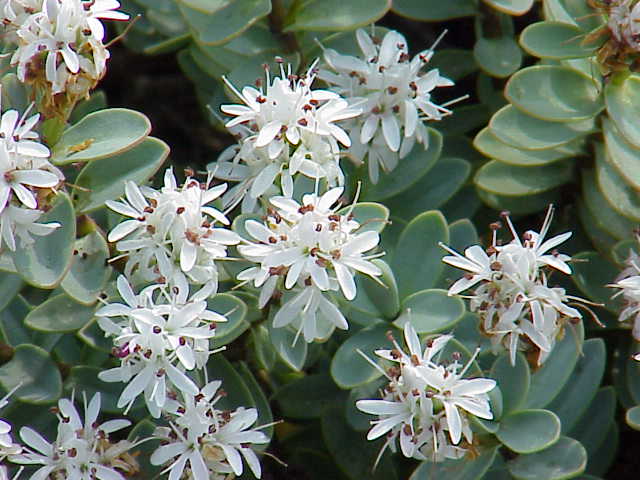
Photo: Kurt Stüber [1], CC BY-SA 3.0 · source

Shrub · Plantaginaceae
Hebe
Veronica pinguifolia
In other languages: Hébé (Français)
Veronica pinguifolia is a low, evergreen shrub from the mountains of the South Island of New Zealand. It forms a wide, cushion-shaped mat about 40 cm high, covered in small, thick, blue-grey leaves. In May and June short white spikes appear, which bees visit. The cultivar ‘Pagei’ is by far the best known and is widely used as ground cover. The plant is one of the hardiest hebes, to about −15 °C, and suits a rock garden, a border or a pot in a sunny, free-draining spot.
Light
Sun or partial shade
preferably some sun
Moisture
Dry to normal
no wet feet
Legal basis
Sand, loam or clay
any pH
Hardiness
down to -15 °C
protect young plants
Size
0.4 m
tall, 0.8 m wide
Flowering
May–June
| Pruning months | April and June |
|---|---|
| Height | 0.4 m |
| Native to Belgium | No, planted |
| Good for bees, butterflies and birds | Yes, for bees |
| Poisonous to people and pets | Not known to be poisonous |
| Flowering | May–June |
Identify
Hebe: how do you recognise it?
- Habit
- Low, cushion-shaped to spreading shrub about 40 cm high and 80 cm wide, with slender, lying to upright branches.
- Leaves
- Small, thick and leathery, blue-grey, in opposite pairs on the stem; evergreen.
- Flowers
- Short white spikes in May and June, at the tips of the shoots.
- Roots
- Fibrous and shallow: it likes free-draining soil and does not tolerate wet feet.
- Cultivars
- ‘Pagei’ is the best known: low, spreading, with blue-grey leaves.
Flowering: May–June · Plants: April–May · Pruning: April and June
In your garden
Why grow it?
- Blue-grey, evergreen leaves that give character to low planting all year.
- A good ground cover: the wide mat keeps weeds down in a sunny spot.
- White flowers in May–June attract bees.
- One of the hardiest hebes, to about −15 °C.
- Low maintenance: a light trim after flowering is enough.
Hebe: where does it grow best?
- Full sun to half shade; in sun the plant stays compact and flowers more.
- Free-draining, not too rich soil: sand, loam or light clay, acid to chalky.
- Moderately dry to normal; never waterlogged in winter.
- Suits a rock garden, a bank or the front of a border; tolerates wind.
- Allow 60–80 cm per plant; as ground cover, 3–4 plants per m².
- Light
- Sun and partial shade
- Soil type
- Sand, loam or clay
- Acidity
- Not fussy
- Moisture
- Dry or normal
- Size
- 0.4 m tall, 0.8 m wide
- Hardiness
- Hardy (to -15 °C)
Goes well with
- Lavender: Same sunny, free-draining spot; scented purple flowers.
- Stonecrop: Thick leaves and late flowers that complement the low mat.
- Blue fescue: Blue-grey grass that echoes the colour of the leaves.
- Creeping thyme: Low, scented ground cover for the same spot.
- Cranesbill: Blue to purple flowers that go well with the grey leaves.
Maintenance
Hebe: when and how to plant it?
Plant in April–May.
- Plant in April–May, when the worst frosts are over, so the plant can root well before winter.
- Dig a hole twice as wide as the root ball; on heavy soil mix in sand or fine grit.
- Set the plant at the same depth as in its pot and firm the soil well.
- Leave 60–80 cm between plants; as ground cover, 3–4 plants per m².
- Water in thoroughly and keep the soil slightly moist in the first year.
- Lay a thin layer of bark or gravel around the base, without covering the stems.
Care
- Water
- In the first year during dry weather, afterwards only in long dry spells. In pots regularly, but never with wet feet.
- Feeding
- In April a handful of organic fertiliser or shrub feed; not after August.
- Mulching
- A thin layer of bark or gravel keeps the soil moist and the crown dry.
- Spent flowers
- Cut off the spikes after flowering: the mat stays neater.
- Weeds
- Weed regularly until the plants meet; after that the mat suppresses weeds by itself.
Tip: Cut off the spent spikes in June and give the plant plenty of sun and free-draining soil: the mat then stays dense. After a few years, tuck in a cutting if the centre starts to open up.
Hebe: when to prune it?
Pruning months: April and June.
When: After flowering, in June, plus a light tidy in April.
How:
- Cut off the spent spikes to just above the leaves.
- Shorten protruding or overlong branches to keep the shape, always within green wood.
- In April: remove dead or frost-damaged twigs back to healthy wood, which only shows clearly in May.
Caution: Do not cut deep into old, bare wood: it often fails to regrow. Do not prune in autumn either.
Propagation
- Semi-ripe cuttings
- In July–September take cuttings of 5–8 cm from non-flowering shoots, strip the lower leaves and insert in sandy compost. Usually rooted in 3–5 weeks.
- Layering
- In spring peg a low branch to the ground with a little soil over it; it roots over the summer and can be separated in autumn.
Hebe: how does it get through the winter?
Hardy to −15 °C: protect young plants.
- Hardy to about −15 °C: it can stay outside in most Belgian winters, also as ground cover.
- Wet winters are more dangerous than frost: make sure drainage is good and do not let a thick layer of leaves lie on the plant.
- In a pot: stand it on feet against a sheltered wall and protect the pot in hard frost.
Diseases and pests
- Root rot: The plant fades and drops leaves on soil that is too wet. Improve drainage with sand or move it to a higher spot.
- Leaf spot: Brown or black spots on the leaves, especially in wet spells. Remove affected leaves and avoid watering over the foliage.
- Frost damage: Brown leaves and dead twigs after a hard winter. Wait until May, then cut back to healthy wood.
- Bare centre: Older plants open up in the middle. Trim lightly every year, tuck in a cutting or young plant and avoid too much shade.
Through the year
- April: Planting. Remove dead twigs. Feed.
- May: Planting. Flowering begins. Cut out frost damage.
- June: Flowering. Cut off spent spikes.
- July: Take cuttings. Water in dry weather.
- August: Take cuttings.
- September: Take cuttings. Separate layers.
- October: Keep thick leaf layers off the plant.
- November: Move pots frost-free. Protect young plants.
Use
Good for wildlife
- Bees
- Nectar and pollen for honeybees and wild bees.
You and this species
Did you know?
- The species name pinguifolia comes from Latin and means ‘thick-leaved’, after the small, fleshy leaves.
- Hebes were long treated as a genus of their own, but are now placed in Veronica (speedwell).
- Coming from the mountains of New Zealand, it is one of the hardiest hebes.