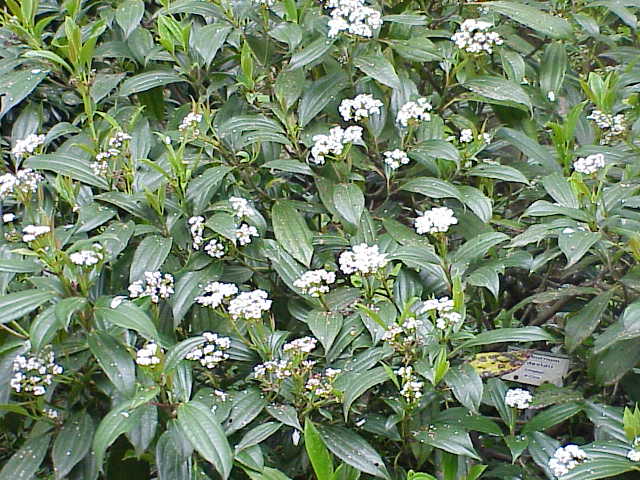
Photo: Kurt Stüber [1], CC BY-SA 3.0 · source

Shrub · Viburnaceae
David viburnum
Viburnum davidii
In other languages: Sneeuwbal (Nederlands) · Viorne de David (Français)
This evergreen viburnum comes from the mountains of western China. It is a low, spreading shrub 0.6–1 m tall and 1–1.5 m wide, with leathery, dark green leaves marked by three deep veins running lengthways. In May and June it bears flat heads of small white flowers. In autumn, female plants carry clusters of striking metallic-blue berries, provided there is a male plant nearby. Gardeners value it as a neat evergreen for the front of a border or as a broad ground cover, even in shade.
Light
Sun to shade
not fussy
Moisture
Normal
no wet feet
Legal basis
Sand, loam or clay
any pH
Hardiness
down to -15 °C
protect young plants
Size
1 m
tall, 1.5 m wide
Flowering
May–June
| Pruning months | April |
|---|---|
| Height | 1 m |
| Native to Belgium | No, planted |
| Good for bees, butterflies and birds | Yes, for birds |
| Poisonous to people and pets | Not known to be poisonous |
| Flowering | May–June |
Identify
David viburnum: how do you recognise it?
- Habit
- Low, dense, dome-shaped shrub 0.6–1 m tall and 1–1.5 m wide.
- Leaves
- Elliptic, 5–15 cm, leathery and glossy dark green, with three deep veins running from base to tip.
- Flowers
- Flat heads of 5–8 cm with small white flowers in May and June; the buds are sometimes tinged pink.
- Fruit
- Oval, metallic-blue berries of about 6 mm on female plants, from autumn into winter.
- Sex
- For berries you need female plants and a male plant nearby.
Flowering: May–June · Plants: April–May and September–October · Pruning: April
In your garden
Why grow it?
- Neat, glossy green leaves all year round, with a striking vein pattern.
- Metallic-blue berries in autumn and winter, a colour rarely seen in the garden.
- Low and broad: ideal at the front of a shrub border, under windows or as ground cover.
- Grows in sun, partial shade and shade.
- Birds eat the berries in winter.
David viburnum: where does it grow best?
- Sun, partial shade or shade; the leaves look their best in shade.
- Ordinary garden soil: sandy, loamy or clay, acid to chalky.
- Moisture-retentive but well-drained; it does not tolerate wet feet.
- Sheltered from cold, drying east winds, which turn the leaves brown.
- Allow 1–1.2 m per plant; as ground cover, in a group 80 cm apart.
- Light
- Sun, partial shade and shade
- Soil type
- Sand, loam or clay
- Acidity
- Not fussy
- Moisture
- Normal
- Size
- 1 m tall, 1.5 m wide
- Hardiness
- Hardy (to -15 °C)
Goes well with
- Lenten rose: Flowers early in spring, in the same partial shade.
- Snowdrop: Small white flowers along the edge, when the shrub is quietly green in winter.
- Ferns: Fine foliage beside the bold, veined leaves of the viburnum.
- Japanese anemone: Flowers in late summer, just as the berries start to colour.
Maintenance
David viburnum: when and how to plant it?
Plant in April–May and September–October.
- Plant in April–May or September–October.
- Plant a group of at least three, with at least one male among the females.
- Dig a hole twice as wide as the root ball and mix in a few spadefuls of compost.
- Set the plant at the same depth as it was in the pot and firm the soil well; keep 80–100 cm apart.
- Water in thoroughly straight away, even if it is raining.
- Spread a layer of compost or wood chips around the base.
Care
- Watering
- Regularly in dry spells in the first year. Later only in long dry periods.
- Feeding
- In April, a layer of compost or a little organic shrub feed.
- Mulching
- A layer of compost or leaf mould keeps the soil cool and moist.
- Berries
- Leave them on the shrub: they decorate the garden into winter and feed the birds.
- Winter damage
- In April, cut off brown leaves and frosted twigs; new shoots soon fill the gaps.
Tip: Plant a group of at least three, with at least one male among the females. That is the only way to get the metallic-blue berries.
David viburnum: when to prune it?
Pruning months: April.
When: Hardly ever needed. A light trim in April is enough.
How:
- Cut frosted or brown twigs back to healthy wood.
- Shorten a few stems that stick out to keep the rounded shape.
- On an old, bare shrub, take out a few old stems at the base.
Caution: Do not clip it with shears: the flower buds, and so this year’s berries, sit at the stem tips.
Propagation
- Semi-ripe cuttings
- In July–August: 10 cm cuttings from this year’s shoots, large leaves cut in half, in moist cutting compost under plastic. A cutting keeps the sex of the parent plant.
- Layering
- In spring, bend a low stem to the ground and peg it down under some soil. Sever after a year.
David viburnum: how does it get through the winter?
Hardy to −15 °C: protect young plants.
- Hardy to about −15 °C: it comes through most Belgian winters without trouble.
- In hard frost and cold wind the leaves can turn brown; the shrub reshoots in spring.
- A sheltered spot among other shrubs or in the shade of a wall limits the damage.
- In a pot: stand it against a wall and wrap the pot in hessian so the roots do not freeze.
Diseases and pests
- No berries: There is no male plant nearby, or you only have male plants. Plant both sexes together.
- Brown leaves after winter: Caused by frost and cold, dry wind. Cut them off in April and give the plant a more sheltered spot.
- Vine weevil: Half-moon notches in the leaf edges; the grubs eat the roots. Pick off the beetles at night by torchlight or use nematodes against the grubs.
- Yellow leaves: Often caused by wet, poorly drained soil. Improve the soil with compost or choose a drier spot.
Through the year
- April: Light pruning and removal of winter damage. Give compost. Plant.
- May: Flowering begins. Plant.
- June: Flowering. Top up the mulch.
- July: Take semi-ripe cuttings. Water in dry spells.
- August: Water in dry spells. The berries colour up.
- September: Metallic-blue berries. Plant.
- October: Plant. The berries decorate the garden.
- December: Evergreen leaves and blue berries; birds eat them.
Use
Good for wildlife
- Birds
- Berries, seeds or insects as food, or a place to nest.
You and this species
Did you know?
- It is named after Armand David, a French missionary and naturalist in China; the handkerchief tree and Père David’s deer also bear his name.
- The plant hunter Ernest Wilson brought it from China to Europe in the early 20th century.
- The three deep leaf veins run from base to tip, so you can recognise the plant at a glance, even without flowers or berries.