Photo: Wikimedia Commons, Public domain · source

Climber · Fabaceae
American wisteria
Wisteria frutescens
In other languages: Amerikaanse blauweregen (Nederlands) · Glycine d’Amérique (Français)
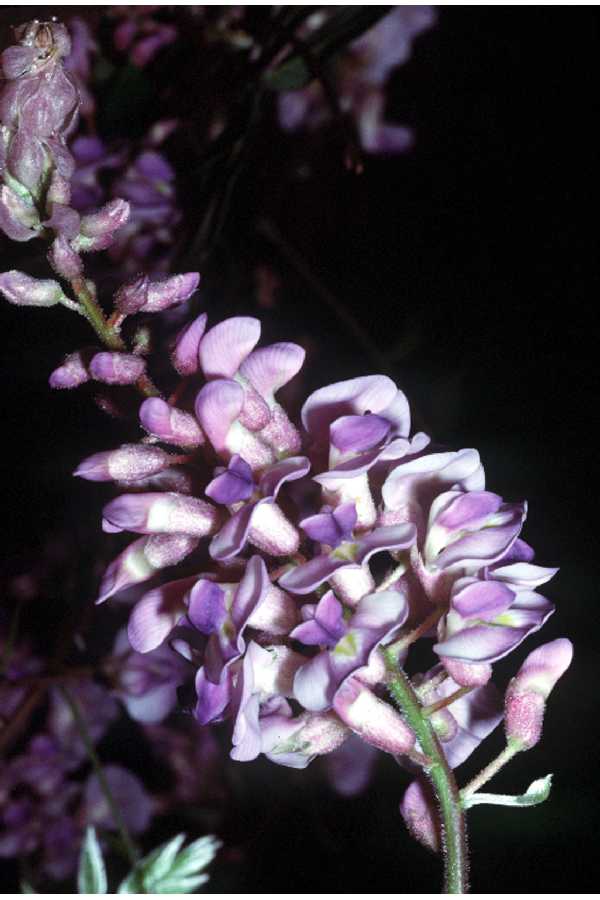
American wisteria (Wisteria frutescens) grows wild in the south-eastern United States, in damp woods and along riverbanks. It is a woody, twining climber that reaches about 8 m, with divided leaves and, in June and July, short, dense clusters of lilac-blue, lightly scented flowers. They appear when the leaves are already out. It is less rampant than Chinese and Japanese wisteria and flowers young; ‘Amethyst Falls’ is the best-known cultivar. It is fully hardy. Be careful, though: all parts are poisonous, especially the seeds in the pods.
Caution: All parts are poisonous, especially the seeds in the pods, which look like pea pods. Children, dogs, cats, horses and other grazing animals are at risk if they eat seeds or pods. Remove pods in autumn, do not leave clippings lying around and wear gloves.
Light
Full sun
warm and bright
Moisture
Normal
no wet feet
Legal basis
Sand, loam or clay
acid to neutral
Hardiness
Fully hardy
down to -30 °C
Size
8 m
tall, 4 m wide
Flowering
June–July
| Pruning months | February and August |
|---|---|
| Height | 8 m |
| Native to Belgium | No, planted |
| Good for bees, butterflies and birds | Yes, for bees |
| Poisonous to people and pets | Yes, take care with children and pets |
| Flowering | June–July |
Identify
American wisteria: how do you recognise it?
- Habit
- Woody, twining climber, up to about 8 m tall and 4 m wide. Over the years it develops a thick, sturdy trunk.
- Leaves
- Pinnate, with 9–15 oval to lance-shaped leaflets; alternate; deciduous.
- Flowers
- Short, dense clusters of about 10–15 cm, lilac-blue and lightly scented, in June–July after the leaves have opened.
- Fruit
- Smooth pods a few centimetres long, which split open in autumn; the seeds are poisonous.
- Roots
- Deep and strong; it dislikes being moved, so choose the right spot from the start.
Flowering: June–July · Plants: March–May and September–October · Pruning: February and August
In your garden
Why grow it?
- Flowers at a young age, in June–July, with clusters that are shorter and denser than those of Chinese wisteria.
- Less rampant and easier to control than Chinese or Japanese wisteria.
- Fully hardy, to about −30 °C, and late-flowering, so late spring frosts rarely hit the buds.
- Fragrant flowers that attract bees.
- Lovely over a pergola, a house wall or a sturdy arch: a classic climber with an American feel.
American wisteria: where does it grow best?
- Full sun for the best flowering; in part shade it grows, but flowers less.
- Deep, moisture-retentive, free-draining soil: sand, loam or clay, acid to neutral. Not in waterlogged or compacted soil.
- Sheltered from strong wind, preferably against a south-, east- or west-facing wall.
- Give it a sturdy support: a pergola, a strong arch or thick, taut wires on the wall. Keep it away from gutters, window frames and roof tiles.
- Allow 3–4 m of space along the wall; it gets heavy.
- Light
- Sun
- Soil type
- Sand, loam or clay
- Acidity
- Acid or neutral
- Moisture
- Normal
- Size
- 8 m tall, 4 m wide
- Hardiness
- Hardy (to -30 °C)
Goes well with
- Climbing rose: A climbing rose on the same pergola flowers in June; after that the wisteria takes over, or they flower together.
- Lavender: At the front of the border, in the same sunny spot, with purple flowers and a sweet scent.
- Hardy geranium: Covers the base and flowers at the same time.
- Clematis: A late-flowering clematis climbs between the branches and flowers later in summer.
Maintenance
American wisteria: when and how to plant it?
Plant in March–May and September–October.
- Plant in March–May or in September–October, when the soil is neither frozen nor too wet.
- Put the support in place first: strong wires or a pergola, at least 30–40 cm from the wall.
- Dig a hole twice as wide as the root ball and mix in compost. Preferably buy a plant raised from a cutting or graft of a named cultivar, ideally in flower: seedlings sometimes take many years to flower.
- Plant at the same depth as in the pot, tie in the shoots and, if you like, shorten them to 3–4 buds.
- Water in generously straight away and spread a 5–8 cm layer of mulch around the base.
Care
- Water
- For the first two years water weekly in dry spells, in the morning at the base. Later only in long dry periods in spring and summer.
- Feeding
- In March, a layer of compost. Avoid nitrogen-rich fertilisers: they give plenty of leaves and few flowers. A high-potassium flowering-plant feed in spring helps.
- Mulching
- A layer of mulch in spring keeps the roots cool and moist.
- Support
- Tie the main shoots to the support and do not let them grow into gutters, round pipes or under roof tiles.
- Pods
- Remove the pods in autumn, so children or animals cannot find the poisonous seeds.
Tip: Shorten the side shoots in August to 5–6 leaves and in February to 2–3 buds: that gives the most flowers. Buy a plant of a named cultivar, ideally in flower.
American wisteria: when to prune it?
Pruning months: February and August.
When: Twice a year: in August and in February.
How:
- August: shorten this year’s long, thin side shoots to 5–6 leaves (about 20–30 cm).
- February: shorten those same side shoots again to 2–3 buds. This is where the flower clusters form.
- Tie the main shoots to the support and shorten the tips if it gets too long.
- Remove shoots below the graft and suckers from the roots.
Caution: Wear gloves and keep clippings out of reach of children and animals: all parts are poisonous.
Propagation
- Layering
- In spring or autumn bend a long, supple shoot down to the ground, wound it at one point and fix it under the soil with a stone or peg. After a year it roots and you can separate it.
- Seed
- Collect the pods in autumn and sow the seeds in spring (in a pot, 1 cm deep). The seedlings differ from the parent plant and only flower after many years; keep the seeds out of reach of children.
American wisteria: how does it get through the winter?
Hardy to −30 °C.
- Fully hardy, to about −30 °C: no protection is needed, even in hard Belgian winters.
- For young plants, put a layer of mulch around the base in the first two winters.
- In a pot: possible for a young plant, but it needs plenty of room. Stand the pot against a wall and wrap it in hessian so the roots do not freeze.
- The woody framework stays nicely visible against the wall or pergola in winter.
Diseases and pests
- No flowers: Young plant, seedling, too much shade, too much nitrogen or wrong pruning. Plant in the sun, give a high-potassium feed, prune in August and February and be patient.
- Aphids: On young shoots in spring. Spray off with water or rub them off by hand; ladybirds usually deal with them.
- Yellow leaves: Iron deficiency on chalky soil, or soil that is too wet. Give organic fertiliser, improve drainage and avoid lime.
- Damaged support: An old plant is very heavy: check the fixings and wires every year, and keep it away from gutters and roof tiles.
Through the year
- February: Shorten side shoots to 2–3 buds.
- March: Plant. Apply compost.
- April: Plant. Apply mulch. Water in dry spells.
- May: Plant. Tie in to the support.
- June: Flowering begins. Water in dry spells.
- July: Flowering. Leave or cut off faded clusters.
- August: Shorten side shoots to 5–6 leaves. Water in dry spells.
- September: Plant. Check the pods.
- October: Plant. Remove the pods.
- November: Leaf fall. Check the support.
- December: Rest. Enjoy the woody framework.
Use
Edible and useful
Not edible. All parts of American wisteria are poisonous, especially the seeds in the pods: these look like pea or bean pods, and just a few seeds cause vomiting, stomach ache and diarrhoea in a child. Dogs, cats and horses fall ill from them too. Cut off the faded flowers or, at the latest in autumn, the pods, do not leave clippings lying about and teach children that the pods are not peas. If any is swallowed, call a poison centre (in Belgium 070 245 245) or your doctor at once.
Good for wildlife
- Bees
- Nectar and pollen for honeybees and wild bees.
You and this species
Did you know?
- The genus name Wisteria honours Caspar Wistar, an American physician and anatomist (1761–1818).
- American wisteria is much less rampant than the Chinese and Japanese species, which are considered invasive in parts of the United States.
- In autumn the pods can split open with a sharp crack and throw out the seeds.