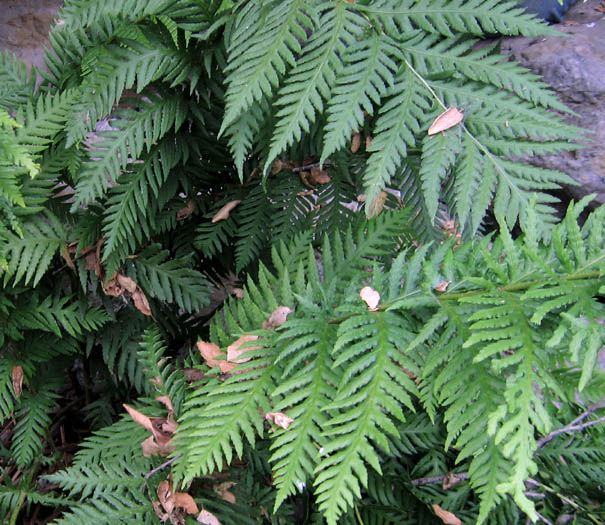
Photo: Anthony Valois and the National Park Service, Public domain · source

Fern · Blechnaceae
Giant chain fern
Woodwardia fimbriata
In other languages: Woodwardia (Nederlands) · Woodwardia (Français)
Giant chain fern is a large, evergreen fern from western North America, where it grows from British Columbia to California along streams, by springs and in damp coastal forests. A short, stout rhizome produces a broad clump of stiff, pinnate fronds that reach 1.5 m in the garden and arch gracefully. On the underside, the elongated spore clusters lie side by side in rows like the links of a chain, which gives the plant its common name. Gardeners choose it as a centrepiece for a sheltered, shady corner, because few ferns grow this large and stay green through winter. It does need a sheltered spot, moist, humus-rich soil and some protection in severe winters.
Light
Partial shade or shade
tolerates little sun
Moisture
Normal to wet
must not dry out
Legal basis
Sand or loam
acid to neutral
Hardiness
down to -15 °C
protect young plants
Size
1.5 m
tall, 1 m wide
| Pruning months | April |
|---|---|
| Height | 1.5 m |
| Native to Belgium | No, planted |
| Poisonous to people and pets | Not known to be poisonous |
Identify
Giant chain fern: how do you recognise it?
- Habit
- A broad, funnel-shaped clump 1–1.5 m tall and about 1 m wide, with gracefully arching fronds.
- Fronds
- Large and pinnate, with deeply cut leaflets; stiff, almost leathery, fresh to mid-green and evergreen.
- Spores
- Elongated spore clusters in chain-like rows along the veins on the underside of the fronds. Ferns do not flower.
- Roots
- A short, thick, upright rhizome: the plant stays put and does not spread.
- Young fronds
- In spring the new fronds unfurl like large coils from the heart of the clump.
Plants: April–May and September · Pruning: April
In your garden
Why grow it?
- One of the largest garden ferns, with fronds up to 1.5 m: a real eye-catcher.
- Evergreen: it gives the shade border structure even in winter.
- Grows as a neat clump and does not send out runners.
- Ideal for a sheltered, moist, shady corner, under trees or on the north side of a wall.
- Gives the garden a lush, almost exotic feel alongside hostas and other foliage plants.
Giant chain fern: where does it grow best?
- Partial shade or shade; avoid fierce midday sun, which scorches the fronds.
- Humus-rich, moisture-retentive sandy or loamy soil, acid to neutral.
- Moist to wet, for example at the edge of a pond or stream, but not in standing water.
- Sheltered from wind and hard frost, under trees or in the lee of a wall or hedge.
- Allow at least 1 m of space per plant.
- Light
- Partial shade and shade
- Soil type
- Sand or loam
- Acidity
- Acid or neutral
- Moisture
- Normal or wet
- Size
- 1.5 m tall, 1 m wide
- Hardiness
- Hardy (to -15 °C)
Goes well with
- Hosta: Large, broad leaves that contrast with the finely cut fronds.
- Rodgersia: Loves the same moist partial shade and has strikingly large leaves.
- Japanese maple: An elegant small tree that casts light shade and colours beautifully in autumn.
- Shield fern: A smaller evergreen fern for the foreground.
- Wood anemone: Small white spring flowers at its feet, before the new fronds open.
Maintenance
Giant chain fern: when and how to plant it?
Plant in April–May and September.
- Plant in April–May or in September, so the roots can establish before winter.
- Dig a hole twice as wide as the root ball and mix in plenty of leaf mould or well-rotted compost.
- Plant at the same depth as in the pot: the crown must not end up below the soil.
- Keep at least 1 m from other large plants.
- Water generously straight away and keep the soil moist throughout the first year.
- Spread a layer of leaf mould or shredded leaves around the base.
Care
- Water
- Keep the soil moist at all times, especially in the first year and in dry summers. Drying out causes brown frond edges.
- Feeding
- A layer of leaf mould or well-rotted compost in spring is enough; no artificial fertiliser is needed.
- Mulching
- A layer of leaf mould each spring keeps the soil cool, moist and rich in humus.
- Shelter
- Choose a spot out of the wind: in a windy place the large fronds tear or snap.
- In a pot
- Possible in a large tub of humus-rich compost, but it then dries out quickly and is more vulnerable to frost.
Tip: Choose a sheltered, moist, shady spot and give it real space: in the right place it becomes more impressive every year. In severe winters, cover the crown with a thick layer of leaves.
Giant chain fern: when to prune it?
Pruning months: April.
When: In April, just before the new fronds emerge. The evergreen foliage is otherwise not pruned.
How:
- Cut off only brown, damaged or flattened old fronds at the base.
- Leave healthy green fronds: they stay attractive for a good while yet.
- Take care of the young, coiled fronds in the centre: they snap off easily.
Caution: Do not prune in autumn: the old fronds protect the crown of the plant in winter.
Propagation
- Spores
- In late summer, let a frond with ripe spore clusters dry on paper and sow the spores on moist, sterile seed compost under glass. It takes a few years to get a decent plant.
- Division
- An old plant with several crowns can be carefully divided in April; each piece needs its own crown with roots. Do not divide a plant with a single crown.
Giant chain fern: how does it get through the winter?
Hardy to −15 °C: protect young plants.
- Hardy to about −15 °C: in a sheltered spot it comes through most Belgian winters.
- In severe winters, cover the crown and base with a thick layer of fallen leaves.
- After hard frost the fronds may turn brown; leave them until April, as the crown usually sprouts again.
- In a tub: stand it against a sheltered wall and wrap the pot in hessian, or move it into a cool, light place in hard frost.
Diseases and pests
- Brown frond edges: A sign of drought or too much sun. Keep the soil moist and choose a shadier position.
- Frost damage: Brown, limp fronds after a hard winter. Cut them off in April and protect the crown with leaves the following winter.
- Wind damage: Torn or snapped fronds in an exposed spot. Move the plant to a sheltered corner.
- Vine weevil: In pots, the grubs can eat the roots, so the plant wilts for no obvious reason. Watering nematodes against the grubs into the pot helps.
Through the year
- January: Leave winter protection in place.
- March: Spread leaf mould around the base.
- April: Cut off old, damaged fronds. Plant or divide.
- May: New fronds unfurl. Plant.
- June: Keep the soil moist.
- July: Water in dry spells.
- August: Water in dry spells. Collect ripe spores.
- September: Plant.
- November: Leave fallen leaves around the base.
- December: In hard frost, cover the crown with a layer of leaves.
You and this species
Did you know?
- The name ‘chain fern’ refers to the spore clusters, which lie in rows along the veins like the links of a chain.
- The genus is named after the English botanist Thomas Jenkinson Woodward; fimbriata means ‘fringed’.
- In its native range, the fronds can grow longer than 2 m in a sheltered, wet spot.