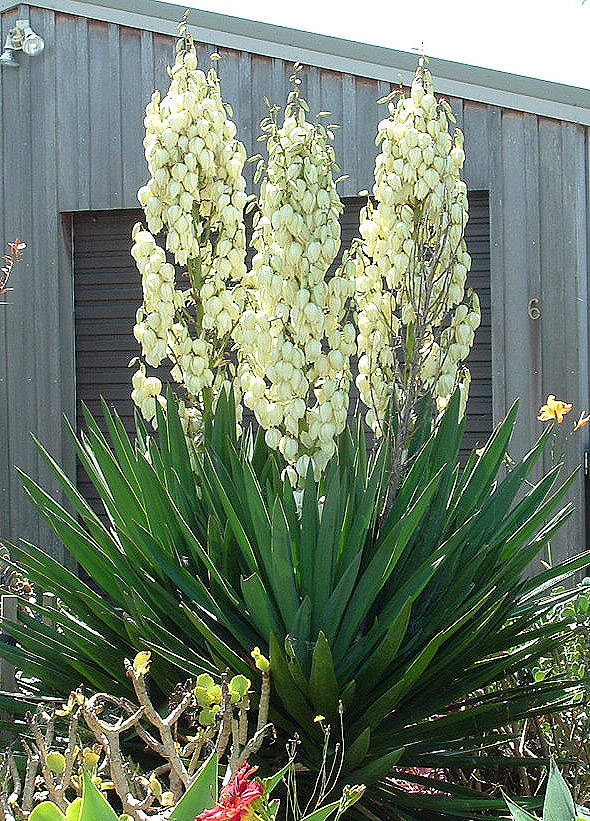
Photo: Moriori, Public domain · source

Shrub · Asparagaceae
Adam’s needle
Yucca filamentosa
In other languages: Palmlelie (Nederlands) · Yucca filamenteux (Français)
Adam’s needle comes from the south-eastern United States, where it grows in sandy, dry soil along the coast and in open woodland. It is a stemless rosette of stiff, sword-shaped leaves with fine, curly white threads along the edges. In July–August tall flower stems rise from the centre, carrying panicles of nodding, creamy white bells. Gardeners love its exotic, architectural shape and, unlike many other yuccas, it is fully hardy here. Well-known cultivars are ‘Color Guard’, with a yellow centre, and ‘Bright Edge’, with a yellow margin.
Caution: The leaves are stiff with a sharp point: do not plant it next to a path, a sandpit or where children play.
Light
Full sun
warm and bright
Moisture
Dry
tolerates drought
Legal basis
Sand, loam or clay
any pH
Hardiness
Fully hardy
down to -25 °C
Size
1 m
tall, 1 m wide
Flowering
July–August
| Pruning months | April and September |
|---|---|
| Height | 1 m |
| Native to Belgium | No, planted |
| Good for bees, butterflies and birds | Yes, for bees |
| Poisonous to people and pets | Not known to be poisonous |
| Flowering | July–August |
Identify
Adam’s needle: how do you recognise it?
- Habit
- Stemless rosette of leaves 60–75 cm tall; over the years it forms a clump of several rosettes about 1 m wide.
- Leaves
- Lance-shaped, 30–75 cm long, stiff and blue-green to dark green, with a sharp tip and curly white threads along the edge.
- Flower
- Nodding, bell-shaped flowers about 5 cm long on a branched stem held well above the leaves, in July–August.
- Colour
- Creamy white; in ‘Color Guard’ and ‘Bright Edge’ the leaves are partly yellow too.
- Roots
- Thick and fleshy, with short underground runners from which new rosettes grow.
Flowering: July–August · Plants: April–May · Pruning: April and September
In your garden
Why grow it?
- Evergreen and architectural: a strong accent all year in a gravel garden or border.
- Impressive panicles of creamy white bells in July–August.
- Drought-tolerant and fully hardy on dry, free-draining soil.
- Bees visit the flowers.
- Almost no work: no pruning, no feeding and little water.
Adam’s needle: where does it grow best?
- Full sun: in shade it flowers little or not at all.
- Free-draining soil: sand, gravel or light loam; clay too, if you mix in plenty of grit or coarse sand.
- Dry: wet roots in winter are its worst enemy.
- Keep it away from paths and play areas: the leaf tips are sharp.
- Allow about 1 m of space per plant.
- Light
- Sun
- Soil type
- Sand, loam or clay
- Acidity
- Not fussy
- Moisture
- Dry
- Size
- 1 m tall, 1 m wide
- Hardiness
- Hardy (to -25 °C)
Goes well with
- Feather grass: Fine, swaying stems as a soft contrast to the stiff leaves.
- Globe thistle: Blue globes in summer and just as drought-tolerant.
- Lavender: Purple and silver-grey in the same dry, sunny gravel garden.
- Ice plant: Broad pink flower heads in late summer, when the yucca has finished flowering.
Maintenance
Adam’s needle: when and how to plant it?
Plant in April–May.
- Plant in April–May, when the soil has warmed up.
- Dig a generous hole and on heavy soil mix in grit or coarse sand; on clay plant slightly raised if possible.
- Set the plant at the same depth as in the pot: the centre of the rosette must stay above the soil.
- Leave about 1 m between plants.
- Water straight away and now and then in dry weather during the first few weeks.
- A layer of gravel or grit around the base keeps the neck dry and suits the plant.
Care
- Water
- Only for the first few weeks after planting. After that extra water is rarely needed; in a pot, water occasionally in summer.
- Feeding
- Not needed: it grows best on poor soil.
- Flower stem
- Cut the flower stem off at the base after flowering.
- Dead leaves
- In spring, pull or cut away dry brown leaves at the base of the rosette.
- In a pot
- Use a terracotta pot with a drainage hole and potting compost mixed with plenty of grit. In winter stand the pot against a wall and out of the rain.
Tip: On heavy soil mix plenty of grit into the planting hole and plant slightly raised: dry feet in winter are the secret of a healthy yucca.
Adam’s needle: when to prune it?
Pruning months: April and September.
When: Pruning is not needed. Cut off the spent flower stem in September and remove dead leaves in April.
How:
- Cut the withered flower stem off as low as possible with sharp secateurs or a small saw.
- In April, pull or cut away dry brown leaves at the base of the rosette.
- A rosette that has flowered stops growing and slowly dies. Cut it out once the young side rosettes are big enough.
Caution: Wear sturdy gloves and work carefully: the leaf tips are sharp and easily jab, even into your eyes.
Propagation
- Offsets
- In April–May, cut young rosettes with a piece of root away from the parent plant and plant them separately in free-draining soil.
- Root cuttings
- In winter, lay 5–8 cm pieces of thick root in a pot of sandy cutting compost and cover them lightly. New rosettes appear in spring.
Adam’s needle: how does it get through the winter?
Hardy to −25 °C.
- Fully hardy to about −25 °C, but only on dry soil: winter wet is more dangerous than frost.
- No protection is needed; snow on the rosette does no harm.
- In a pot: in winter stand it under a canopy or against a wall so that the compost does not get soaked.
Diseases and pests
- Rot: The centre of the rosette turns brown and soft, especially after a wet winter on heavy soil. Plant in a free-draining, slightly raised spot and remove affected rosettes.
- Leaf spot: Brown or grey spots on the leaves in wet weather. Cut off affected leaves and choose an airy spot.
- No flowers: Young plants only flower after a few years, and too much shade holds back flowering. Give it full sun and a little patience.
- Dying rosette: After flowering, the rosette that flowered slowly dies. That is normal: the side rosettes take over.
Through the year
- January: Take root cuttings. Nothing to do in open ground.
- April: Plant. Remove dry brown leaves.
- May: Plant. Divide off side rosettes.
- June: The flower stem rises from the centre.
- July: Flowering.
- August: Flowering. Water plants in pots occasionally.
- September: Cut off the spent flower stem.
- November: Move pots under a canopy, out of the winter rain.
Use
Good for wildlife
- Bees
- Nectar and pollen for honeybees and wild bees.
You and this species
Did you know?
- In its homeland it is pollinated by small yucca moths, which do not occur here. That is why it rarely sets seed in our gardens.
- The curly white threads are fibres that peel away from the leaf edge; they give it the name filamentosa.
- The name Adam’s needle refers to the sharp leaf tip with its threads, like a needle and thread.