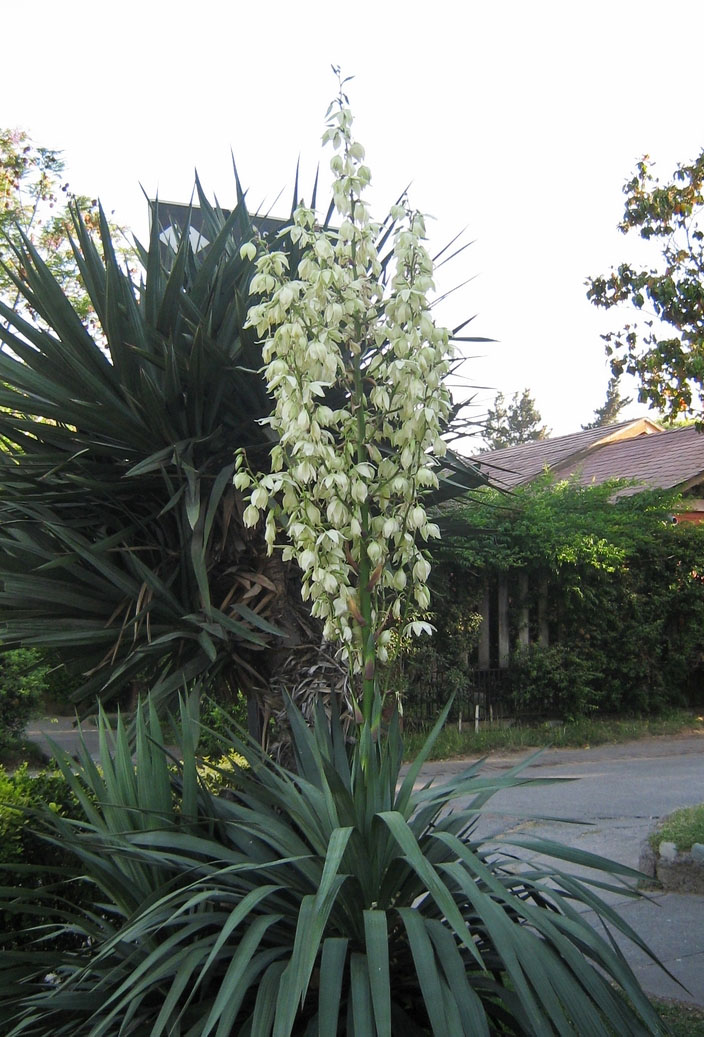
Photo: Penarc, CC BY-SA 4.0 · source

Shrub · Asparagaceae
Spanish dagger
Yucca gloriosa
In other languages: Palmlelie (Nederlands) · Yucca (Français)
Spanish dagger comes from the south-eastern United States, where it grows on sandy coastal dunes. It is an evergreen plant with stiff, sword-shaped, dark blue-green leaves ending in a sharp point, which together form a large rosette. In August–September an impressive flower stem of about 2 m appears, bearing nodding, creamy-white bell-shaped flowers. It tolerates drought and wind and is hardy to about −15 °C, as long as it does not stand in wet soil. That makes it a strong eye-catcher for a sunny terrace, a gravel garden or a Mediterranean corner.
Caution: The leaf tips are hard and sharp and can cause deep wounds and eye injuries, especially to children. Do not plant it beside a path or play area, wear gloves and safety goggles when tidying and do not let children or pets chew on the plant.
Light
Full sun
warm and bright
Moisture
Dry
tolerates drought
Legal basis
Sand, loam or clay
any pH
Hardiness
down to -15 °C
protect young plants
Size
2 m
tall, 1.5 m wide
Flowering
August–September
| Height | 2 m |
|---|---|
| Native to Belgium | No, planted |
| Poisonous to people and pets | Not known to be poisonous |
| Flowering | August–September |
Identify
Spanish dagger: how do you recognise it?
- Habit
- Evergreen rosette plant, 1.5–2 m high and 1–1.5 m wide. Over the years it forms a short trunk and offsets.
- Leaves
- Stiff and sword-shaped, 40–60 cm long, dark blue-green, ending in a hard, sharp point.
- Flowers
- Upright panicle of about 2 m with nodding, creamy-white bell-shaped flowers in August–September. Young plants only flower after a few years.
- Roots
- Deep, fleshy and strong. Pieces of root left in the ground can resprout.
Flowering: August–September · Plants: April–May
In your garden
Why grow it?
- An architectural plant that is green all year round, even in winter.
- Impressive flowering in August–September: a tall panicle of creamy-white bells.
- Tolerates drought, heat and wind.
- Little work: no pruning, little water and hardly any feeding.
- Lovely in a pot, on a terrace and in gravel or Mediterranean-style gardens.
Spanish dagger: where does it grow best?
- Full sun, in a warm, sheltered spot, preferably against a south-facing wall.
- Well-drained sandy or loamy soil, acid to chalky. Poor soil is fine; make clay soil free-draining with coarse sand or grit.
- Dry: it tolerates drought very well, but not wet feet, especially in winter.
- Do not plant it beside a path or play area, because the sharp leaf tips can cause injuries.
- Allow 1.5 m of space per plant.
- Light
- Sun
- Soil type
- Sand, loam or clay
- Acidity
- Not fussy
- Moisture
- Dry
- Size
- 2 m tall, 1.5 m wide
- Hardiness
- Hardy (to -15 °C)
Goes well with
- Lavender: Same sun and dry soil, with a soft colour next to the stiff leaves.
- Stonecrop: A low, drought-tolerant ground cover in the sun.
- Sea holly: Blue, spiny flowers in the same warm style.
- Ornamental grasses: Soft plumes contrast with the stiff leaves.
Maintenance
Spanish dagger: when and how to plant it?
Plant in April–May.
- Plant in April–May so that it can root well before winter.
- Choose a sunny, well-drained spot, preferably on a slight slope or mound.
- Dig a hole twice as wide as the root ball; in heavy soil, mix plenty of coarse sand or grit into the soil.
- Set the plant at the same depth as in its pot and firm the soil. Do not let the crown disappear below ground.
- Water thoroughly straight away, then in the first year only during prolonged drought.
- Spread a thin layer of gravel or chippings around the base; do not pile wet mulch against the stem.
Care
- Water
- In the first year only during prolonged drought, after that rarely. Too much water is worse than too little.
- Feeding
- Hardly needed: a little compost or slow-release fertiliser in May is enough.
- Tidying
- In spring, remove withered lower leaves: pull them off or cut them off. Wear gloves and goggles.
- Spent flowers
- After flowering, cut the flower stem back to the rosette. The rosette that has flowered usually dies; the offsets take over.
- Repotting
- In a pot: a wide, heavy pot with drainage holes and a very sandy mix. Repot every 2–3 years in spring.
Tip: Plant it on a slightly raised, sunny spot with free-draining soil: wet feet in winter are more dangerous than cold. Keep it away from paths, because the tips are sharp.
Spanish dagger: when to prune it?
When: It is not pruned, but you do tidy up: the withered leaves in spring and the flower stem after flowering.
How:
- Pull or cut off withered, brown lower leaves in spring.
- Cut the faded flower stem back to the rosette in September–October.
- Remove a rosette that has flowered and is dying with a saw or sharp knife, so the offsets have room.
- Wear gloves and safety goggles: the leaf tips are sharp.
Caution: The leaf tips are hard and sharp: protect your eyes and hands.
Propagation
- Offsets
- In April–May, detach an offset with a little root from the mother plant with a sharp knife or spade and pot it in sandy compost. Keep the soil slightly moist until it establishes.
- Stem cuttings
- A sawn-off piece of trunk with a bud can root in warm, sandy soil. Let the cut dry for a few days first. Rooting can take weeks to months.
Spanish dagger: how does it get through the winter?
Hardy to −15 °C: protect young plants.
- Hardy to about −15 °C. It is not the cold but the combination of wet soil and frost that is most dangerous.
- Plant it in a free-draining spot and do not let water stand around the base in winter.
- In severe frost, tie the leaves together and protect the rosette with fleece or hessian against rain and frost.
- In a pot: put it in a bright, frost-free place (about 0–10 °C) and water very little.
Diseases and pests
- Rot: Yellowing, floppy leaves and a soft base after a wet winter or in compacted soil. Provide a free-draining spot, do not overwater and cut away rotten parts.
- Brown leaf tips: Usually frost damage or a cold, wet winter. Cut off brown parts in spring; new leaves grow out healthy from the heart.
- Few flowers: Young plants only flower after a few years; too little sun or a cool summer also prevents flowering. Give it full sun and patience.
- Mealybug and scale: White cottony clumps or brown scales between the leaves, especially on potted plants. Wipe them off with a soft brush and soapy water and rinse.
Through the year
- March: Remove winter protection. Remove withered leaves.
- April: Plant. Take offsets.
- May: Plant. Water now and then during prolonged drought.
- June: Leave in the sun; hardly any water.
- July: Almost nothing to do; the flower stem grows.
- August: Flowering starts: tall panicle of creamy-white bells.
- September: Flowering. Cut off the faded stem.
- October: Cut off the stem; bring potted plants indoors.
- November: Have fleece or hessian ready against wet frost.
- December: Rest.
You and this species
Did you know?
- In its homeland, yucca flowers are pollinated by yucca moths. They are absent here, which is why it rarely sets seed in our gardens.
- It belongs to the asparagus family (Asparagaceae), like asparagus, agave and hyacinth.
- In the wild it often grows on sandy coastal dunes in the south-eastern United States, which explains why it prefers dry, sandy soil.