Side by side
Spotted laurel or Japanese aralia? How to tell them apart
Aucuba japonica · Fatsia japonica
How to tell them apart – spotted laurel: evergreen shade shrub with large, glossy, often yellow-speckled leaves and green twigs; Japanese aralia: huge, palmately lobed leaves.
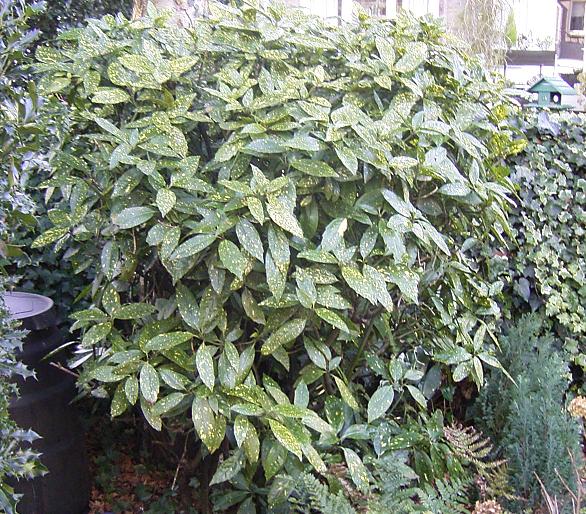


How do you recognise them?
- Spotted laurel
- Evergreen shade shrub with large, glossy, often yellow-speckled leaves and green twigs.
- Japanese aralia
- Evergreen shrub with huge, glossy, palmately lobed leaves and, in autumn, little balls of white flowers.
- Compared with spotted laurel: huge, palmately lobed leaves.
| Spotted laurel | Japanese aralia | |
|---|---|---|
| Leaves | Opposite, 8–20 cm, elliptic, coarsely toothed in the upper half, leathery and glossy; spotted with yellow in many garden forms. | Alternate, 20–40 cm across, palmate with 7–9 deep lobes, leathery and glossy, on a long stalk. |
| Flowering | Small, purplish-brown flowers in upright clusters in March–April; male and female on separate plants (March–April). | Spherical umbels of creamy white flowers in large clusters, in October–November (October–November). |
| Fruit | Glossy scarlet, elongated berries (about 1.5 cm) on female plants, all winter long; poisonous. | Black berries in late winter and spring. |
| Bark | Thick, bright green twigs, even in winter. | Thick, sparsely branched stems with large leaf scars. |
| Shape and height | Shrub, 1.5–3 m | Shrub, 2–4 m |
| Site | Partial shade or shade, any garden soil, normal | Partial shade or shade, any garden soil, normal |
| Native to Belgium | No, planted | No, planted |
| Good for bees, butterflies and birds | – | – |
| Poisonous to people and pets | Yes, take care with children and pets | Not known to be poisonous |
| Pruning months | April–May | April–May |
What does it mean for your garden?
- Spotted laurel is poisonous to people and pets: take care with children and animals.
Read on
- Plant profile: Spotted laurel
- Plant profile: Japanese aralia
- Spotted laurel: when and how to prune
- Japanese aralia: when and how to prune
- Identification key
Also looks like
This comparison is compiled from the Bladwijzer species pages.