Photo: TeunSpaans, CC BY-SA 3.0 · source

Shrub · Silk-tassel family (Garryaceae)
Spotted laurel
Aucuba japonica · also: Japanese laurel, Aucuba
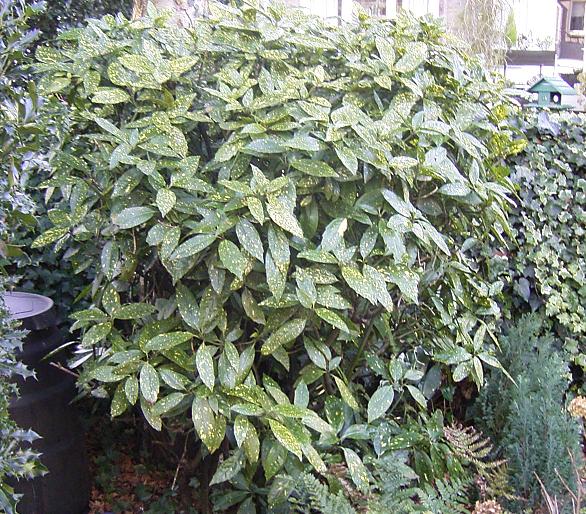
Spotted laurel is a tough evergreen shrub of 1.5–3 m for shade. It has large, glossy leaves, speckled with yellow in many garden forms, on thick green twigs. Male and female flowers grow on separate plants: only female plants bear glossy red berries in winter, and then only with a male nearby. It grows even in deep shade under trees and in dark town gardens. The berries and leaves are poisonous.
Caution: The berries and leaves are poisonous: they can cause stomach ache, vomiting and diarrhoea. Keep young children and pets away from the red berries.
Light
Partial shade or shade
tolerates little sun
Moisture
Normal
no wet feet
Legal basis
Any garden soil
any pH
Hardiness
Throughout Belgium
no protection needed
Size
1.5–3 m
tall
Flowering
March–April
| Pruning months | April–May |
|---|---|
| Height | 1.5–3 m |
| Native to Belgium | No, planted |
| Poisonous to people and pets | Yes, take care with children and pets |
| Flowering | March–April |
Identify
Spotted laurel: how do you recognise it?
- Habit
- Rounded, dense evergreen shrub of 1.5–3 m.
- Leaf
- Opposite, 8–20 cm, elliptic, coarsely toothed in the upper half, leathery and glossy; spotted with yellow in many garden forms.
- Twigs
- Thick, bright green twigs, even in winter.
- Flower
- Small, purplish-brown flowers in upright clusters in March–April; male and female on separate plants.
- Fruit
- Glossy scarlet, elongated berries (about 1.5 cm) on female plants, all winter long; poisonous.
- Difference from cherry laurel
- Cherry laurel has alternate leaves with an (almost) untoothed edge, white flower spikes and black cherries.
- Difference from Japanese aralia
- Japanese aralia has huge, palmately lobed leaves.
Flowering: March–April · Pruning: April–May
Identify by feature: Evergreen leaves · Red berries
Looks like it, but isn’t
- Cherry laurel Prunus laurocerasus: alternate leaves with an (almost) untoothed edge, white flower spikes and black cherries. Difference from cherry laurel
- Japanese aralia Fatsia japonica: huge, palmately lobed leaves. Difference from Japanese aralia
In your garden
Why grow it?
- Grows in deep shade, where little else will grow, even under trees.
- Evergreen, with yellow-speckled leaves that brighten a dark corner.
- Red berries all winter on female plants.
- Tough: tolerates town air, dry shade and little care.
Spotted laurel: where does it grow best?
- Partial to deep shade; in full sun the leaves scorch.
- Any free-draining soil, acid or chalky; no wet feet.
- Copes with dry shade under trees and the sheltered, dark corner of a town garden.
- Allow 2 m width.
- Light
- Partial shade or shade
- Legal basis
- Any garden soil
- Moisture
- Normal
- Size
- 2.5 m tall, 2 m wide
- Hardiness
- Throughout Belgium, no protection needed
Goes well with
- Holly: Another evergreen for shade; together a dark green backdrop with red berries in winter.
- Japanese skimmia: Another evergreen shade shrub, with red berries or buds in winter.
- Oregon grape: Yellow flowers in winter next to the speckled leaves, in the same shade.
Good and bad companions
Goes well with
- Tolerates shade and suits planting under large trees such as: ginkgo, box elder, ash, honey locust, field maple, silver maple
Maintenance
Spotted laurel: when and how to plant it?
- Plant in spring (April–May) or early autumn (September–October), root-balled or from a pot.
- For berries, plant a female with a male nearby, or choose a variety that bears berries on its own, such as ‘Rozannie’.
- Dig a generous planting hole and mix in a little compost.
- Water generously after planting and in dry spells during the first year.
Care
- Watering
- In dry spells during the first year; after that rarely needed, except in a pot.
- Feeding
- A little compost in spring.
- Mulch
- A layer of leaf mould keeps the soil under trees moist.
- Berries
- Leave them: they colour the shrub all winter, but keep an eye on small children.
Tip: A variegated spotted laurel lights up a dark corner like a lamp: put it against a wall in the shade or under trees, not in the sun.
Spotted laurel: when to prune it?
Pruning months: April–May.
When: In April–May.
How:
- Cut overlong branches back with secateurs to just above a leaf: leaves cut through with hedge shears turn brown at the edges.
- A shrub that has grown too big or bare can be cut back hard; it sprouts again from old wood.
- Prune female plants sparingly: every branch you remove will bear no more berries.
Caution: April–May falls in the nesting season: check for nesting birds in the shrub before you prune.
Propagation
- Cuttings
- Semi-ripe cuttings of 10–15 cm root readily in late summer in a pot under glass or plastic. A cutting is male or female, like its parent plant.
Spotted laurel: how does it get through the winter?
Hardy throughout Belgium: no protection needed.
- Hardy in Belgium and the Netherlands.
- In hard frost, leaves and shoot tips may turn black; cut them off in April and the shrub will sprout again.
- On female plants the red berries last all winter.
Diseases and pests
- Scorched leaves: Brown or black patches on the leaves in full sun. Move it to a shadier spot.
- Black shoot tips: After hard frost or on wet soil, shoot tips and leaves turn black. Cut them off and make sure the soil drains well.
- No berries: Only female plants bear berries, and then only with a male nearby.
Through the year
- January: Red berries on female plants.
- March: Flowering: small purplish-brown flowers.
- April: Prune; cut off frost damage; plant.
- May: Last pruning month; plant.
- August: Take semi-ripe cuttings.
- September: Plant root-balled or pot-grown plants.
- November: The berries turn red.
Use
What can you use it for?
- Garden and landscape
- Tough evergreen shrub for deep shade, even under trees and in town gardens.
Caution: The berries and leaves are poisonous.
You and this species
Did you know?
- The first shrubs in Europe were all female and never bore berries; only when plant hunter Robert Fortune brought male plants from Japan around 1860 did the red berries appear.
- In the 19th century it became a favourite of town gardens: it put up with soot, smoke and shade.