Side by side
White bryony or hop? How to tell them apart
Bryonia dioica · Humulus lupulus
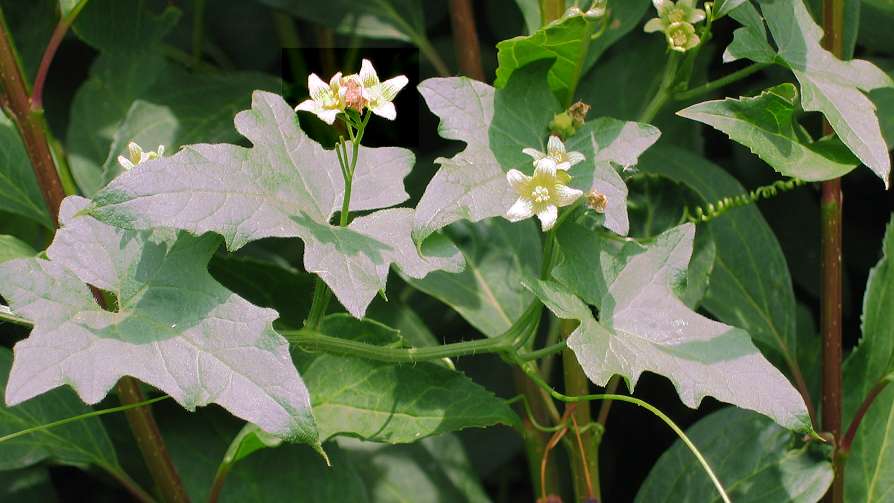
How to tell them apart – white bryony: climbs with curly tendrils and has alternate leaves and red berries; hop: opposite leaves, no tendrils, and green hop cones.


How do you recognise them?
- White bryony
- Herbaceous climber with curly tendrils, palmately lobed, rough leaves and, in autumn, clusters of red berries.
- Compared with hop: climbs with curly tendrils and has alternate leaves and red berries.
- Hop
- Rough twining climber with opposite, vine-like lobed leaves and, in late summer, green ‘hop cones’.
- Compared with white bryony: opposite leaves, no tendrils, and green hop cones.
| White bryony | Hop | |
|---|---|---|
| Leaves | Alternate, 5–10 cm, palmately 5-lobed and rough-hairy; a tendril next to each leaf. | Opposite, 10–15 cm, palmately 3–5-lobed (sometimes unlobed near the top), coarsely toothed and rough. |
| Flowering | Dioecious: greenish-white flowers (1–2 cm) with green veins; male ones in long-stalked clusters, female ones smaller and short-stalked, May–September (June–August). | Dioecious: male plants with loose panicles of small yellowish-green flowers, female plants with green, cone-shaped flower heads, July–August (July–August). |
| Fruit | Red berries (6–8 mm) in clusters on female plants, August–October; very poisonous. | Hop cones: pale green little cones (2–4 cm) of overlapping scales with yellow, bitter-smelling glands (lupulin), August–September. |
| Bark | Thin, rough-hairy stems that die back every year, growing from a thick, whitish, tuberous root. | Angular stems with hooked hairs that feel rough; they die back in autumn and regrow from the rootstock every spring. |
| Shape and height | Climber, climbs to 2–4 m | Climber, twines 4–8 m every year |
| Site | Sun or partial shade, any garden soil, normal | Sun or partial shade, any garden soil, normal |
| Native to Belgium | Yes | Yes |
| Good for bees, butterflies and birds | – | – |
| Poisonous to people and pets | Yes, take care with children and pets | Not known to be poisonous |
| Pruning months | November–March | November–March |
What does it mean for your garden?
- White bryony is poisonous to people and pets: take care with children and animals.
- Both are native and good for wildlife: choose what suits your soil, your light and the space you have.
Read on
- Plant profile: White bryony
- Plant profile: Hop
- White bryony: when and how to prune
- Hop: when and how to prune
- Identification key
Also looks like
This comparison is compiled from the Bladwijzer species pages.