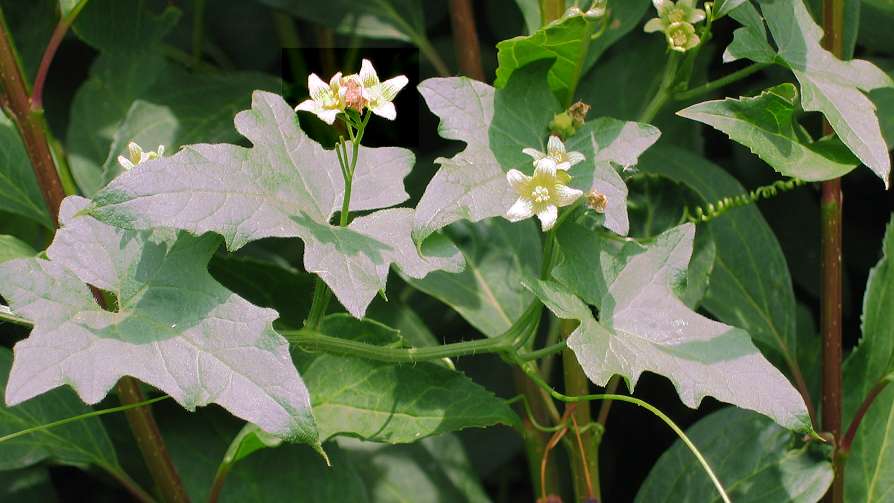
Photo: Wikimedia Commons, CC BY-SA 3.0 · source

Climber · Gourd family (Cucurbitaceae)
White bryony
Bryonia dioica · also: Bryony
White bryony is a native, herbaceous climber that hauls itself up to 2–4 m through hedges, thickets and fences with curly tendrils. Every year its stems die back and regrow in spring from a thick, whitish, tuberous root. From May to September it bears small greenish-white flowers, and in autumn clusters of red berries hang on the female plants. It is essential for the bryony mining bee, but the whole plant is very poisonous, especially the berries and the root.
Caution: The whole plant is very poisonous to people, pets and livestock, especially the berries and the tuberous root: they cause violent vomiting, diarrhoea and stomach cramps. The red berries are tempting to children. The sap irritates the skin and can cause blisters: wear gloves.
Light
Sun or partial shade
preferably some sun
Moisture
Normal
no wet feet
Legal basis
Any garden soil
any pH
Hardiness
Throughout Belgium
no protection needed
Size
climbs to 2–4 m
tall
Flowering
June–August
| Pruning months | November–March |
|---|---|
| Height | climbs to 2–4 m |
| Native to Belgium | Yes |
| Poisonous to people and pets | Yes, take care with children and pets |
| Flowering | June–August |
Identify
White bryony: how do you recognise it?
- Habit
- Herbaceous climber of 2–4 m with curly tendrils, which dies back every year and regrows from a tuberous root.
- Leaf
- Alternate, 5–10 cm, palmately 5-lobed and rough-hairy; a tendril next to each leaf.
- Stems and root
- Thin, rough-hairy stems that die back every year, growing from a thick, whitish, tuberous root.
- Flower
- Dioecious: greenish-white flowers (1–2 cm) with green veins; male ones in long-stalked clusters, female ones smaller and short-stalked, May–September.
- Fruit
- Red berries (6–8 mm) in clusters on female plants, August–October; very poisonous.
- Difference from hop
- Hop has opposite leaves, no tendrils, and green hop cones.
- Difference from black bryony
- Black bryony (Dioscorea communis) has glossy, heart-shaped leaves without lobes and no tendrils; it also has red berries.
Flowering: June–August · Pruning: November–March
Identify by feature: Red berries
Looks like it, but isn’t
- Hop Humulus lupulus: opposite leaves, no tendrils, and green hop cones. Difference from hop
- Black bryony (Dioscorea communis): glossy, heart-shaped leaves without lobes and no tendrils; also has red berries.
In your garden
Why grow it?
- Belongs in a natural hedge or woodland edge, where it often turns up by itself.
- The bryony mining bee collects pollen only from this plant: no bryony, no bryony mining bee.
- The red berries are food for birds in autumn.
- Dies back every winter, so it puts hardly any load on its support.
White bryony: where does it grow best?
- Sun to partial shade, in a hedge, thicket or woodland edge.
- Any soil, preferably rich, that is not too wet.
- It climbs with curly tendrils that wind around twigs, mesh and wire. It cannot climb a bare wall and does not damage walls, gutters or trees.
- It can smother small shrubs in summer; in a sturdy hedge it does little harm, as it dies back every winter.
- Not where small children play or where pets or livestock can reach the berries.
- Light
- Sun or partial shade
- Legal basis
- Any garden soil
- Moisture
- Normal
- Size
- 3 m tall, 1 m wide
- Hardiness
- Throughout Belgium, no protection needed
Goes well with
- Hawthorn: A sturdy, native hedging shrub that white bryony climbs through, as in the wild.
- Blackthorn: Together a wild hedge with blossom in March and berries for birds in autumn.
- Dog rose: A native shrub for the same hedge, with pink flowers in June and hips in autumn.
Good and bad companions
Goes well with
- Suits the woodland edge or the light shade of: ginkgo, box elder, ash, honey locust, field maple, silver maple
- Can climb into old, large trees: english oak, scots pine, sycamore, large-leaved lime
Maintenance
White bryony: when and how to plant it?
- It is rarely sold: it usually arrives by itself, as birds spread the seeds.
- To sow it, sow fresh seeds outdoors in autumn at the foot of a hedge; they germinate erratically.
- Choose a spot in a natural hedge or woodland edge, away from play areas.
- Leave a plant that has come up in a good spot where it is: the deep tuber makes it hard to move.
Care
- Watering
- Not needed.
- Feeding
- Not needed.
- Keeping it in check
- In summer, pull stems out of shrubs that it is smothering too much; wear gloves.
- Seedlings
- Birds spread the seeds: pull up unwanted seedlings while young, before a large tuber has formed.
Tip: Only female plants bear berries, and only male plants produce pollen. If it grows along a path or play area, keep a male plant if you can: the bryony mining bee gets its pollen, and there are no poisonous berries.
White bryony: when to prune it?
Pruning months: November–March.
When: In winter, once the stems have died back.
How:
- No pruning needed: the stems die back every year.
- Clear away the dead stems, or leave them for overwintering insects.
- To get rid of it, dig out the tuberous root.
Caution: Wear gloves: the sap and berries are poisonous.
Propagation
- Sowing
- Sow fresh seeds from ripe berries outdoors in autumn; they germinate in spring, often erratically. Wash your hands afterwards.
White bryony: how does it get through the winter?
Hardy throughout Belgium: no protection needed.
- Fully hardy: the tuberous root survives in the ground.
- The stems die back in autumn; new shoots appear in spring.
Diseases and pests
- Poisonous berries: Red berries at a child’s eye level, in a hedge along a path or play area. Cut off the stems with berries or remove the plant.
- Unwanted plants: Seedlings or old plants where you don’t want them. Pull up seedlings while young; with older plants you have to dig out the tuber, as cutting alone doesn’t help.
- Smothered shrubs: Small shrubs under a dense mat of stems in summer. Pull away some of the stems, wearing gloves.
Through the year
- January: Cut off dead stems or leave them standing; real pruning is not needed.
- February: Clear away dead stems; dig out unwanted tubers.
- March: Last clear-up, before the new shoots come up.
- April: New shoots climb through the hedge with their curly tendrils.
- May: Flowering begins: the bryony mining bee is on the wing.
- July: Flowering; pull up seedlings in unwanted places.
- September: Red berries: keep children and pets away.
- November: The stems die back: cut them off or leave them; sowing.
- December: Clear away dead stems or leave them for insects.
Use
What can you use it for?
- For wildlife
- The bryony mining bee (Andrena florea) collects pollen only from this plant; birds eat the berries.
- Garden and landscape
- Belongs in a natural hedge or woodland edge; dies back every winter.
Caution: The whole plant is very poisonous, especially the berries and the root; the sap can irritate the skin.
You and this species
Did you know?
- The only native member of the gourd family in our region. Its large root used to be sold as ‘mandrake’: a fake version of the magical plant.
- The bryony mining bee collects pollen only from this plant: where white bryony grows, you can see it on the male flowers in summer.
- ‘Dioica’ means dioecious: male and female flowers grow on separate plants.