Side by side
Common dogwood or spindle? How to tell them apart
Cornus sanguinea · Euonymus europaeus
How to tell them apart – common dogwood: curved veins and red twigs; spindle: shrub with square green twigs and striking pink fruits with orange seeds.

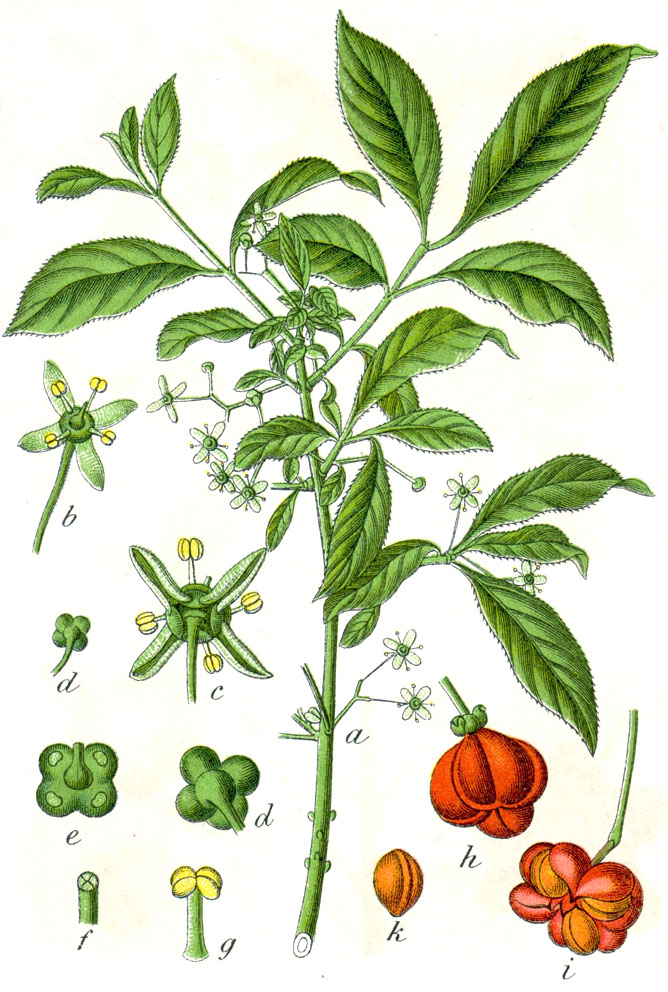


How do you recognise them?
- Common dogwood
- Shrub with red twigs in winter and leaf veins that curve towards the tip.
- Compared with spindle: curved veins and red twigs.
- Spindle
- Shrub with square green twigs and striking pink fruits with orange seeds.
| Common dogwood | Spindle | |
|---|---|---|
| Leaves | Opposite, oval, 4–8 cm, untoothed, with curved veins. Tear a leaf gently and thin white threads stay hanging between the pieces. Wine-red autumn colour. | Opposite, oval to lance-shaped, 5–8 cm, finely toothed; red autumn colour. |
| Flowering | Flat heads of small white flowers in June (May–June). | Inconspicuous greenish-yellow flowers in May (May–June). |
| Fruit | Bluish-black berries, not edible. | Pink, four-lobed capsules that split open to reveal orange seeds (autumn); poisonous. |
| Bark | Twigs blood-red on the sunny side, especially in winter. | Young twigs green and square, often with corky ridges. |
| Shape and height | Shrub, 2–4 m | Shrub, 2–5 m |
| Site | Sun or partial shade, any garden soil, normal | Sun or partial shade, any garden soil, normal |
| Native to Belgium | Yes | Yes |
| Good for bees, butterflies and birds | Yes, for bees and birds | Yes, for butterflies and birds |
| Poisonous to people and pets | Not known to be poisonous | Yes, take care with children and pets |
| Pruning months | February–March | November–March |
What does it mean for your garden?
- Spindle is poisonous to people and pets: take care with children and animals.
- Both are native and good for wildlife: choose what suits your soil, your light and the space you have.
Read on
- Plant profile: Common dogwood
- Plant profile: Spindle
- Common dogwood: when and how to prune
- Spindle: when and how to prune
- Identification key: the question that separates them
Also looks like
This comparison is compiled from the Bladwijzer species pages.