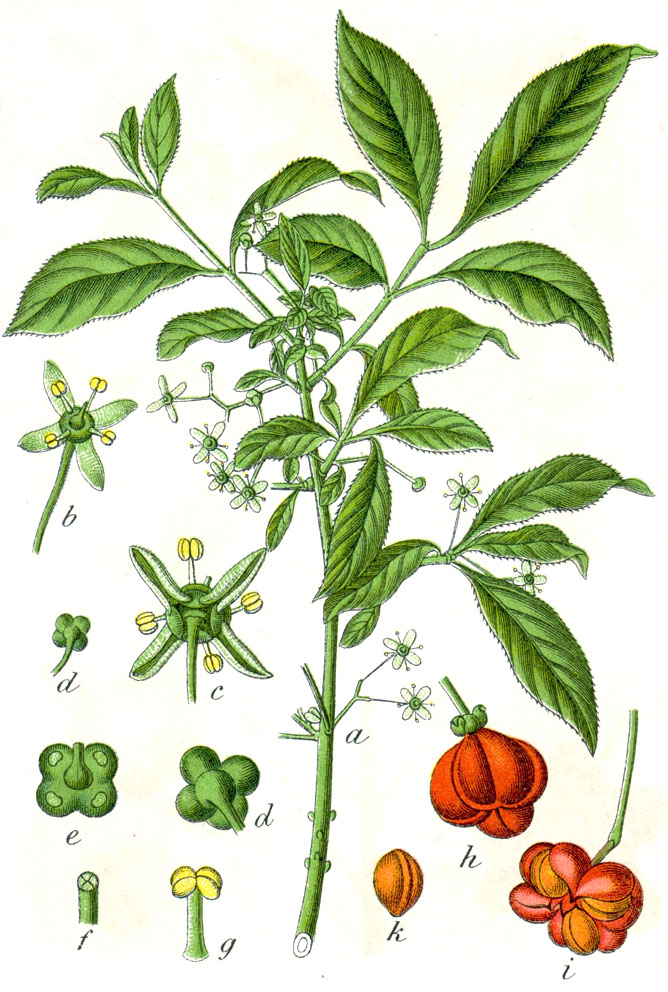
Photo: Johann Georg Sturm (Painter: Jacob Sturm), Public domain · source

Shrub · Spindle family (Celastraceae)
Spindle
Euonymus europaeus · also: Spindle tree
Spindle is a native shrub of 2–5 m that blazes in autumn: its leaves turn red and its pink, four-lobed fruits split open to reveal bright orange seeds. In Dutch it is named after them, as the fruit looks like a cardinal’s hat. The young twigs are green and square. It likes chalky soil, in sun or partial shade, and fits nicely into a mixed hedge. All parts are poisonous.
Caution: All parts are poisonous, especially the eye-catching fruits and seeds: they cause vomiting and severe diarrhoea, and in larger amounts heart problems too. The shrub is also dangerous for dogs, cats, horses and livestock. Don’t plant it where young children play or alongside a field.
Light
Sun or partial shade
preferably some sun
Moisture
Normal
no wet feet
Legal basis
Any garden soil
neutral to chalky
Hardiness
Throughout Belgium
no protection needed
Size
2–5 m
tall
Flowering
May–June
| Pruning months | November–March |
|---|---|
| Height | 2–5 m |
| Native to Belgium | Yes |
| Good for bees, butterflies and birds | Yes, for butterflies and birds |
| Poisonous to people and pets | Yes, take care with children and pets |
| Flowering | May–June |
Identify
Spindle: how do you recognise it?
- Habit
- Shrub or small tree of 2–5 m, upright with a loose crown.
- Leaf
- Opposite, oval to lance-shaped, 5–8 cm, finely toothed; red autumn colour.
- Bark
- Young twigs green and square, often with corky ridges.
- Flower
- Inconspicuous greenish-yellow flowers in May.
- Fruit
- Pink, four-lobed capsules that split open to reveal orange seeds (autumn); poisonous.
- Difference from common dogwood
- Common dogwood has curved veins and red twigs.
Flowering: May–June · Pruning: November–March
Identify by feature: Red autumn colour · Orange berries
Looks like it, but isn’t
- Common dogwood Cornus sanguinea: curved veins and red twigs. Difference from common dogwood
In your garden
Why grow it?
- Pink fruits with orange seeds and red autumn colour.
- Native: flowers for insects, seeds for robins.
- Needs little pruning and is easy in a mixed hedge.
Spindle: where does it grow best?
- Sun to partial shade; in sun the autumn colour and fruits are at their best.
- Ideally chalky, fertile soil that doesn’t dry out; no wet feet.
- Allow 3 m width.
- Not where young children play, alongside a field with livestock or right next to the vegetable garden.
- Light
- Sun or partial shade
- Legal basis
- Any garden soil
- Moisture
- Normal
- Size
- 5 m tall, 3 m wide
- Hardiness
- Throughout Belgium, no protection needed
Goes well with
- Guelder rose: Red berries next to pink fruits: a riot of autumn colour in a mixed hedge.
- Hazel: A native shrub for the same hedge, with catkins in winter.
- Wild privet: Black berries and scented flowers, on the same chalky soil.
- Field maple: Yellow autumn colour next to the red leaves of the spindle.
Good and bad companions
Goes well with
- Together a mixed native hedge, good for birds and insects: hawthorn, blackthorn, hazel, dog rose, common dogwood, guelder rose, wild privet, field maple
Maintenance
Spindle: when and how to plant it?
- Plant from November to March, bare-root or root-balled.
- In a mixed hedge or hedgerow: one plant every 1–1.5 m among other native shrubs.
- Plant at the same depth as before and firm the soil.
- Water in dry spells during the first year.
Care
- Watering
- In dry spells during the first year; hardly at all after that.
- Feeding
- Not needed; a little compost on poor soil.
- Checking
- In May–June, look for spindle ermine webbing and black aphids (see problems).
- Fruits
- Leave them for the birds, but keep children away.
Tip: Plant it where the autumn sun falls on it, ideally in front of a dark background such as a holly hedge: the pink fruits and red leaves will really light up.
Spindle: when to prune it?
Pruning months: November–March.
When: Dead, diseased and broken branches can be removed at any time of year. If pruning is needed, do it during winter dormancy (November–March).
How:
- Needs little pruning; thin out old branches in winter.
- Every few years, saw one of the oldest stems off at the base so that young shoots can come through.
- Wear gloves and clear up the prunings: the twigs and leaves are poisonous too.
Caution: Finish the winter pruning before mid-March, when the nesting season starts.
Propagation
- Sowing
- Sow the orange seeds, cleaned of their fleshy coat, outdoors in autumn; they often take a year and a half to germinate. Wear gloves.
- Cuttings
- Semi-ripe cuttings of 10–15 cm root in July under glass or plastic.
Spindle: how does it get through the winter?
Hardy throughout Belgium: no protection needed.
- Fully hardy.
- The split fruits often hang on into winter, as colourful food for robins and other birds.
Diseases and pests
- Spindle ermine: In May–June the shrub can be completely covered in webbing and stripped bare by the caterpillars of the spindle ermine moth. Spectacular but harmless: it releafs in July. If you like, cut out the first webs.
- Black bean aphid: Spindle is the winter host of the black bean aphid: in spring the shoot tips are covered in black aphids, which then move on to broad beans and other plants. So don’t plant it right next to the vegetable garden.
- Few fruits: Too much shade gives few flowers and fruits; give it more sun.
Through the year
- January: Winter pruning: thin out the oldest stems.
- February: Pruning and planting.
- March: Finish pruning before mid-March; last month for planting.
- May: Flowering; watch for spindle ermine webbing and aphids.
- July: Stripped shrubs releaf.
- September: Autumn colour begins; the fruits turn pink.
- October: Fruits split open: orange seeds for robins.
- November: Planting; winter pruning can start.
- December: Winter pruning.
Use
What can you use it for?
- Garden and landscape
- Native shrub for a mixed hedge, with superb autumn colour and fruit.
- For wildlife
- Robins eat the seeds.
Caution: All parts are poisonous: don’t plant it where young children play.
Good for wildlife
- Birds
- Berries, seeds or insects as food, or a place to nest.
- Caterpillars
- Host plant: caterpillars of butterflies or moths eat the leaves.
- Hoverflies
- Open flowers for hoverflies; many of their larvae eat aphids.
You and this species
Did you know?
- The fruit looks like a cardinal’s hat. All parts are poisonous.
- Its hard, fine-grained wood was once used to make spindles for spinning wool: hence the English name.
- Charred twigs gave drawing charcoal; in French, drawing charcoal is still called ‘fusain’.
- Its hard, fine-grained wood was once used for spindles to spin wool, hence the English name. The French word fusain is also the name of the drawing charcoal made from its wood.
- In May and June the shrubs are sometimes completely wrapped in webs spun by caterpillars of the spindle ermine moth. It looks dramatic, but the shrub simply puts out new leaves afterwards.