Side by side
Flowering quince or firethorn? How to tell them apart
Chaenomeles · Pyracantha
How to tell them apart – flowering quince: thorny shrub that flowers in March–April on bare twigs in red, orange, pink or white, followed by hard, fragrant little quinces; firethorn: evergreen, with white flower heads and clusters of small berries.
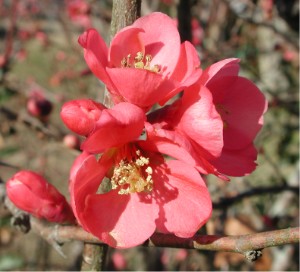


How do you recognise them?
- Flowering quince
- Thorny shrub that flowers in March–April on bare twigs in red, orange, pink or white, followed by hard, fragrant little quinces.
- Firethorn
- Evergreen, thorny shrub with masses of orange, red or yellow berries in autumn.
- Compared with flowering quince: evergreen, with white flower heads and clusters of small berries.
| Flowering quince | Firethorn | |
|---|---|---|
| Leaves | Alternate, 3–8 cm, oval, finely toothed and glossy; vigorous shoots often have large, kidney-shaped stipules. | Alternate, small (2–5 cm), glossy and finely toothed. |
| Flowering | Cup-shaped flowers (3–5 cm) in clusters on the old wood, from March to May, often before the leaves; scarlet, orange, pink or white (March–May). | Clusters of white flowers in May–June (May–June). |
| Fruit | Hard, apple-like, yellowish-green fruits (3–6 cm) that smell strongly in autumn; too sour raw, but good for jelly. | Orange, red or yellow berries in dense clusters, lasting well into winter. |
| Bark | Tangled, greyish-brown branches with short spines. | Branches with sharp thorns. |
| Shape and height | Shrub, 1–2.5 m | Shrub, 2–4 m |
| Site | Sun or partial shade, any garden soil, normal | Sun or partial shade, any garden soil, normal |
| Native to Belgium | No, planted | No, planted |
| Good for bees, butterflies and birds | – | Yes, for bees and birds |
| Poisonous to people and pets | Not known to be poisonous | Not known to be poisonous |
| Pruning months | May–June | May–August |
What does it mean for your garden?
- Choose what suits your soil, your light and the space you have: see the growing conditions in the table.
Read on
- Plant profile: Flowering quince
- Plant profile: Firethorn
- Flowering quince: when and how to prune
- Firethorn: when and how to prune
- Identification key
Also looks like
- Quince or flowering quince
- Cotoneaster or firethorn
- Hawthorn or firethorn
- Midland hawthorn or firethorn
Identify by feature
This comparison is compiled from the Bladwijzer species pages.