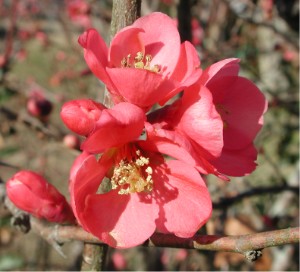
Photo: Wikimedia Commons, CC BY-SA 3.0 · source

Shrub · Rose family (Rosaceae)
Flowering quince
Chaenomeles · also: Japanese quince, Japonica, Chaenomeles
Flowering quince, or Japanese quince, is a thorny shrub of 1–2.5 m from China and Japan. As early as March–April, often before the leaves, its bare branches are covered in cup-shaped flowers in scarlet, orange, pink or white. In autumn come hard, yellowish-green little quinces with a wonderful scent, delicious in jelly. It grows in sun and partial shade in any good soil, is ideal against a wall or as a low, thorny hedge, and gives queen bumblebees early nectar.
Caution: Flowering quince is a host plant of fireblight, a serious bacterial disease of pear, apple, hawthorn and quince, among others. If there are fruit trees nearby, keep a close eye on it and remove affected branches immediately.
Light
Sun or partial shade
preferably some sun
Moisture
Normal
no wet feet
Legal basis
Any garden soil
any pH
Hardiness
Throughout Belgium
no protection needed
Size
1–2.5 m
tall
Flowering
March–May
| Pruning months | May–June |
|---|---|
| Height | 1–2.5 m |
| Native to Belgium | No, planted |
| Poisonous to people and pets | Not known to be poisonous |
| Flowering | March–May |
Identify
Flowering quince: how do you recognise it?
- Habit
- Broad, dense shrub of 1–2.5 m with tangled, thorny branches.
- Leaf
- Alternate, 3–8 cm, oval, finely toothed and glossy; vigorous shoots often have large, kidney-shaped stipules.
- Bark
- Tangled, greyish-brown branches with short spines.
- Flower
- Cup-shaped flowers (3–5 cm) in clusters on the old wood, from March to May, often before the leaves; scarlet, orange, pink or white.
- Fruit
- Hard, apple-like, yellowish-green fruits (3–6 cm) that smell strongly in autumn; too sour raw, but good for jelly.
- Difference from quince
- Quince is a small tree without spines, with large pinkish-white flowers in May and large, downy quinces.
- Difference from firethorn
- Firethorn is evergreen, with white flower heads and clusters of small berries.
Flowering: March–May · Harvest and fruit: October–November · Pruning: May–June
Identify by feature: Pink blossom · Thorns or prickles
Looks like it, but isn’t
- Quince Cydonia oblonga: a small tree without spines, with large pinkish-white flowers in May and large, downy quinces. Difference from quince
- Firethorn Pyracantha: evergreen, with white flower heads and clusters of small berries. Difference from firethorn
In your garden
Why grow it?
- One of the first to flower: bright colours as early as March–April.
- Early nectar and pollen for queen bumblebees and bees.
- Fragrant little quinces for jelly and syrup.
- Thorny and dense: a low, impenetrable hedge, or a wall-trained shrub.
Flowering quince: where does it grow best?
- Sun to partial shade; in sun it flowers most freely and the fruits ripen better.
- Any good garden soil; on very chalky soil the leaves can turn yellow.
- Allow 2 m width; against a wall it stays flat.
- Lovely against a sunny or partly shaded wall, in a border or as a low, thorny hedge.
- Light
- Sun or partial shade
- Legal basis
- Any garden soil
- Moisture
- Normal
- Size
- 1.5 m tall, 2 m wide
- Hardiness
- Throughout Belgium, no protection needed
Goes well with
- Forsythia: Yellow next to orange or red, both early in spring.
- Japanese kerria: Yellow flowers in April and, like flowering quince, happy in partial shade.
- Winter jasmine: Against the same wall: yellow flowers in winter, then the flowering quince takes over.
- Spring bulbs: Daffodils and tulips at its foot flower at the same time.
Good and bad companions
Goes well with
- Suits the woodland edge or the light shade of: ginkgo, box elder, ash, honey locust, field maple, silver maple
Best kept away from
- Fruit trees that can catch fireblight from this plant: apple, pear, nashi pear
Maintenance
Flowering quince: when and how to plant it?
- Plant from November to March; pot-grown plants all year round, except in frost or drought.
- For a low hedge: 2–3 plants per metre.
- Mix a little compost into the soil and plant at the same depth as before.
- Against a wall: plant 30–40 cm from the wall and tie the branches in a fan onto wires.
Care
- Watering
- In dry spells during the first year; hardly at all after that, except at the foot of a dry wall.
- Feeding
- A little compost in spring is enough.
- Fruits
- Pick the little quinces in October, when they turn yellow and smell strongly; they keep for a few weeks.
- Gloves
- Wear sturdy gloves when pruning: the spines are short but sharp.
Tip: Put a few ripe little quinces in a bowl indoors: they will scent the room with fruit for weeks. Cook the rest with apples to make jelly.
Flowering quince: when to prune it?
Pruning months: May–June.
When: After flowering (May–June).
How:
- Shorten the flowered shoots to 2–3 buds and remove crowded old branches.
- Against a wall you can train it flat: after flowering, cut side shoots growing away from the wall back to 2–3 buds.
Caution: Do not prune in winter: it flowers on the old wood, and pruning then removes the flower buds.
Propagation
- Layering
- In spring, bend a low branch to the ground, cover it with soil and sever it after a year.
- Semi-ripe cuttings
- In July–August, take semi-ripe cuttings of 10–15 cm and root them under plastic.
Flowering quince: how does it get through the winter?
Hardy throughout Belgium: no protection needed.
- Fully hardy.
- The flower buds are already on the branches in winter; late frost can damage open flowers, but the shrub itself does not suffer.
Diseases and pests
- Fireblight: Flowers, leaves and shoot tips suddenly wilt and turn brownish-black, as if scorched. Cut affected branches well back into healthy wood, disinfect your secateurs and take the prunings away.
- Yellow leaves: Chlorosis on very chalky soil. Add compost and leaf mould.
- Aphids: Aphids on the young shoots in spring; natural predators usually deal with them.
- Few flowers: Usually pruned in winter. Prune only after flowering.
Through the year
- March: Flowering begins; early nectar for bumblebees.
- April: Full flower, often before the leaves.
- May: After flowering: prune.
- June: Last pruning; trim wall-trained plants.
- July: Take semi-ripe cuttings.
- October: Harvest the little quinces for jelly.
- November: Planting.
Use
What can you use it for?
- Garden and landscape
- Early-flowering shrub for a sunny border, against a wall or as a low, thorny hedge.
- For wildlife
- Early nectar and pollen for queen bumblebees and bees.
- Food and drink
- The fragrant little quinces are delicious cooked, in jelly and syrup.
Caution: Host plant of fireblight.
Edible and useful
- Fruit (October–November)
- Pick the fruits in October, when they are yellow-green and strongly scented; they are ripe then, even though they stay hard. Pick them before the frost comes, as they keep better. Raw, they are far too sour and hard: always cook them. Cut them into pieces with the skin on. For jelly the cores can go in the pan; for the other recipes remove the cores and pips.
- Storing
- Whole, the fruits keep for weeks in a cool, airy place, not touching; they scent the house beautifully, but keep them away from other fruit. Chopped and cooked, they can be frozen. Jelly and chutney keep for a year in sterilised jars, cordial for six months in bottles.
Caution: Raw, the fruits are hard, very sour and astringent: always cook them. The pips contain amygdalin, like apple pips: do not eat them and remove them, except for jelly, where they are thrown away with the pulp after draining. Flowering quince is often treated or planted along busy verges: only use fruit from a bush you are sure has not been sprayed, and rinse it well. If you are allergic to apples or other fruit of the rose family, be careful. Never eat anything you have not identified with certainty.
Eating and using is at your own risk: see the terms of use.
Recipes
- Japanese quince jelly (Jelly · ± 4 jars of 250 ml · 1.5 hrs + 1 night draining)
- Japanese quince cordial (Syrup · ± 600 ml · 40 min + 1 day steeping)
- Japanese quince chutney (Dish · ± 3 jars of 250 ml · 1 hr 15 min)
- Japanese quince liqueur (Liqueur · ± 700 ml · 30 min + 8 weeks steeping and maturing)
You and this species
Did you know?
- In Latvia and Lithuania, Japanese quince is grown as a fruit crop for juice and syrup, rich in vitamin C.
- The name Chaenomeles comes from Greek and means ‘split apple’: people once believed the fruit split open.
- Queen bumblebees emerging from hibernation in March find one of their first meals in its flowers.