Side by side
White poplar or grey poplar? How to tell them apart
Populus alba · Populus × canescens
You recognise white poplar by its leaf with a brilliant white, felted underside, lobed like a maple leaf on long shoots; grey poplar has a roundish, coarsely toothed leaf with a grey, felted underside that often becomes almost hairless later on.
Turn a leaf over: snow white and thickly felted on white poplar, grey and felted or already almost hairless on grey poplar. Then look at the leaf of a long, vigorous shoot: palmate with 3–5 lobes on white poplar, larger and at most slightly lobed on grey poplar. On both, the bark is greyish white with rows of dark, diamond-shaped lenticels.


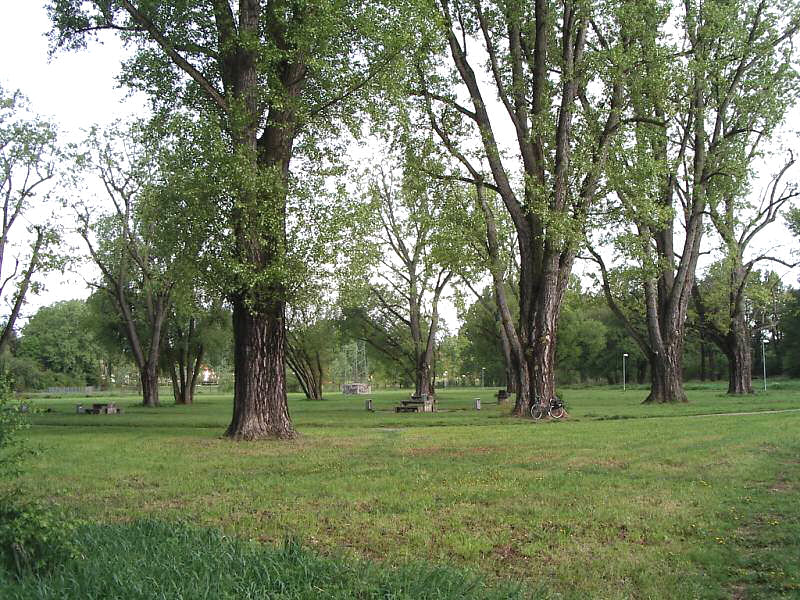
Photo: The original uploader was Keichwa at German Wikipedia., Photograph Keichwa, CC BY-SA 3.0 · source

Grey poplar Populus × canescens
| White poplar | Grey poplar | |
|---|---|---|
| Leaves | Alternate; on long shoots palmate with 3–5 lobes, on short shoots oval with wavy teeth. Underside and young twigs white-felted. | Alternate; on short shoots roundish to oval, 4–8 cm, irregularly and coarsely toothed; on long shoots larger and slightly lobed. Underside grey-felted, often becoming almost hairless later. |
| Flowering | March | Grey, hairy catkins in March, before the leaves (March). |
| Fruit | Catkins in March; fluffy seeds in May. | Fluffy seeds in May, on female trees. |
| Bark | Whitish-grey with rows of dark, diamond-shaped lenticels; dark and fissured at the base of the trunk. | Whitish grey with rows of dark, diamond-shaped lenticels; dark and furrowed at the base of the trunk. |
| Shape and height | Broadleaf tree, 15–30 m | Broadleaf tree, 20–30 m |
| Site | Full sun, any garden soil, dry to wet | Full sun, any garden soil, dry to wet |
| Native to Belgium | No, naturalised | Yes |
| Good for bees, butterflies and birds | Yes, for butterflies | – |
| Poisonous to people and pets | Not known to be poisonous | Not known to be poisonous |
| Pruning months | November–March | November–March |
The best feature in each season
- Spring
- Both have grey, hairy catkins in March before the leaves. The young leaves and twigs of white poplar are brilliant white and felted.
- Summer
- When the wind moves through the crown, a white poplar lights up white all over; a grey poplar looks more greyish green. On short shoots, the leaf of white poplar is oval and wavy-toothed, that of grey poplar roundish and coarsely toothed.
- Autumn
- Look at the twigs and buds: white and felted until autumn on white poplar, greyer and less felted on grey poplar.
- Winter
- The trunks look very alike: greyish white with dark diamonds, dark and fissured at the base. Dead leaves under the tree with a still brilliant white underside point to white poplar.
Where do they grow?
Grey poplar is a natural cross between white poplar and aspen, and grows fairly commonly in woods, wooded banks and along rivers. White poplar comes from central and southern Europe, is naturalised here and grows mainly along the coast and in the dunes.
Which one for your garden?
- Both grow 15–30 m tall and produce many root suckers, even far from the tree in lawns and borders: not suitable for an ordinary garden, but fine for a large wooded bank or the edge of the dunes.
- For wildlife, choose grey poplar or aspen instead. Don’t plant white poplar in or next to dunes and nature reserves, where its suckers crowd out native plants.
Did you know? Thanks to its root suckers, a single poplar can grow into a whole copse of genetically identical trees, which are really all one plant.
Read on
- Plant profile: White poplar
- Plant profile: Grey poplar
- White poplar: when and how to prune
- Grey poplar: when and how to prune
- Identification key