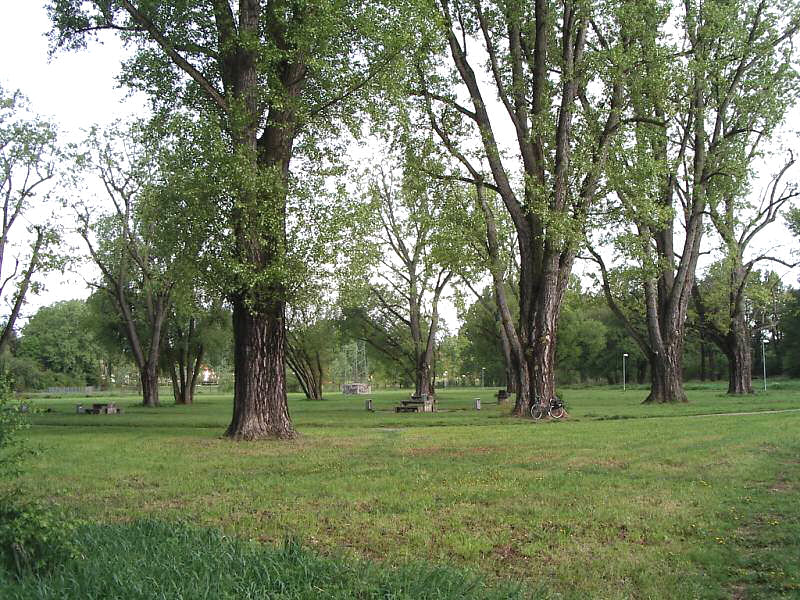
Photo: The original uploader was Keichwa at German Wikipedia., Photograph Keichwa, CC BY-SA 3.0 · source

Broadleaf tree · Willow family (Salicaceae)
Grey poplar
Populus × canescens
Grey poplar is a natural cross between white poplar and aspen. You can recognise it by its whitish-grey trunk with rows of dark, diamond-shaped lenticels and by its roundish, coarsely toothed leaf with a grey-felted underside. It grows fast, stands up well to wind and copes with wet as well as dry, sandy soil. Left to grow freely it reaches 20–30 m with a crown of about 15 m, and it throws up many root suckers, so that a single tree can grow into a whole thicket. So it doesn’t belong in an ordinary garden, but it does suit a hedgerow, a park or a windbreak on spacious ground.
Caution: Forms many root suckers, even far from the tree in lawns and borders, and the roots seek out water: don’t plant it close to houses, sewers or drains.
Light
Full sun
warm and bright
Moisture
Dry to wet
not fussy
Legal basis
Any garden soil
any pH
Hardiness
Throughout Belgium
no protection needed
Size
20–30 m
tall
Flowering
March
| Pruning months | November–March |
|---|---|
| Height | 20–30 m |
| Native to Belgium | Yes |
| Poisonous to people and pets | Not known to be poisonous |
| Flowering | March |
Identify
Grey poplar: how do you recognise it?
- Habit
- Tree of 20–30 m with a broad, rounded crown about 15 m across; often forms a thicket of root suckers around the trunk.
- Leaves
- Alternate; on short shoots roundish to oval, 4–8 cm, irregularly and coarsely toothed; on long shoots larger and slightly lobed. Underside grey-felted, often becoming almost hairless later.
- Bark
- Whitish grey with rows of dark, diamond-shaped lenticels; dark and furrowed at the base of the trunk.
- Flowers
- Grey, hairy catkins in March, before the leaves.
- Fruit
- Fluffy seeds in May, on female trees.
- Difference from white poplar
- White poplar has deeply lobed leaves on long shoots, like a maple leaf, with a snow-white felted underside.
- Difference from aspen
- Aspen has an almost round, hairless leaf that trembles in the slightest breeze.
Flowering: March · Pruning: November–March
Identify by feature: White or silver underside · White trunk
Looks like it, but isn’t
- White poplar Populus alba: leaf on long shoots deeply lobed like a maple leaf, with a snow-white felted underside. Difference from white poplar
- Aspen Populus tremula: almost round, hairless leaf that trembles in the slightest breeze. Difference from aspen
In your garden
Why grow it?
- Fast-growing and wind-firm: a quick windbreak on spacious ground.
- Copes with wet and with dry, sandy soil, and its roots bind the soil.
- The whitish-grey trunk with its diamond-shaped lenticels looks good all year round.
- Important for insects; old trunks are used by woodpeckers.
Grey poplar: where does it grow best?
- Full sun.
- Not fussy: wet or dry soil, sand, loam or clay.
- Allow for 20–30 m in height and a crown of about 15 m, plus suckers far from the trunk: only for a park, a hedgerow, a windbreak or a large farmyard.
- Keep it well away from houses, sewers and drains: the roots seek out water.
- Light
- Full sun
- Legal basis
- Any garden soil
- Moisture
- Dry to wet
- Size
- 25 m tall, 15 m wide
- Hardiness
- Throughout Belgium, no protection needed
Goes well with
- Silver birch: Another light pioneer for sandy soil; together they quickly form a woodland edge.
- Hawthorn: Fills in the base of a windbreak or hedgerow.
- Dog rose: Flowers in June and bears red hips; fills the edge of a hedgerow.
Good and bad companions
Goes well with
- Tolerate the shade under this tree: oregon grape, rhododendron, oleaster, japanese skimmia, garden privet, camellia, laurustinus, box-leaved honeysuckle
Maintenance
Grey poplar: when and how to plant it?
- Plant from November to March when the ground isn’t frozen.
- Young trees or dug-up root suckers establish best.
- For a windbreak, plant them a few metres apart; the suckers will fill the gaps on their own.
- Ideally plant it in grassland that you mow regularly: that keeps the suckers in check.
Care
- Suckers
- Mow them regularly in lawns and grassland; in a hedgerow or copse you can leave them.
- Watering
- Only in the first year during prolonged drought.
- Feeding
- Not needed.
- Inspection
- Have old trees along roads and paths checked for falling branches.
Tip: Looking for a tree for a wet or sandy spot in an ordinary garden? Then choose alder (wet) or silver birch (sand) instead, and save grey poplar for a windbreak or hedgerow where suckers are welcome.
Grey poplar: when to prune it?
Pruning months: November–March.
When: Dead, diseased and broken branches can be removed at any time of year. If pruning is needed, do it during winter dormancy (November–March).
How:
- Little pruning needed: give a young tree a single leader and remove crossing branches.
- Mow root suckers regularly; hard pruning only produces more suckers.
Caution: Felling a grey poplar doesn’t solve the sucker problem: the roots then sucker all the more. Keep mowing them for a few years afterwards.
Propagation
- Root suckers
- In winter, dig up a sucker with a good piece of root and replant it in its new spot.
Grey poplar: how does it get through the winter?
Hardy throughout Belgium: no protection needed.
- Fully hardy and wind-firm.
- In winter the whitish-grey trunk with its dark, diamond-shaped lenticels stands out even more.
Diseases and pests
- Root suckers: They pop up far from the tree, in lawns and borders. Mowing or cutting them regularly is the only solution; pulling them out or felling the tree makes it worse.
- Rust: Orange spore pustules on the underside of the leaves in late summer. Harmless.
- Large poplar longhorn beetle: The larvae bore tunnels in the trunk; sawdust at the base of the trunk gives them away. A healthy tree usually lives with them.
Through the year
- January: Prune if needed; dig up suckers for replanting.
- February: Pruning; planting season when there is no frost.
- March: Grey catkins; last month for pruning and planting.
- May: Fluff from female trees.
- June: Mow off suckers in the grass.
- September: Mow off suckers once more.
- November: Planting season; pruning can start again.
- December: Prune if needed.
Use
What can you use it for?
- Garden and landscape
- Fast-growing, wind-firm tree for wet and sandy soil; its roots bind the soil.
- For wildlife
- Important for insects; old trunks are used by woodpeckers.
Caution: Forms many root suckers, even far from the tree, in lawns and borders.
You and this species
Did you know?
- A natural cross between white poplar and aspen. It forms many root suckers, so that a single tree can grow into a whole thicket.
- Its Dutch name ‘abeel’ (English ‘abele’) comes via Old French from Latin albellus, ‘whitish’, after the pale trunk and leaf undersides.