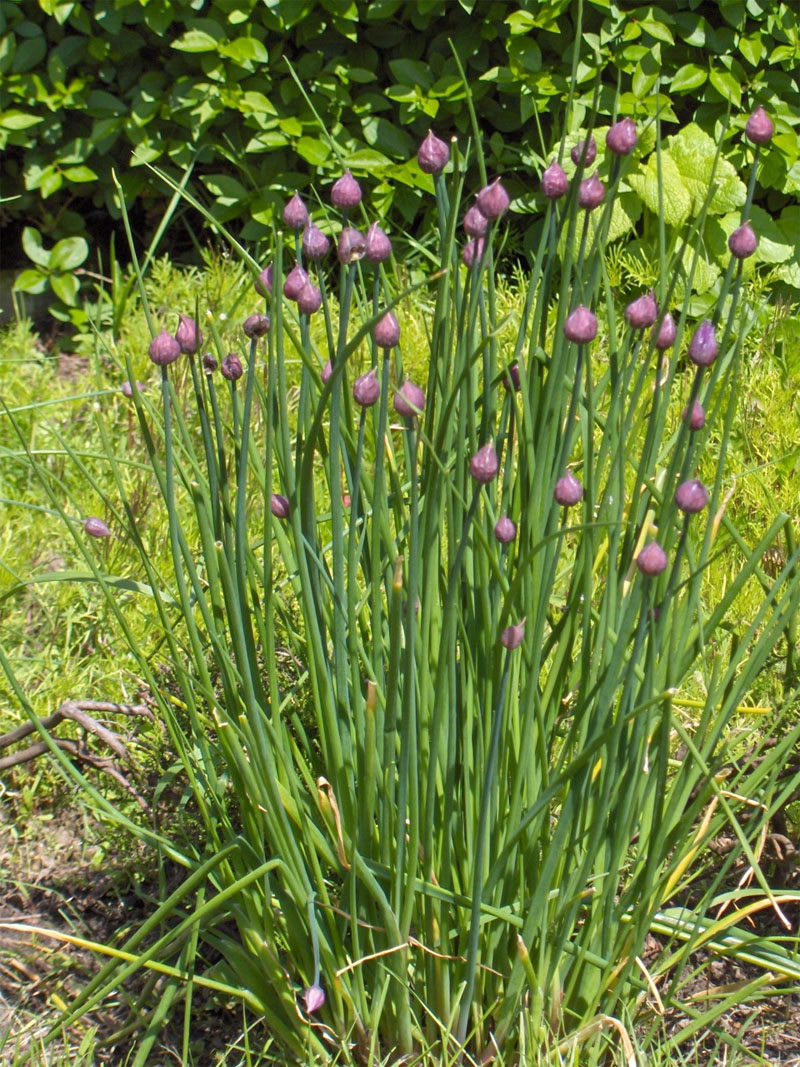
Photo: Wikimedia Commons, CC BY-SA 3.0 · source

Herbaceous plant · Daffodil family (Amaryllidaceae)
Chives
Allium schoenoprasum
In other languages: Bieslook (Nederlands) · Ciboulette (Français)
Grows wild in Belgium.
Chives are a perennial onion that forms dense clumps of hollow, grass-like tubular leaves, 20–40 cm tall, with pink to lilac pompons of flowers in May–July. In the wild they grow in damp mountain meadows, on riverbanks, gravel and rocks across much of Europe; in Belgium wild chives are rare and you mostly see them as garden escapes. In the garden they are one of the easiest kitchen herbs: you snip the fine, mildly oniony leaves fresh from the plant all season. You recognise them by the round, hollow leaves that smell of onion when crushed, and by the papery sheath around the young flower bud. The flowers are also a magnet for bumblebees and bees.
Caution: Like all onions, chives are toxic to dogs and cats if they eat larger amounts. Do not let pets nibble them, and do not give them leftovers containing chives or onion.
Light
Sun or partial shade
preferably some sun
Moisture
Normal
no wet feet
Hardiness
Fully hardy
down to -30 °C
Size
0.3 m
tall, 0.25 m wide
Flowering
May–July
| Pruning months | March and July |
|---|---|
| Height | 0.3 m |
| Native to Belgium | Yes |
| Flowering | May–July |
Identify
How to recognise it
- Growth form
- Perennial forming dense clumps 20–40 cm tall, from small, elongated bulbs packed closely together.
- Leaf
- Hollow, round and tubular, 2–5 mm thick, fresh green to bluish green. Smells and tastes mildly of onion when crushed.
- Flower
- A round head of 2–4 cm made of dozens of small, star-shaped, pink to lilac flowers, in May–July. The bud is first enclosed in a papery sheath.
- Fruit/Seed
- Small three-celled capsules with black, angular seeds, ripe in July–August.
- Stem
- The flower stem is round, hollow and about as long as the leaves, but firmer and tougher: less pleasant to eat.
- Confusion with
- Crow garlic, a wild onion of verges and fields, also has hollow leaves, but its head carries mostly small bulbils and it smells stronger. Ramsons has broad, flat leaves and white flowers. Garlic chives have flat leaves, white flowers in August and a garlic flavour.
Flowering: May–July · Pruning: March and July
In your garden
Why grow it?
- In May–June the flowers are a magnet for bumblebees, honeybees and solitary bees.
- One of the easiest kitchen herbs: from March to autumn you cut fresh leaves, and they keep growing back.
- The flowers are edible too: pulled apart, they add a mild onion flavour and a pink colour to salads or herb butter.
- A neat, low edging plant for the vegetable garden, the herb garden or a pot on the patio.
- Fully hardy and faithful for years: a clump lives a long time, especially if you divide it every few years.
Chives: where does it grow best?
- In the wild in damp mountain meadows, on riverbanks, gravel and rocks; in Belgium rare and often escaped from gardens.
- Full sun to half shade: in sun they flower more freely, in half shade the leaves stay more tender.
- Any good garden soil that does not dry out: humus-rich loam or sand with compost. Avoid soil that stays wet in winter.
- Suitable for the vegetable garden, the herb garden, as edging and in pots at least 15–20 cm deep.
Goes well with
- Parsley: A classic herb duo, in the vegetable garden and in the kitchen.
- Thyme: A low, fragrant edging in the sun that also flowers for bees.
- Pot marigold: Orange flowers beside the pink pompons, and a magnet for hoverflies.
- Strawberry: Chives make a neat, low edge along the strawberry bed.
- Carrot: Old kitchen-garden tradition puts chives between the carrots; they certainly look good there.
Maintenance
Chives: when and how to plant it?
- Buy a pot-grown plant from a nursery or garden centre, or ask a neighbour for a piece of a clump. Never take plants from the wild: wild chives are rare in Belgium.
- Plant in March–May or in September, 20–25 cm apart and at the same depth as in the pot.
- Or sow: indoors in March in small pots, outdoors in April–May. Put ten to twenty seeds in each pot, cover them with a thin layer of soil and keep them moist; they germinate in 2–3 weeks.
- Use fresh seed: chive seed only stays reliably viable for one or two years.
- Plant out the young tufts when they are 10 cm tall, keeping each pot together as one clump, and water straight away.
Care
- Water
- Water in dry spells, especially in pots. The leaves turn yellow and tough when the soil dries out.
- Feeding
- A spadeful of compost in March is enough. After a big harvest, a little extra compost helps the leaves get going again.
- Harvesting
- Cut a whole handful of leaves at once, 3–5 cm above the ground: they regrow nicely. Do not just snip the tips, or the clump becomes tough.
- Flowers
- Let a few clumps flower for the bees and remove the flower buds on others if you mainly want leaves.
- Dividing
- After 3–4 years a clump becomes congested and less vigorous: divide it in spring.
Tip: Always cut chives a whole handful at a time, just above the ground, rather than snipping only the tips: the leaves stay young and tender and the clump does not become tough.
Pruning and mowing
Pruning months: March and July.
When: In March, remove the old dead leaves; in July, after flowering, cut the whole clump back.
How:
- In March, cut away last year’s withered leaves so the young growth can come through freely.
- After flowering, in July, cut the whole clump back to 3–5 cm. Within a few weeks you will have fresh, tender leaves again.
- In a nature garden, leave a few flower stems until the seed is ripe: that gives you seedlings.
- If you do not want seedlings, cut off the spent heads before they turn brown.
Caution: Never cut lower than 3 cm above the ground: you would damage the bulbs and the clump would regrow slowly.
Propagation
- Division
- In March–April or September, lift the clump and split it by hand or with a spade into pieces of five to ten bulbs; replant at once and water.
- Seed
- Sow in March–May, indoors or outdoors, using fresh seed. If you leave the flowers, they sometimes self-sow.
Chives: how does it get through the winter?
Hardy to −30 °C.
- The leaves die back in late autumn; the bulbs overwinter in the soil.
- Fully hardy, even in severe frost.
- For fresh leaves in winter: in November pot up a piece of a clump, leave it outside in the cold for a few weeks, then bring it onto a cool, bright windowsill.
- In February–March the first green shoots appear again.
Diseases and pests
- Rust: Orange pustules on the leaves, especially in wet summers. Cut the clump right back, put the leaves in the household waste and give the plant more space and air.
- Thrips: Small silvery-grey flecks on the leaves in dry, warm weather. Watering and cutting the leaves back helps.
- Yellow leaves: A sign of drought or of an old, exhausted clump. Water, add compost or divide the clump.
- Aphids: Sometimes on the flower buds. Spray off with water; ladybirds and hoverflies usually deal with them.
Through the year
- March: Cut away old leaves. Add compost. Sow indoors. Divide clumps.
- April: First harvest. Sow or plant outdoors.
- May: Harvest. Flowering begins: bees and bumblebees on the flowers.
- June: Full flower. Pick flowers for salads.
- July: After flowering, cut the whole clump back to 3–5 cm. Water in dry spells.
- August: Harvest the new, tender leaves. Collect seed from a few flowering clumps.
- September: Plant or divide clumps. Keep harvesting.
- October: Last harvest; chop the surplus and freeze it.
- November: Pot up a piece to force indoors. The leaves die back.
You and this species
Did you know?
- The name schoenoprasum comes from the Greek schoinos (rush) and prason (leek): ‘rush leek’, after the hollow, rush-like leaves.
- Chives are one of the most widespread onions: they grow wild across large parts of Europe, Asia and North America.
- Steep the flower heads in white vinegar for a few weeks and it turns a lovely pink, with a gentle onion flavour.