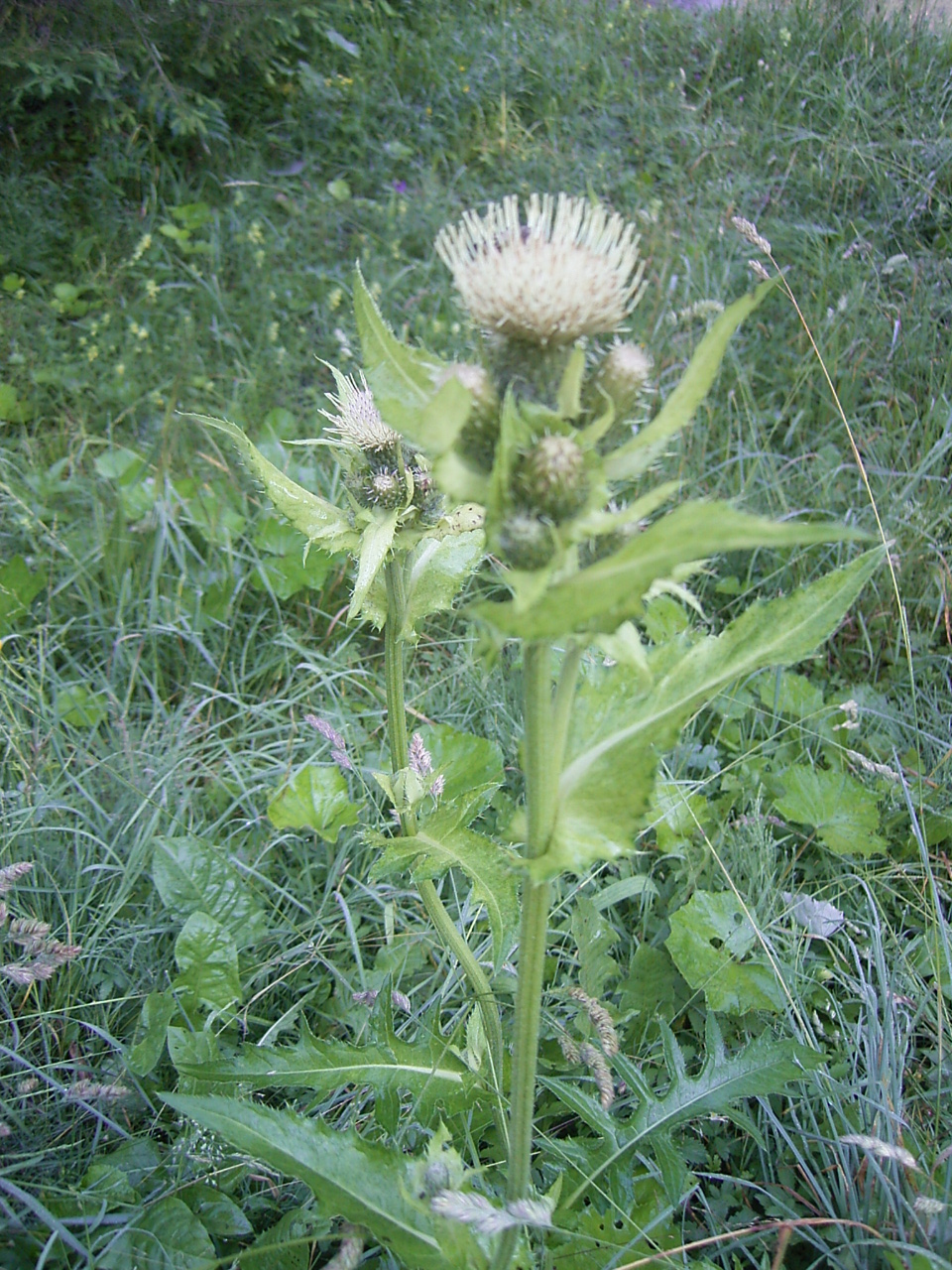
Photo: No machine-readable author provided. TeunSpaans assumed (based on copyright claims)., CC BY-SA 3.0 · source

Herbaceous plant · Daisy family (Asteraceae)
Cabbage thistle
Cirsium oleraceum
In other languages: Moeskruid (Nederlands) · Cirse maraîcher (Français)
Grows wild in Belgium.
Cabbage thistle is a tall, barely prickly thistle of wet, nutrient-rich grassland, tall-herb vegetation and stream banks. In Belgium it is locally common, especially in stream valleys in central and eastern Belgium and in Wallonia, on chalky or loamy soil; in the west of Flanders it is rarer. You can recognise it by its pale, soft green leaves that clasp the stem with ear-like lobes and by its pale yellow flower heads, clustered at the top and surrounded by large, yellow-green bracts. It flowers from July to September and is then a busy source of nectar for bumblebees, bees and butterflies. Its name refers to the former use of the young leaves as a vegetable.
Light
Sun or partial shade
preferably some sun
Moisture
Normal to wet
must not dry out
Hardiness
Fully hardy
down to -30 °C
Size
1.2 m
tall, 0.5 m wide
Flowering
July–September
| Pruning months | March and September |
|---|---|
| Height | 1.2 m |
| Native to Belgium | Yes |
| Flowering | July–September |
Identify
How to recognise it
- Habit
- Tall perennial of 50–150 cm with a straight, little-branched, grooved stem without spiny wings; few leaves higher up.
- Leaf
- Large, soft and pale green, undivided to deeply pinnately lobed, with a stem-clasping base with ear-like lobes and an edge with weak spines that barely prick.
- Flower
- Pale yellow, sometimes slightly reddish-tinged flower heads of 2.5–4 cm, clustered at the top of the stem and surrounded by large, oval, yellow-green bracts; from July to September.
- Fruit/Seed
- Light brown achenes with a white, feathery pappus that blow away on the wind.
- Roots
- A short, thick rhizome with fleshy roots; the plant forms clumps but does not spread aggressively.
- Look-alikes
- Marsh thistle has purple flower heads and a spiny-winged stem. Creeping thistle is lower, has small lilac heads and spreads with creeping roots. The pale yellow heads with large bracts make cabbage thistle unmistakable.
Flowering: July–September · Pruning: March and September
In your garden
Why grow it?
- A top nectar plant in late summer: bumblebees, honeybees, hoverflies and butterflies visit the flower heads.
- The seeds feed goldfinches and other seed-eaters in autumn.
- Various insects, such as picture-winged flies and weevils, live in the flower heads and stems.
- A gentle thistle: its little spines are so weak that they hardly prick.
- A typical plant of flowery wet hay meadows and stream valleys; where it grows in numbers, the grassland is often valuable.
- The dry stems give insects shelter in winter.
Cabbage thistle: where does it grow best?
- In the wild in wet, nutrient-rich hay meadows, tall-herb vegetation with meadowsweet, along streams and ditches and in damp floodplain woodland.
- Sun to partial shade.
- Moist to wet, fertile soil, preferably chalky or loamy; heavy clay too.
- In the garden in a wet wildflower meadow, by a pond or ditch, or at the back of a damp border.
Goes well with
- Meadowsweet: Tall, fragrant, creamy white plumes in the same wet tall-herb vegetation.
- Purple-loosestrife: Purple spikes that flower at the same time: a lovely contrast with the pale yellow heads.
- Common valerian: Pink umbels in June–July on the same wet soil.
- Hemp-agrimony: Pink nectar-rich flowers in late summer, a magnet for butterflies.
- Yellow loosestrife: Clusters of yellow flowers at the water’s edge in July–August.
Maintenance
Cabbage thistle: when and how to plant it?
- Never dig up plants in the wild: buy them from a nursery for native plants or sow your own.
- Plant in March–April or in September–October, 40–50 cm apart, in moist soil.
- Sow in autumn, outdoors in a tray or where it is to grow: the seed often germinates better after a cold spell.
- Press the seed lightly onto moist soil and barely cover it.
- Keep the soil moist in the first year; after that, water only in long dry spells in a drier spot.
- Seedlings often only flower in their second year.
Care
- Water
- Not needed in a wet spot; in an ordinary border, water in dry summers.
- Feeding
- Not needed; the rich, wet soil it likes is enough.
- Mowing
- Mow a wet hay meadow with cabbage thistle once a year, in September after the seed has set, and remove the cuttings.
- Leave the seed heads
- Leave the spent flower heads standing: goldfinches eat the seeds.
- Self-seeding
- It self-seeds moderately. Pull out unwanted seedlings in spring.
Tip: Put cabbage thistle in a wet, sunny spot and leave the spent heads until winter: you will have nectar for bumblebees from July to September and then seeds for the goldfinches.
Pruning and mowing
Pruning months: March and September.
When: In the garden in March; a wet hay meadow is mown in September.
How:
- Leave the spent stems standing over winter for seed-eating birds and overwintering insects.
- In March, cut the dead stems close to the ground, before the new leaves appear.
- Mow a wet wildflower meadow in September and remove the cuttings.
- If you want fewer seedlings, cut off some of the heads after flowering.
Propagation
- Seed
- Sow fresh seed outdoors in autumn, in a tray or where it is to grow; it germinates in spring. Keep the seedbed moist.
- Division
- In March–April, split a large clump with a sharp spade into pieces each with a few buds and replant them straight away.
Cabbage thistle: how does it get through the winter?
Hardy to −30 °C.
- The parts above ground die back in autumn; the plant overwinters as a rhizome, and in early spring a rosette of large, soft leaves appears.
- Fully hardy, to about −30 °C.
- The dry stems and fluffy heads stay standing: goldfinches eat the last seeds and insects shelter in the stems.
Diseases and pests
- Aphids: Black aphids on the stem tips in June. Ladybirds and hoverfly larvae clear them up.
- Flopping: On very rich soil and in shade the stems go limp. Plant it in sun and do not feed.
- Drying out: In a dry spot it stays small and wilts in summer. Choose a moist spot.
- Unwanted seedlings: Seedlings in a border are easy to pull up in spring.
- Fear of thistles: Neighbours sometimes think of invasive creeping thistle. Cabbage thistle does not spread aggressively and only self-seeds moderately.
Through the year
- March: Cut down dead stems. Plant or divide.
- April: Large rosettes of soft leaves appear.
- May: The stems grow.
- June: Buds appear among the yellow-green bracts. Watch out for aphids.
- July: Flowering begins: bumblebees and bees on the heads.
- August: Full flower. Butterflies on the flowers.
- September: Last flowers and fluffy seed. Mow a wet hay meadow.
- October: Sow in a tray or in place. Goldfinches on the heads.
- November: Leave the stems standing for birds and insects.
You and this species
Did you know?
- Oleraceum means used as a vegetable in Latin: the young leaves and stems were once eaten cooked. The English name cabbage thistle and the Dutch name moeskruid, vegetable herb, recall the same use.
- Cabbage thistle is one of the few thistles with yellow flowers in our region.
- It sometimes hybridises with marsh thistle; the hybrids have flower heads in a colour between pale yellow and purple.