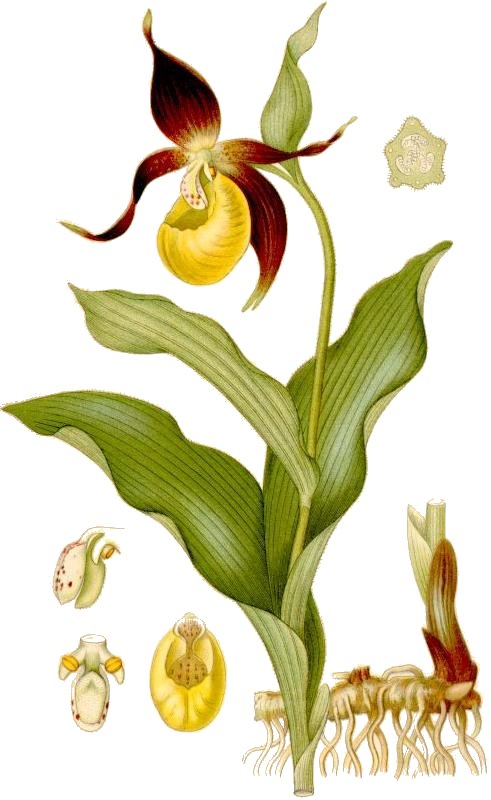
Photo: Carl Axel Magnus Lindman, Public domain · source

Herbaceous plant · Orchid family (Orchidaceae)
Lady’s-slipper
Cypripedium calceolus
In other languages: Vrouwenschoentje (Nederlands) · Sabot de Vénus (Français)
Grows wild in Europe, but not in Belgium.
The lady’s-slipper is the largest and perhaps the best-known wild orchid in Europe. It grows in open deciduous and coniferous woodland, along woodland edges and in clearings on limy soils, from the French Jura and the Alps to Scandinavia and Siberia. It does not grow wild in Belgium today, and the only plants that belong in a garden are ones raised from seed in a laboratory. You recognise it at once by its inflated yellow lip shaped like a clog, surrounded by twisted, purplish-brown petals and sepals. The flower is a clever trap for small bees, and the plant has become a symbol of nature conservation across Europe.
Caution: Protected species: the lady’s-slipper is legally protected throughout Europe. Never pick it or dig it up in the wild; dug-up plants almost always die anyway. Only buy plants raised from seed in a laboratory, from a specialist nursery.
Light
Partial shade
no harsh midday sun
Moisture
Normal
no wet feet
Hardiness
Fully hardy
down to -30 °C
Size
0.4 m
tall, 0.3 m wide
Flowering
May–June
| Pruning months | October |
|---|---|
| Height | 0.4 m |
| Native to Belgium | No, planted |
| Flowering | May–June |
Identify
How to recognise it
- Habit
- Perennial orchid 20–50 cm tall with a creeping rhizome; old plants form clumps with many stems.
- Leaf
- Three to five broad, elliptic leaves, 5–18 cm long, sheathing the stem, with deep parallel veins; slightly hairy and fresh green.
- Flower
- One or two (rarely three) flowers per stem in May–June. An inflated yellow lip 3–4 cm long, shaped like a clog, surrounded by four narrow purplish-brown segments, the two side ones spirally twisted.
- Fruit/Seed
- An upright capsule holding thousands of dust-fine seeds. They only germinate with the help of a soil fungus, and a seedling takes many years to flower.
- Roots
- A horizontal rhizome just below the surface, with long, fleshy roots spreading out flat. In autumn the buds for next year form on it.
- Confusion with
- Not in the wild: no other European orchid has such a yellow pouch. Many Cypripedium hybrids are sold, in white, pink and red shades; they are often easier, but they are not the same species. Check the scientific name on the label.
Flowering: May–June · Pruning: October
In your garden
Why grow it?
- The largest flower of any European orchid: a real eye-catcher in a shady corner.
- A remarkable pollination trick: small bees fall into the slippery pouch and can only escape at the back, brushing past the stigma and stamens.
- A long-lived plant: in a good spot a clump grows year after year until it carries dozens of flowers.
- Nursery-raised plants in your garden are a safe way to enjoy this rare species without harming wild populations.
- Flowers in May–June, between the spring flowers and the summer perennials of a shady border.
- The deeply veined leaves remain decorative after flowering, until autumn.
Lady’s-slipper: where does it grow best?
- In the wild in open deciduous and coniferous woodland, woodland edges, clearings and scrub on limestone, up to about 2000 m in the mountains.
- Half shade is ideal: morning sun and afternoon shade, or the dappled light under tall trees.
- Open, humus-rich, well-drained soil with some lime, neutral to slightly alkaline; never compacted or acid.
- The soil must stay moist in summer but never be waterlogged in winter: that makes the rhizome rot.
- In the garden: a sheltered spot in a shady border, on the north-east side of a shrub or in a woodland garden, where nobody digs.
Goes well with
- Sweet woodruff: A low, white-flowered carpet for half shade on limy soil; do keep it away from the base of the orchid.
- Hart’s-tongue fern: Glossy, evergreen fronds that, like the lady’s-slipper, love lime and shade.
- Columbine: Blue or purple flowers in May–June, in the same open woodland and woodland edges.
- Solomon’s seal: Arching stems with white bells as a calm, taller backdrop.
- Wood anemone: White spring flowers that have already gone by the time the lady’s-slipper flowers.
Maintenance
Lady’s-slipper: when and how to plant it?
- Only buy lady’s-slippers from a specialist nursery that raises them from seed in a laboratory; ask about it and be wary of cheap plants of unknown origin.
- Never dig plants up from the wild: the lady’s-slipper is protected throughout Europe, and dug-up plants almost always die.
- Plant in autumn (September–October) or early in spring, while the plant is dormant.
- Dig a hole 30–40 cm wide and fill it with an open mix of garden soil, leaf mould and coarse limestone grit for good drainage.
- Lay the rhizome flat, spread the roots out and make sure the buds sit 1–3 cm below the surface.
- Water moderately, cover with a thin layer of leaf mould and mark the spot so you do not dig into it by mistake.
Care
- Water
- Keep the soil slightly moist from April to August; in dry spells water with rainwater. No watering in winter.
- Feeding
- Hardly needed, if at all. A thin layer of leaf mould in autumn is enough; too much fertiliser does more harm than good.
- Mulching
- A layer of leaf mould or shredded leaves keeps the roots cool and the soil moist. Do not pile it up against the buds.
- Peace and quiet
- Never dig, hoe or rake around the plant: the shallow roots and buds are easily damaged.
- Competition
- Keep vigorous neighbours such as ivy or large ferns at a distance; the lady’s-slipper likes space around its base.
- Faded flowers
- Cut off the faded flower if you do not want seed: the plant then puts its energy into the rhizome.
Tip: Plant the lady’s-slipper where it will never have to move and mark the spot well: the less it is disturbed, the bigger and more free-flowering the clump becomes every year.
Pruning and mowing
Pruning months: October.
When: In October, once the leaves are completely yellow and withered.
How:
- Cut the withered stems off just above the ground, or gently pull them away if they come loose by themselves.
- Leave green leaves until they die off naturally: the plant draws its reserves for next year from them.
- Remove the dead leaves, as slugs and fungi like to overwinter in them.
- After flowering, cut off the faded flower if you do not want seed to ripen.
Caution: Never cut green leaves in summer: it weakens the plant and can cost you next year’s flowers.
Propagation
- Division
- Only with large, healthy clumps: in autumn or early spring, separate a piece of rhizome with at least two or three buds and plenty of roots. Replant it elsewhere straight away.
- Seed
- Practically impossible at home: the dust-fine seeds only germinate with a soil fungus or under sterile conditions in a laboratory. Leave this to specialist growers.
Lady’s-slipper: how does it get through the winter?
Hardy to −30 °C.
- The leaves die back in autumn; the plant overwinters as a rhizome with fat buds just below the surface.
- Very hardy, to about −30 °C: cold is not a problem, but wet soil in winter is.
- A layer of fallen leaves over the spot protects the buds against frost without snow cover and changeable weather.
- Mark the spot with a cane so you do not step on the emerging shoots in spring.
Diseases and pests
- Slugs: In April they eat the young shoots and buds, sometimes until nothing is left. Check in the evening, pick them off and attract hedgehogs and ground beetles to the garden.
- Root rot: In wet, compacted soil the rhizome and buds rot. Provide open, well-drained soil and never plant in a hollow where water collects.
- Drying out: Brown leaf edges in summer point to drought or too much sun. Water with rainwater and mulch, or move the plant to a cooler spot in autumn.
- No flowers: Young plants often take a few years to flower. Too much shade or competition also holds back flowering: give the plant a little more light and space.
Through the year
- March: Keep the spot clear; watch for emerging shoots and slugs.
- April: Shoots appear. Pick off slugs, keep the soil slightly moist.
- May: Start of flowering: the yellow slippers open.
- June: Flowering. Cut off faded flowers if you do not want seed.
- July: Water with rainwater in dry spells.
- August: Leaves stay green; keep the soil slightly moist.
- September: Planting month: put in new plants or divide large clumps.
- October: Cut away the withered leaves. Add a thin layer of leaf mould.
- November: Dormant. Next year’s buds are waiting underground.
You and this species
Did you know?
- The name Cypripedium comes from Greek: Kypris, a name for the goddess Aphrodite (Venus to the Romans), and pedilon, sandal. That is why the French call it sabot de Vénus. Calceolus is Latin for ‘little shoe’.
- The flower has no nectar. Small bees, mainly mining bees, slide into the pouch, cannot climb back over the smooth, inward-curving rim and crawl out at the back. On the way they brush past the stigma and pick up pollen on their backs.
- In Britain the lady’s-slipper had been almost wiped out by pickers and collectors by the early twentieth century. A single wild plant survived in Yorkshire and was guarded in secret for years.