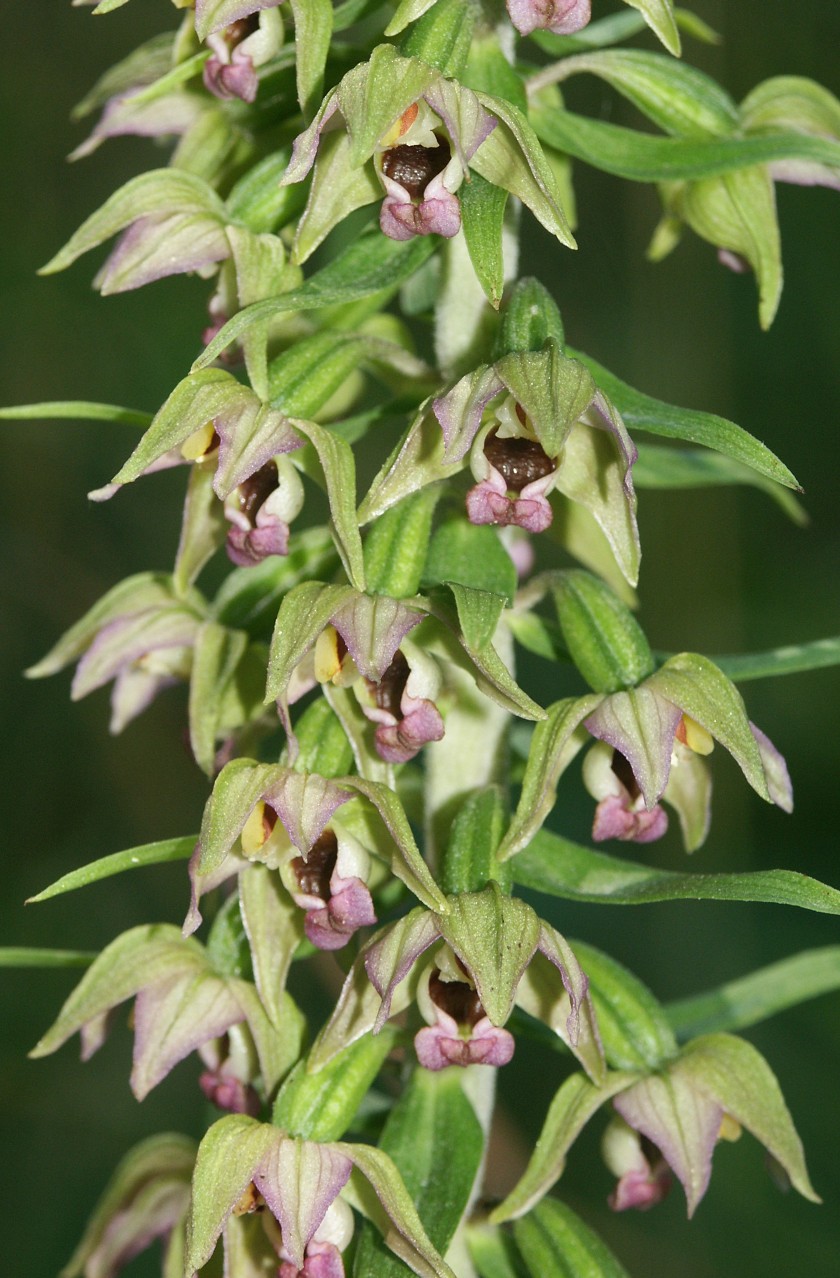
Photo: Wikimedia Commons, CC BY-SA 3.0 · source

Herbaceous plant · Orchid family (Orchidaceae)
Broad-leaved helleborine
Epipactis helleborine
In other languages: Brede wespenorchis (Nederlands) · Épipactis à larges feuilles (Français)
Grows wild in Belgium.
Broad-leaved helleborine is a native orchid of deciduous woodland, woodland edges, avenues and parks, and one of the most widespread wild orchids in Belgium. It often turns up where you would not expect an orchid: under trees in town parks, on verges, among shrubs in the dunes and sometimes even in gardens. You can recognise it by its sturdy stem with broad, strongly veined leaves arranged in a spiral, and by the long, often one-sided spike of greenish to purplish-red flowers in July and August. The flowers produce plenty of nectar and are mainly pollinated by wasps. Like all wild orchids in Belgium it is protected: enjoy it where it grows.
Caution: All wild orchids are protected in Belgium: do not pick them, dig them up or collect seed in the wild. Only buy plants from a nursery that propagates them itself.
Light
Partial shade or shade
tolerates little sun
Moisture
Normal
no wet feet
Hardiness
Fully hardy
down to -25 °C
Size
0.5 m
tall, 0.2 m wide
Flowering
July–August
| Height | 0.5 m |
|---|---|
| Native to Belgium | Yes |
| Flowering | July–August |
Identify
How to recognise it
- Habit
- Perennial orchid, 30–80 cm tall, sometimes up to 1 m, with one or a few sturdy, upright stems from a short rhizome.
- Leaf
- Broadly oval to elliptic, 5–15 cm long, with prominent parallel veins, arranged spirally around the stem; fresh to dark green, without spots.
- Flower
- In July–August a long, often one-sided spike of 15–50 flowers. Each flower is 1–1.5 cm, greenish tinged pink to purple; the lip has a cup-shaped, dark inner part full of nectar and a heart-shaped front part.
- Fruit/Seed
- Hanging, elongated capsules containing thousands of dust-like seeds that are spread by the wind.
- Stem
- Sturdy, green to purplish, finely downy near the top.
- Look-alikes
- Marsh helleborine grows on wet, chalky soil and has a white, frilly lip. Dark-red helleborine has wine-red, scented flowers and grows on limestone. When not in flower it looks a little like Solomon’s seal, but that has an arching stem with leaves in two rows.
Flowering: July–August
In your garden
Why grow it?
- A true wild orchid that also appears in villages and towns: a lovely surprise in a garden with old trees or a quiet shady corner.
- A rich source of nectar in summer for wasps, its main pollinators; other insects visit too.
- It flowers in July–August, when little else is in flower in the shade.
- It lives in partnership with soil fungi and grows mainly where the soil is left undisturbed: a sign of a living, healthy soil.
- Fascinating to follow: the number of flowering plants varies greatly from year to year, and in some years a plant stays below ground.
Broad-leaved helleborine: where does it grow best?
- In the wild: light deciduous and coniferous woodland, woodland edges, avenues, coppice, hedgerows and scrub in the dunes, on chalky to slightly acid soil.
- It also turns up in town parks, cemeteries, on verges under trees and in gardens with old trees.
- In the garden: partial or light shade, on humus-rich, not too dry soil that is not dug.
- No fertilised border or lawn: it needs undisturbed soil where the fungi are left alone.
Goes well with
- Male fern: Fresh green in the same partial shade, without crowding the orchid.
- Wood anemone: Flowers in spring on the same humus-rich woodland soil, long before the helleborine.
- Solomon’s seal: Another woodland plant with graceful stems, flowering as early as May.
- Sweet woodruff: A low ground cover for shade, with small white stars in May.
- Hazel: A shrub with light shade under which the orchid is happy to grow.
Maintenance
Broad-leaved helleborine: when and how to plant it?
- All wild orchids are protected: never dig up plants in the wild, not even from a verge or park. Transplanted orchids rarely survive anyway, because they lose their soil fungi.
- Only buy plants from a specialist nursery that propagates its own orchids, and ask where they come from.
- Plant in spring or autumn in partial shade, at the same depth as in the pot, in humus-rich, undisturbed soil, for example under shrubs or at a woodland edge.
- Do not add fertiliser or fresh compost; a thin layer of leaf mould or fallen leaves is enough.
- Water after planting and keep the soil slightly moist during the first year.
- Your best chance: a quiet, shady corner with leaf litter under trees. If the species grows nearby, it sometimes appears by itself, as the dust-like seed travels far.
Care
- Watering
- Only during long dry spells in the first year. Not needed after that.
- Feeding
- Do not feed: fertiliser harms the soil fungi the orchid depends on.
- Soil
- Do not dig, hoe or rake around the plant: roots and fungi lie just below the surface. Leave fallen leaves in place.
- Mowing
- If it grows on a verge or grassy strip, mow that spot only in late autumn, once the seed has dispersed.
- Protection
- Young shoots are vulnerable to slugs and are sometimes nibbled by rabbits or deer; a wire mesh cage helps in spring.
Tip: Got one in your garden? Mark the spot with a stick: the orchid is only visible for a few months, and otherwise you might dig it up or mow it by accident.
Pruning and mowing
When: Not needed; leave the stems until they die back naturally in autumn.
How:
- Do not cut off the flower spike after flowering: the capsules need to ripen and release their seed.
- Remove dead stems in late winter, or simply let them rot down.
- Never cut off green leaves: the plant uses them to build up reserves for next year.
Caution: Do not pick the flowers: the plant is protected, and without seed it cannot spread.
Propagation
- Seed
- In the wild by dust-like seed carried on the wind. It only germinates with the right soil fungus, and a seedling takes several years to flower. Sowing it yourself in a garden almost never works.
- Rhizome
- Older plants sometimes form several stems from the rhizome. Dividing is not recommended: the plant recovers poorly.
Broad-leaved helleborine: how does it get through the winter?
Hardy to −25 °C.
- The above-ground parts die back in autumn; the plant overwinters as a rhizome with buds in the soil.
- Fully hardy, to about −25 °C.
- The dry stems with empty capsules sometimes remain standing into winter.
Diseases and pests
- Slugs: They eat young shoots and buds in spring. Encourage a natural garden with hedgehogs, toads and ground beetles.
- Rabbits and deer: They bite off the flower spikes. A wire mesh cage during the growing season protects the plant.
- Sudden disappearance: Orchids sometimes stay below ground for a year or more. Leave the spot alone, do not feed and be patient.
- Drying out: In a spot that is too dry and sunny the leaves wither in summer. Choose light shade and leave leaf litter as a mulch.
Through the year
- April: The first shoots appear. Protect against slugs.
- May: The leaves unfold in a spiral around the stem.
- June: The flower spike grows; the buds become visible.
- July: Flowering begins. Watch for wasps on the flowers.
- August: Flowering, then the hanging capsules swell.
- September: The capsules ripen and release their dust-like seed.
- October: The plant dies back. Leave fallen leaves in place.
- November: Resting below ground. Mark the spot with a stick.
You and this species
Did you know?
- The name ‘helleborine’ means ‘like a hellebore’: the broad, pleated leaves recall those of white false hellebore.
- The flowers are mainly visited by wasps, which are not important pollinators for most other orchids.
- The seeds are as fine as dust and have almost no food reserves: they can only germinate if a soil fungus feeds them.