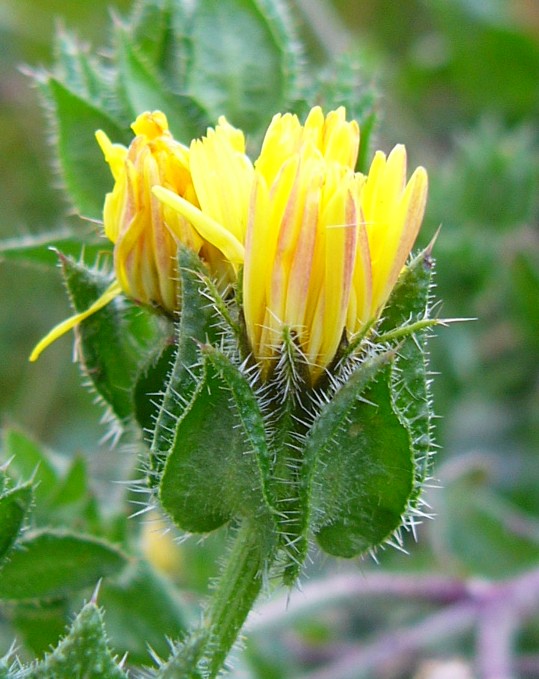
Photo: Thomas Meyer, CC BY-SA 3.0 · source

Herbaceous plant · Daisy family (Asteraceae)
Bristly oxtongue
Helminthotheca echioides
In other languages: Dubbelkelk (Nederlands) · Picride fausse-vipérine (Français)
Grows wild in Belgium.
Bristly oxtongue is a sturdy, rough-haired annual or biennial of 30–90 cm in the daisy family, with yellow, dandelion-like flower heads from June into October. In the wild it grows in sunny, open places: verges, dykes, rough grassland, waste ground and field edges, especially on limy clay and loam. In Belgium it is fairly common along the coast and in the polders, and it is turning up more and more often along roads inland. You recognise it at once by its leaves covered in stiff bristles, each rising from a small white blister, and by the three to five broad, heart-shaped bracts that sit like a second calyx around each flower head. Because it flowers long and late in the year, it is a welcome source of nectar and pollen for bees and hoverflies.
Light
Full sun
warm and bright
Moisture
Dry to normal
no wet feet
Hardiness
Fully hardy
down to -20 °C
Size
0.6 m
tall, 0.4 m wide
Flowering
June–October
| Pruning months | October |
|---|---|
| Height | 0.6 m |
| Native to Belgium | Yes |
| Flowering | June–October |
Identify
How to recognise it
- Habit
- Upright, widely branched plant of 30–90 cm, annual or biennial; in its first year often a flat leaf rosette.
- Leaf
- Oblong and wavy, with an irregularly toothed edge; covered all over with stiff bristles rising from white blisters, so the leaf feels warty and rough. The stem leaves clasp the stem with a heart-shaped base.
- Flower
- Yellow heads of 2–2.5 cm with only ray florets, from June to October. Around each head sit 3–5 broad, heart-shaped, leafy outer bracts: the ‘double calyx’.
- Fruit/Seed
- Small, curved seeds with a long beak and a white, feathery pappus: a seed clock like a dandelion’s.
- Stem
- Stout, furrowed and rough with prickly hairs; when broken it oozes white milky sap.
- Confused with
- Hawkweed oxtongue also has rough hairs and yellow heads, but narrow bracts without a broad ‘second calyx’ and leaves without white blisters. Dandelions and hawkweeds have no stiff bristles on the leaves.
Flowering: June–October · Pruning: October
In your garden
Why grow it?
- Flowers from June into October, when many other wild flowers are over: a late source of nectar and pollen.
- Wild bees, bumblebees, hoverflies and butterflies visit the yellow flower heads.
- In late summer the fluffy seed feeds seed-eaters such as goldfinches.
- A tough pioneer for a sunny, rough corner, a flower-rich verge or a limy bank.
- Its bristly, warty leaves make it a fun plant to teach children to recognise.
Bristly oxtongue: where does it grow best?
- In the wild: verges, dykes, rough grassland, waste ground, building sites and field edges, often not far from the coast.
- Full sun; in shade it dwindles.
- Fertile, limy soil: clay, loam or sandy loam. It copes well with summer drought.
- In the garden: in a rough, sunny corner, a flower-rich verge or on bare, disturbed ground where it can self-sow year after year.
Goes well with
- Wild carrot: White umbels on the same sunny verge, also loved by hoverflies.
- Teasel: Tall, prickly structure; the seed heads draw goldfinches in winter.
- Chicory: Sky-blue flowers on the same limy, sunny soil.
- Viper’s bugloss: Blue flower spikes for bumblebees; bristly oxtongue’s scientific name refers to it.
- Common knapweed: Purple heads for bees and butterflies on a flower-rich verge.
Maintenance
Bristly oxtongue: when and how to plant it?
- Buy seed of native origin from a nursery or seed supplier for wild plants, perhaps in a mix for verges or rough grassland.
- Sow in September–October or March–April on open, weed-free ground; sow thinly, press the seed in and barely cover it.
- Keep the soil moist until germination, then thin the seedlings to 30–40 cm.
- You can also sow in small pots and plant out the young rosettes in autumn or spring, while the taproot is still small.
- After the first time it usually self-sows on bare ground.
- Never dig up plants from the wild or from nature reserves.
Care
- Water
- Not needed, except for young seedlings in a dry spring.
- Feeding
- Not needed. On rich soil it grows tall and floppy; poor soil keeps it sturdy.
- Mowing
- On a verge or rough patch, mow once in October, after seed set, and remove the cuttings.
- Spreading
- On open ground it self-sows freely. Dig out surplus rosettes in spring with a weeding knife while the taproot is still short.
- Letting it seed
- Leave a few plants to ripen if you want it back next year; the fluff also blows into the neighbours’ gardens.
Tip: Look closely at a leaf: every stiff bristle sits on a small white blister. That is how you tell bristly oxtongue at once from all the other yellow daisies.
Pruning and mowing
Pruning months: October.
When: In October, after seed set; or earlier if you want to limit self-sowing.
How:
- Cut or mow the plants once most of the seed has dispersed.
- For fewer seedlings, cut off the seed clocks before they open.
- Leave a few stems standing until spring: insects shelter in them and birds pick out the last seeds.
- Wear gloves: the stiff bristles prickle.
Propagation
- Seed
- Ripens from August. Sow it where it is to grow in autumn or spring; it also self-sows readily.
Bristly oxtongue: how does it get through the winter?
Hardy to −20 °C.
- Plants that germinate in summer or autumn overwinter as a flat, bristly rosette and flower the following year.
- Flowering plants die after setting seed; the dry stems remain standing.
- The rosettes are hardy to about −20 °C and come through an ordinary Belgian winter without trouble.
- Leave dead stems standing as shelter for overwintering insects.
Diseases and pests
- Self-sowing: On bare, rich ground it can self-sow heavily. Cut off some of the seed clocks and weed out young rosettes.
- Aphids: Sometimes on the stem tips in summer. Ladybirds and hoverfly larvae usually deal with them.
- Too little light: In shade or among tall grass it stays small and flowers poorly. Give it an open, sunny spot.
- Prickly hairs: The stiff bristles are unpleasant when weeding. Wear sturdy gloves.
Through the year
- March: You can still sow on an open, sunny spot. Last year’s rosettes start growing.
- April: Dig out surplus seedlings while they are small.
- May: The flowering stems shoot up.
- June: First yellow flower heads.
- July: Full flower; bees and hoverflies visit the flowers.
- August: Flowers and first seed clocks; goldfinches come for the seed.
- September: Still in full flower. Sow for flowers next year.
- October: Last flowers. Mow spent plants or leave some standing.
- December: Rosettes overwinter; dead stems shelter insects.
You and this species
Did you know?
- Its Dutch name, ‘dubbelkelk’ (double calyx), refers to the broad, heart-shaped outer bracts that surround the flower head like a second calyx.
- The species name echioides means ‘like Echium’, viper’s bugloss, because of the rough, bristly leaves. The French name, picride fausse-vipérine, refers to it too.
- For a long time it was called Picris echioides and was placed in the same genus as hawkweed oxtongue.