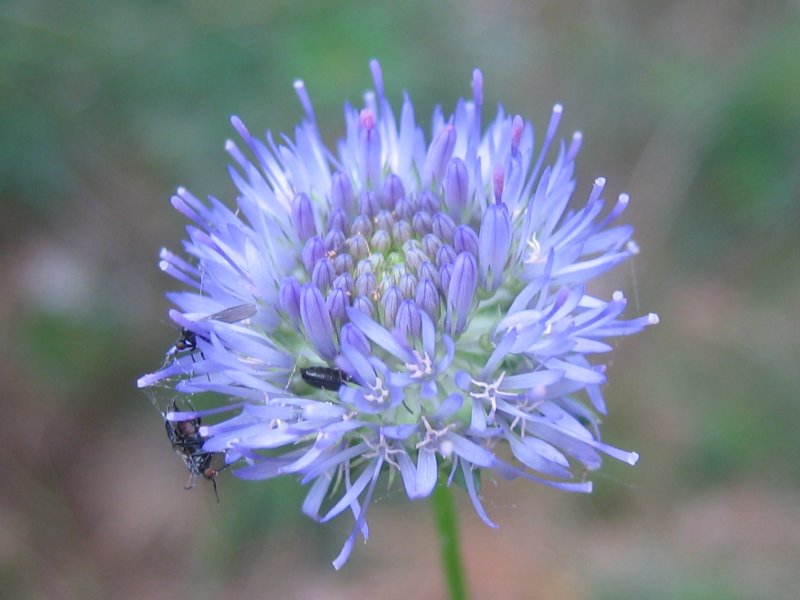
Photo: Kristian Peters -- Fabelfroh 06:14, 4 October 2006 (UTC), CC BY-SA 3.0 · source

Herbaceous plant · Bellflower family (Campanulaceae)
Sheep’s-bit
Jasione montana
In other languages: Zandblauwtje (Nederlands) · Jasione des montagnes (Français)
Grows wild in Belgium.
Sheep’s-bit is a native plant, usually biennial, of dry, poor, acid sandy soil: thin grassland, heath edges, sandy verges and banks, inland dunes, old walls and rocks. In Belgium it is fairly common in the Campine (Kempen) and on other sandy soils, but it disappears where the soil is fertilised or becomes overgrown. With its pompoms of sky-blue flowers it looks like a small field scabious or devil’s-bit scabious, but it belongs to the bellflower family. The round heads, 1–2.5 cm across, stand on slender stems above a rosette of narrow, wavy, hairy leaves. It flowers from June to September and is a favourite of wild bees, hoverflies and butterflies.
Light
Full sun
warm and bright
Moisture
Dry
tolerates drought
Hardiness
Fully hardy
down to -25 °C
Size
0.3 m
tall, 0.2 m wide
Flowering
June–September
| Pruning months | September |
|---|---|
| Height | 0.3 m |
| Native to Belgium | Yes |
| Flowering | June–September |
Identify
How to recognise it
- Habit
- Usually biennial, sometimes annual or a short-lived perennial: a low rosette in the first year, then several ascending, branched stems 10–40 cm tall.
- Leaf
- Narrowly oblong to linear, 1–5 cm long, with a wavy edge, hairy and stalkless; alternate, mainly at the base and on the lower part of the stem.
- Flower
- Small, sky-blue flowers together in a round head 1–2.5 cm across, surrounded by green bracts. Each flower has five narrow, strap-like lobes; the styles stick out above the flowers.
- Fruit/Seed
- Small capsules with countless tiny, shiny seeds, which fall from the ripe heads in dry weather.
- Stem
- Slender, hairy below and hairless above; the upper part below the head is long and leafless.
- Look-alikes
- Field scabious is much larger, with lilac heads with larger outer flowers and divided leaves. Devil’s-bit scabious grows on damp soil and has undivided leaves. Small scabious grows on chalk. In all these species the leaves are opposite; in sheep’s-bit they are alternate.
Flowering: June–September · Pruning: September
In your garden
Why grow it?
- Sky-blue pompoms from June to September, in dry places where almost nothing else flowers.
- A popular source of nectar and pollen for many wild bees, hoverflies and butterflies.
- A key plant for a thin, sandy garden, a heather garden or a sunny bank on acid soil.
- Small and modest: it also fits in a rock garden, between stones or along a sandy path.
- It self-seeds on bare sand, so a few plants can grow into a lasting group.
Sheep’s-bit: where does it grow best?
- In the wild: dry, thin grassland on sand, heath edges, sandy verges and banks, inland dunes, quarries, old walls and rocks.
- It needs full sun and poor, acid, well-drained sandy soil; on chalk and rich soil it disappears.
- Bare ground is important: in dense, tall vegetation it does not last long.
- In the garden: a sunny heather garden, a sandy bank, a thin flowery lawn on sand, a dry wall or the edge of a gravel path.
Goes well with
- Heather: Purple flowers in August–September on the same poor, acid sandy soil.
- Harebell: Delicate blue bells next to the blue pompoms, on dry, poor soil.
- Hare’s-foot clover: Soft, greyish-pink heads on bare sand, at the same time.
- Cat’s-ear: Yellow heads among the blue, also popular with wild bees.
- Grey hair-grass: A low, blue-grey grass of open blown sand that brings the feel of an inland dune.
Maintenance
Sheep’s-bit: when and how to plant it?
- Buy seed or plants from a nursery specialising in native plants. Never take plants or seed from the wild.
- Sow in September–October or in March–April on the surface of bare, weed-free sandy soil. Mix the tiny seed with some dry sand to spread it thinly and press it down; do not cover it, as it needs light to germinate.
- If you sow in pots, use poor, sandy seed compost and prick out the little rosettes as soon as they are big enough.
- Plant in spring or early autumn, in groups of 5–10, 15–20 cm apart.
- If your soil is too rich, first make it poorer by removing the topsoil or adding a layer of sand.
- Water only in dry spells during the first few weeks.
Care
- Watering
- Only after sowing and planting. Established plants cope well with hot, dry summers.
- Feeding
- Never: on rich soil it gets swamped by grass and disappears.
- Mowing
- Mow a thin verge or sandy grassland once a year, in September, after seed set, and remove the cuttings.
- Bare ground
- Every autumn, scrape a few patches of bare sand so the seed finds a place to germinate.
- Self-seeding
- Leave the faded heads until they turn brown, then shake them out over bare sand.
Tip: Sow sheep’s-bit in a spot you deliberately keep open, such as the edge of a sandy path: scraping a few patches clear every autumn is enough to keep it in your garden for years.
Pruning and mowing
Pruning months: September.
When: In September, when the heads have finished flowering and the seeds are ripe.
How:
- Leave the flowering stems after flowering until the heads are brown and dry.
- Shake or tap the ripe heads over bare ground before mowing.
- Then mow or cut short and remove the cuttings.
- Spare the green rosettes of young plants: they will flower next year.
Caution: Do not mow in June or July: you would lose flowers and seed, and this short-lived plant would soon disappear.
Propagation
- Seed
- Sow in September–October or in March–April on the surface and do not cover. Seedlings first form a rosette and usually flower the following year.
- Self-sown seedlings
- On bare sand, seedlings appear by themselves. Move young rosettes in autumn or early spring with a small root ball.
Sheep’s-bit: how does it get through the winter?
Hardy to −25 °C.
- Young plants overwinter as a small green rosette that flowers the following year.
- Plants that have flowered usually die after setting seed.
- Hardy to about −25 °C; wet soil in winter harms it more than frost.
- Leave a few dry stems as shelter for small insects.
Diseases and pests
- Disappears after a few years: It is short-lived and has to self-seed. Without bare patches that is impossible: scrape open some soil every year.
- Smothered by grass: On soil that is too rich, grass grows too fast. Make the soil poorer by mowing and removing the cuttings, or choose a poorer spot.
- Rotting: In heavy, wet soil the rosettes rot in winter. Choose poor, well-drained sandy soil.
- Slugs: They sometimes eat young rosettes. Sow a little more thickly and let hedgehogs, toads and ground beetles do their work.
Through the year
- March: Sowing on bare sand is possible. The rosettes grow.
- April: Plant out young plants.
- June: Start of flowering. Do not mow.
- July: Full flower. Watch for wild bees and butterflies.
- August: Flowering and first ripe heads.
- September: Shake out the seed. Mow and remove the cuttings. Sow.
- October: Sow or move rosettes. Scrape open a few bare patches.
- November: Rest: small rosettes overwinter.
You and this species
Did you know?
- Although it looks very much like a scabious, sheep’s-bit belongs to the bellflower family, like the harebell.
- The species name montana (‘of the mountains’) is rather misleading: in Belgium it grows mainly in the lowlands on sand, although it also occurs on rocks in the Ardennes.
- The name sheep’s-bit is usually explained as a plant that sheep like to eat.