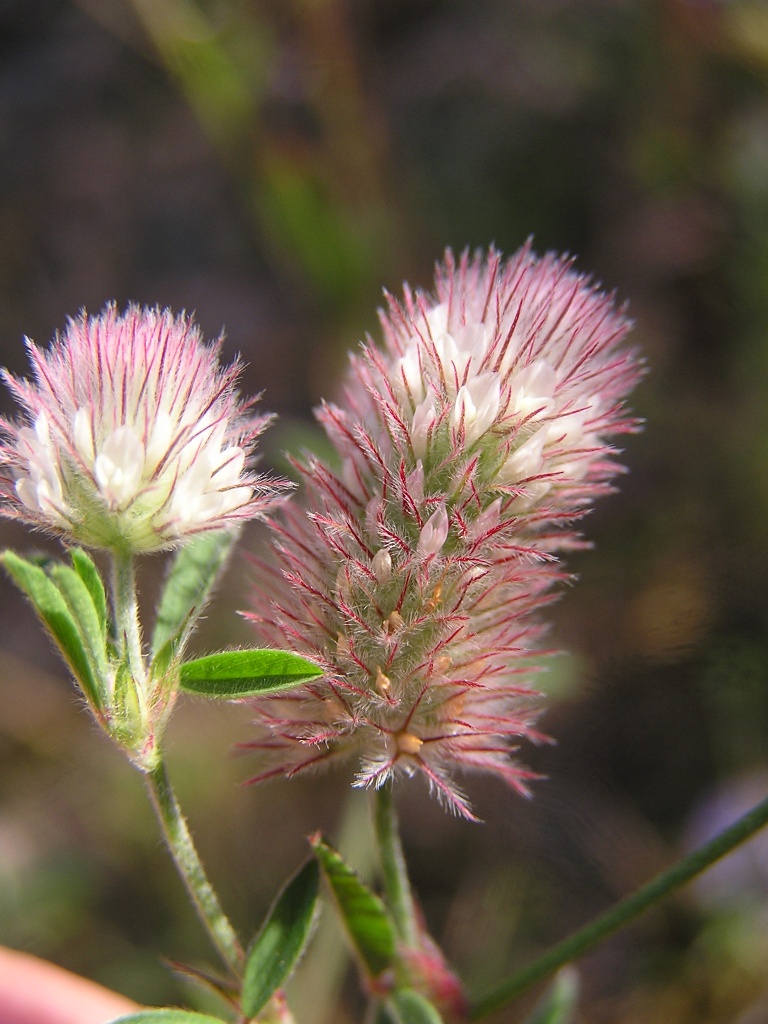
Photo: Michael Becker, CC BY-SA 3.0 · source

Herbaceous plant · Pea family (Fabaceae)
Hare’s-foot clover
Trifolium arvense
In other languages: Hazenpootje (Nederlands) · Trèfle des champs (Français)
Grows wild in Belgium.
Hare’s-foot clover is a small annual clover, 5–30 cm tall, with softly hairy, greyish-pink flower heads that really do look like a hare’s foot. It grows in dry, sunny, sandy places: dunes, heath edges, poor verges, sandy field margins, railway banks and sandy waste ground. In Belgium it is common in the Campine, on the sandy soils of Flanders and on the coast, but scarcer on loam and clay. You can recognise it by the narrow, hairy leaflets and above all by the elongated, woolly heads of 1–2.5 cm, in which the long, feathery calyx teeth almost hide the tiny pinkish-white flowers. Bees and bumblebees love it, and like all members of the pea family it fixes nitrogen from the air.
Light
Full sun
warm and bright
Moisture
Dry
tolerates drought
Hardiness
Fully hardy
down to -20 °C
Size
0.2 m
tall, 0.15 m wide
Flowering
June–September
| Pruning months | September |
|---|---|
| Height | 0.2 m |
| Native to Belgium | Yes |
| Flowering | June–September |
Identify
How to recognise it
- Habit
- Upright, branched annual, sometimes biennial, 5–30 cm, with softly hairy stems that are often tinged red.
- Leaf
- Trifoliate; the leaflets are narrowly oblong, 1–2 cm, softly hairy and finely toothed at the tip. Long, pointed stipules.
- Flower
- Elongated, cylindrical heads of 1–2.5 cm, greyish pink and woolly because of the long, feathery calyx teeth; the tiny white to pink flowers are shorter than the calyx. Flowers from June to September.
- Fruit/Seed
- A small pod with one seed, hidden in the hairy calyx. The woolly calyces help spread the seed on the wind or in animal fur.
- Roots
- A thin taproot with nodules full of nitrogen-fixing bacteria.
- Confusion with
- Knotted clover and rough clover have rounded, non-woolly heads and broader leaflets. Hare’s-tail grass, an ornamental grass, also has woolly heads, but narrow grass leaves and no clover leaf.
Flowering: June–September · Pruning: September
In your garden
Why grow it?
- Flowers all summer, from June to September, on dry sand where few other flowers offer nectar: bumblebees, honeybees and wild bees visit it.
- A dainty little plant for a sand or gravel garden, a sunny bank or a poor, sandy verge.
- The woolly heads stay attractive for a long time and are lovely in small dried arrangements.
- As a member of the pea family it lives together with bacteria in root nodules that fix nitrogen from the air.
- A characteristic plant of dry, open sand: where it grows, the soil is poor and unfertilised.
Hare’s-foot clover: where does it grow best?
- In the wild in dunes, on heath edges, in dry grassland, poor verges, railway land and sandy fields or waste ground.
- Full sun.
- Dry, poor, lime-poor to slightly limy sand or gravel; no wet or rich soil.
- In the garden: in a sand or gravel garden, between paving laid on sand, in a poor wildflower meadow or on a sunny, dry bank.
Goes well with
- Sheep’s-bit: Blue pompons on the same dry sand.
- Mouse-ear hawkweed: Pale yellow flower heads and silvery rosettes in a sand garden.
- Harebell: Blue bells on a poor verge.
- Lady’s bedstraw: Fragrant yellow plumes in the same dry, sunny meadow.
Maintenance
Hare’s-foot clover: when and how to plant it?
- Buy seed from a supplier of native plants; it is rarely sold as a pot plant.
- Sow in September–October or March–April where it is to grow, on poor, open soil; on rich soil, first mix plenty of sand into the top layer.
- Sow the seed thinly, press it in and barely cover it.
- Keep the soil moist until germination; after that no watering is needed.
- Thin little or not at all; 10–15 cm between plants is enough.
- Never dig up plants in dunes or other nature reserves.
Care
- Water
- Not needed; it is made for drought.
- Feeding
- Never: on rich soil it disappears under grasses and larger plants.
- Mowing
- Mow a poor wildflower meadow in September, once the seed has fallen; remove the cuttings.
- Bare soil
- As an annual it needs small bare patches to germinate. After mowing, rake the soil open here and there.
- Letting it seed
- Let the heads ripen so that it self-sows every year.
Tip: On rich garden soil hare’s-foot clover does not last long: scatter the seed on a patch of pure sand, for example along a path or in a gravel garden, and it will self-sow for years.
Pruning and mowing
Pruning months: September.
When: Not needed; mow a poor wildflower meadow in September, after seed set.
How:
- Let the heads ripen and the seed fall before you mow.
- Mow high and remove the cuttings, so the soil stays poor.
- Feel free to pick a few heads for a dried arrangement, but leave most of them.
Propagation
- Seed
- Ripens from July to September. Pick dry heads, rub them out and sow in autumn or spring.
Hare’s-foot clover: how does it get through the winter?
Hardy to −20 °C.
- It usually dies after setting seed; plants that germinate in autumn overwinter as a small rosette.
- The seed overwinters in the soil and germinates in spring or autumn.
- The dry, grey heads sometimes stay standing into winter.
Diseases and pests
- Competition: On rich soil or among tall grass it disappears. Keep the soil poor and open.
- Wet soil: On wet, heavy soil the small rosettes rot in winter. Choose a dry, sandy spot.
- Slugs: In a wet spring slugs sometimes eat the seedlings. Sow a little more thickly then.
Through the year
- March: Sow on poor, open soil.
- April: Seedlings and overwintered rosettes grow.
- June: First greyish-pink, woolly heads.
- July: Full flower; bumblebees and bees on the heads.
- August: Flowers and ripening seed. Pick heads for a dried arrangement.
- September: After the seed has fallen, mow and remove the cuttings. Sowing possible.
- October: Autumn seedlings appear as small rosettes.
You and this species
Did you know?
- The wool on the heads does not come from the flowers themselves, but from the long, feathery calyx teeth.
- In many languages the name refers to a hare: in French it is also called pied-de-lièvre, and in Dutch hazenpootje, little hare’s paw.
- Arvense means ‘of the fields’: it used to grow widely in poor, sandy fields.