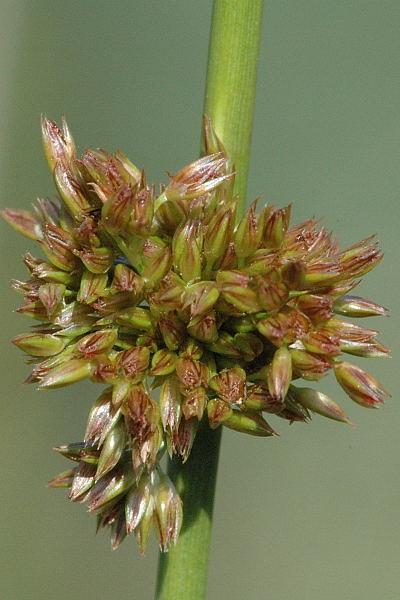
Photo: James K. Lindsey, CC BY-SA 3.0 · source

Grass-like plant · Rush family (Juncaceae)
Compact rush
Juncus conglomeratus
In other languages: Biezenknoppen (Nederlands) · Jonc aggloméré (Français)
Grows wild in Belgium.
Compact rush is a native rush that grows in sturdy tussocks on wet, acid, nutrient-poor ground. In Belgium you find it mainly in the sandy regions and the Ardennes: on wet heath, in damp grassland and along ditches, ponds and woodland paths. It looks very much like the better-known soft rush, but has dull, finely ridged stems and a compact, rounded flower head that seems to grow out of the side of the stem. The tussocks give insects, spiders and small animals shelter all year round. In the garden it is a modest, evergreen structural plant for a wet corner, a pond edge or a rain garden.
Light
Sun or partial shade
preferably some sun
Moisture
Moist to wet
must not dry out
Hardiness
Fully hardy
down to -30 °C
Size
0.6 m
tall, 0.4 m wide
Flowering
May–July
| Pruning months | March |
|---|---|
| Height | 0.6 m |
| Native to Belgium | Yes |
| Flowering | May–July |
Identify
How to recognise it
- Growth habit
- Dense, upright tussock 30–80 cm tall with many round stems; no true leaves.
- Stem
- Round, dull grey-green and clearly ridged, especially just below the flower head; filled with white, spongy pith. Brown sheaths at the base.
- Flower
- Small, brown and inconspicuous, in a dense, rounded head that seems to come out of the side of the stem, from May to July. The part of the stem above it is actually a bract.
- Fruit/Seed
- Brown capsule of 2–3 mm with many tiny seeds; the remains of the style sit on a small bump at the top of the capsule.
- Roots
- Short, dense rhizome with many fine roots: the tussock widens slowly.
- Confusion with
- Soft rush has smooth, glossy, bright green stems and usually a looser, spreading flower head; the remains of the style sit in a small hollow at the top of the capsule. Hard rush has blue-green stems with interrupted pith.
Flowering: May–July · Pruning: March
In your garden
Why grow it?
- Dense tussocks that shelter insects, spiders, beetles and young frogs all year round.
- In wet grassland the tussocks give cover to meadow birds and their chicks.
- The seed capsules feed the caterpillars of a few small moths that specialise in rushes.
- Evergreen: the stems stay largely green in winter and give structure to a wet corner.
- A tough plant for a pond edge, wet ditch or rain garden that copes with changing water levels.
- A good indicator: where compact rush grows, the soil is wet, acid and fairly poor.
Compact rush: where does it grow best?
- In the wild on wet heath, in damp, nutrient-poor grassland and hay meadows, along ditches, heathland pools, ponds and wet woodland paths.
- Acid to slightly acid, poor soil: sand, peaty soil or loam; never on chalk or limestone.
- Sun to partial shade; the soil must be moist to wet for most of the year, although it tolerates a short dry spell.
- In the garden: at a pond edge, in a wet ditch, rain garden or bog area, or in a pot in shallow water up to about 10 cm deep.
Goes well with
- Ragged-robin: Pink, ragged flowers in May–June between the green stems, on the same wet soil.
- Greater bird’s-foot trefoil: Small yellow flowers in summer, loved by bumblebees, also on acid, wet soil.
- Devil’s-bit scabious: Violet-blue pompons in late summer, a top plant for bees and butterflies on wet, poor soil.
- Cross-leaved heath: Pink bells of wet heath; together they make a small piece of heathland in your garden.
- Water forget-me-not: Sky-blue flowers at the pond edge all summer long.
Maintenance
Compact rush: when and how to plant it?
- Buy compact rush from a nursery for native plants or for water and marginal plants. Never dig up tussocks from the wild.
- Plant in spring (April–May) or in September–October, when the soil is wet.
- Space plants 40–50 cm apart, at the same depth as in the pot, on a wet bank or in a bog area.
- You can also sow it: in spring, scatter the tiny seeds on wet, acid compost and do not cover them, as they need light to germinate. Stand the pot in a tray of water.
- Keep the soil moist at all times in the first year; after that, the plant looks after itself in a wet spot.
Care
- Water
- Nothing needed in a wet spot. In a spot that is too dry, water in summer, or better: choose a wetter spot.
- Feeding
- Do not feed: on poor soil the tussock stays compact and flowers next to it also get a chance.
- Mowing
- In a wet hay meadow, mow once a year in late summer and remove the cuttings; the tussocks can be mown along with the rest.
- Tidying
- In March, pull dead, brown stems out of the tussock so that it stays fresh.
- Seedlings
- Simply pull up or move seedlings that appear around it if you do not want them.
Tip: Not sure whether it is compact rush or soft rush? Run your fingers along the stem just below the flower head: if you feel clear ridges, it is compact rush.
Pruning and mowing
Pruning months: March.
When: In March, before the new stems appear. Not needed every year.
How:
- Leave the tussock standing all winter: insects and spiders overwinter between the stems.
- In March, pull out or cut the brown, dead stems; leave the green ones.
- If the tussock is old and untidy, cut it right back to 10 cm above the ground in March; it soon regrows.
- In a wet hay meadow it can simply be mown with the rest in late summer.
Propagation
- Division
- In April or September, cut a tussock into pieces with a sharp spade, each with stems and roots, and replant straight away in a wet spot.
- Seed
- In spring on wet, acid compost, uncovered (needs light to germinate). Plant out the seedlings after a year.
Compact rush: how does it get through the winter?
Hardy to −30 °C.
- The stems stay largely green: an evergreen tussock for a wet corner.
- Fully hardy, even at the edge of a frozen pond.
- Insects, spiders and small animals overwinter in the dense tussock.
- The brown seed heads stay on the stems well into winter.
Diseases and pests
- Self-seeding: On wet, bare soil it can seed itself freely. Pull up seedlings while young; in closed turf it hardly germinates.
- Too dry: In a dry spot the stems turn brown and the tussock declines. Choose a spot that stays moist all year.
- Tussock too big: Old tussocks become bare in the centre. Divide them every few years.
- Rushes in grassland: If rushes spread strongly in a wet meadow, the soil is often compacted or overgrazed. Mowing in late summer and less trampling help.
Through the year
- March: Pull out brown stems or cut the tussock back.
- April: Plant, divide and sow.
- May: Flowering starts: brown heads on the stems.
- June: In flower.
- July: The capsules ripen. Keep the soil moist in dry weather.
- August: The seeds drop. Keep an eye on seedlings.
- September: Plant and divide. Mow the wet meadow.
- November: Leave the tussock for overwintering insects.
- December: Evergreen stems with brown seed heads.
You and this species
Did you know?
- Conglomeratus is Latin for ‘crowded together’ and refers to the dense, rounded flower head; the Dutch name biezenknoppen (‘rush knobs’) says the same.
- The white pith of rushes was once used as a wick for lamps and rushlights; the Dutch name of the related soft rush, pitrus, still refers to it.
- The seeds become sticky when wet and so cling to feet, hooves and boots. They can survive in the soil for many years.