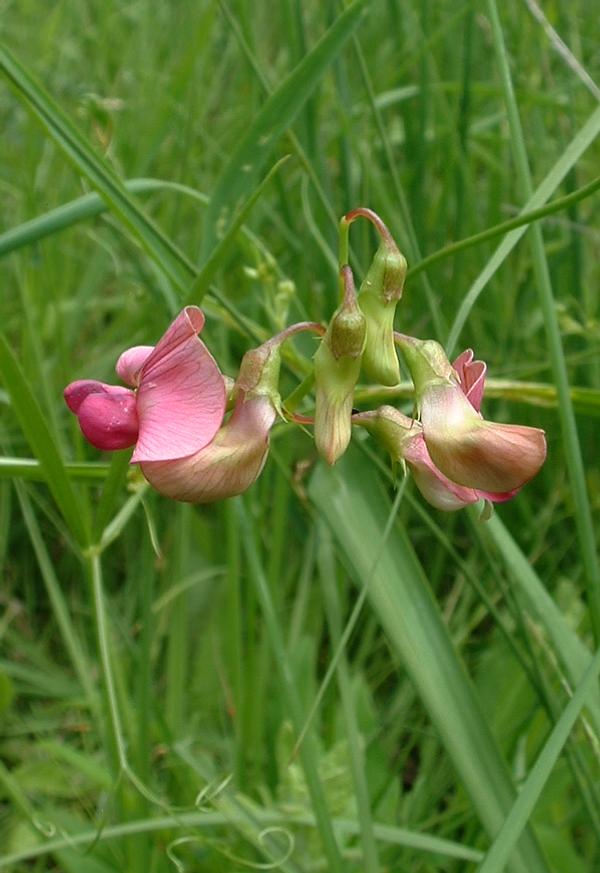
Photo: Jeffdelonge at French Wikipedia, CC BY-SA 3.0 · source

Climber · Pea family (Fabaceae)
Narrow-leaved everlasting-pea
Lathyrus sylvestris
In other languages: Boslathyrus (Nederlands) · Gesse des bois (Français)
Grows wild in Belgium.
Narrow-leaved everlasting-pea is a vigorous climbing perennial of the pea family, with winged stems and clusters of pink flowers with a greenish tinge. It grows at woodland edges, in scrub, hedges, on banks, railway embankments and in quarries, often on limy or stony soil. In Belgium it is found mainly in the south, in the limestone regions of Wallonia; in Flanders it is rare. You recognise it by the broad wings along the stem, the leaves with a single pair of long, narrow leaflets and a branched tendril, and the flowers from June to August. Bumblebees and large wild bees love the flowers.
Caution: The seeds and pods are poisonous, as in many Lathyrus species. Do not let children or pets eat them and do not confuse them with edible peas.
Light
Sun or partial shade
preferably some sun
Moisture
Dry to normal
no wet feet
Hardiness
Fully hardy
down to -25 °C
Size
2 m
tall, 1 m wide
Flowering
June–August
| Pruning months | March |
|---|---|
| Height | 2 m |
| Native to Belgium | Yes |
| Flowering | June–August |
Identify
How to recognise it
- Habit
- Climbing or sprawling perennial with stems 1–2 m long, which clings to shrubs and fences with its tendrils.
- Stem
- Broadly winged: a green wing runs along each side, making the stem look flat and ribbon-like.
- Leaf
- A single pair of long, narrow, lance-shaped leaflets 7–15 cm long, with a branched tendril between them.
- Flower
- Clusters of 3–12 flowers 1.5–2 cm long, dull pink to purplish pink with a greenish back, from June to August.
- Fruit
- Hairless, flat pod 5–7 cm long, which twists open when ripe and shoots out the seeds.
- Roots
- Deep, branching rhizome with root nodules.
- Confusion with
- Broad-leaved everlasting-pea, a garden escape, has broader leaflets, broader stem wings and larger, bright pink flowers. Meadow vetchling is smaller and has yellow flowers.
Flowering: June–August · Pruning: March
In your garden
Why grow it?
- Flowers from June to August with plenty of blooms for bumblebees and large wild bees, such as leafcutter bees.
- A native climber for a hedge, fence or scrub that holds on by itself with its tendrils.
- Fixes nitrogen from the air with the bacteria in its root nodules.
- Long-lived and tough: once established, it comes back every year, even after dry summers.
- A little-known native plant that deserves a place in more gardens.
Narrow-leaved everlasting-pea: where does it grow best?
- In the wild at woodland edges, in scrub, hedges, on banks, in quarries and along railways.
- Sun to partial shade: the base may be in shade as long as the stems can climb towards the light.
- Free-draining, dry to average soil, preferably limy or stony; it tolerates drought.
- In the garden: against a hedge, fence or shrub, in a wild edge or on a sunny bank.
Goes well with
- Dog rose: A native shrub to climb through, with pink flowers and rosehips.
- Common hawthorn: A sturdy hedge for it to climb through.
- Wild marjoram: At its foot, on the same limy, sunny soil.
- Agrimony: Yellow spikes in summer at a woodland edge.
- Tufted vetch: Another climbing pea flower, with violet-blue clusters.
Maintenance
Narrow-leaved everlasting-pea: when and how to plant it?
- Buy plants or seed from a nursery specialising in native plants.
- Sow in March–April or in autumn: soak the seeds overnight in water or roughen them with sandpaper, and sow them 2–3 cm deep in a deep pot.
- Plant young plants in April–May or in September, 50–80 cm apart, at the foot of a shrub, hedge or fence.
- Water in dry spells for the first few months; after that its deep roots are enough.
- In the first year, help the young stems find their support.
- Never dig up plants from the wild.
Care
- Watering
- Only in dry spells in the first year.
- Feeding
- Not needed: as a member of the pea family it makes its own nitrogen.
- Support
- A fence, hedge or screen of twigs to climb; without support it forms a sprawling cushion on the ground.
- Spreading
- It spreads slowly by rhizomes; dig out shoots that go too far.
- Seed
- Let some of the pods ripen if you want it to self-seed.
Tip: Plant it at the foot of an open hedge or a fence: that way it climbs towards the light and you see the flowers at eye level.
Pruning and mowing
Pruning months: March.
When: In March, when you cut away last year’s dead stems.
How:
- Leave the dead stems standing in winter: they give insects shelter.
- In March, cut them just above the ground, before the new shoots appear.
- Then guide the new shoots back to their support.
Propagation
- Seed
- Soak or roughen the seeds and sow in March–April or in autumn in deep pots.
- Division
- In March, dig up a piece of rhizome with shoots; it does not transplant very well, so take a good root ball.
Narrow-leaved everlasting-pea: how does it get through the winter?
Hardy to −25 °C.
- The stems die back in autumn; the rhizome survives the winter deep in the soil.
- Leave the dead stems standing as shelter for insects.
- Fully hardy.
Diseases and pests
- Aphids: On the young tips in May–June. Ladybirds usually deal with them; otherwise spray them off with water.
- Powdery mildew: White powder on the leaves in dry summers. Harmless; space and water help.
- Slugs and snails: They eat young shoots in spring. Protect young plants and collect slugs in the evening.
- Smothering: It can swamp low shrubs. Guide the stems onto a sturdy support.
Through the year
- March: Cut away dead stems. Sow.
- April: New shoots. Plant.
- May: Guide stems to their support. Watch for aphids.
- June: Flowering begins.
- July: Full flower: bumblebees and bees.
- August: Last flowers. Pods ripen.
- September: Collect seed. Plant.
- October: The stems die back.
- November: Leave the dead stems standing.
You and this species
Did you know?
- Ripe pods dry in the sun and suddenly twist open, shooting the seeds some distance away.
- In North America it has been sown to protect banks and roadsides against erosion.
- The wings along the stem are green and make sugars, just like the leaves.