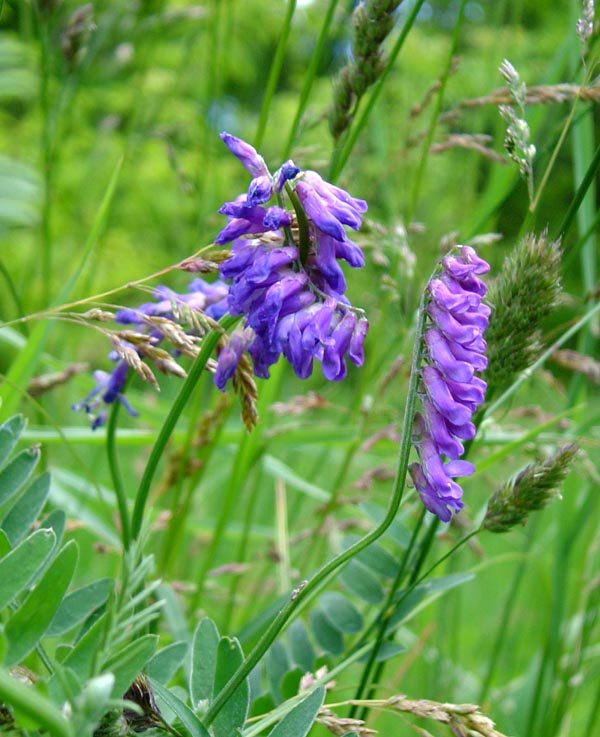
Photo: The original uploader was Hadal at English Wikipedia., CC BY-SA 3.0 · source

Herbaceous plant · Pea family (Fabaceae)
Tufted vetch
Vicia cracca
In other languages: Vogelwikke (Nederlands) · Vesce cracca (Français)
Grows wild in Belgium.
Tufted vetch is a climbing member of the pea family with long, one-sided spikes of bluish purple flowers that scrambles through rough ground and hedges from June to August. It is common throughout Belgium, in hay meadows, verges, ditch sides, field edges and rough grassland, and along hedges and reed fringes. You recognise it by its pinnate leaves with many narrow leaflets and a branched tendril at the tip, and by its dense spikes of up to forty flowers, all facing one way. Bumblebees and other bees come and go all day. Like most members of the pea family, it captures nitrogen from the air with the help of bacteria in its root nodules.
Light
Sun or partial shade
preferably some sun
Moisture
Normal
no wet feet
Hardiness
Fully hardy
down to -30 °C
Size
1 m
tall, 0.5 m wide
Flowering
June–August
| Pruning months | September |
|---|---|
| Height | 1 m |
| Native to Belgium | Yes |
| Flowering | June–August |
Identify
How to recognise it
- Habit
- Perennial climber with creeping rhizomes; stems 0.5–1.5 m long, climbing or sprawling.
- Leaf
- Pinnate, with 6–12 pairs of narrow, slightly hairy leaflets and a branched tendril at the tip.
- Flower
- Bluish purple, about 1 cm, with 10–40 together in a dense, one-sided spike on a long stalk, from June to August.
- Fruit/Seed
- A flat, hairless pod 1.5–2.5 cm long that turns brown and splits open, with 2–6 seeds.
- Roots
- Creeping rhizomes with nodules housing nitrogen-fixing bacteria.
- Confusion with
- Bush vetch has only 2–6 dull purple flowers in short clusters and broader leaflets. Hairy tare has tiny whitish flowers. Meadow vetchling flowers yellow and has just one pair of leaflets per leaf.
Flowering: June–August · Pruning: September
In your garden
Why grow it?
- A rich source of nectar for bumblebees, honeybees and solitary bees from June to August.
- Food plant for the caterpillars of several moths, such as the burnet companion.
- Climbs through grass and shrubs with its tendrils and brings colour to a rough verge or hedge.
- Fixes nitrogen through root nodules, so it fits well into poor, flower-rich grassland.
- The ripe seeds are food for seed-eating birds.
Tufted vetch: where does it grow best?
- In the wild: hay meadows, verges, dykes, hedgerows, field edges, ditch sides and reed fringes.
- Sun to light shade.
- Ordinary to moist soil that is not too rich: sand, loam or clay.
- In the garden: against a hedge, a fence or a woven hurdle, or in a wildflower meadow with tall grasses.
Goes well with
- Meadow vetchling: Yellow flowers beside bluish purple ones, on the same rough verge.
- Common knapweed: Purple heads for butterflies, in the same hay meadow.
- False oat-grass: A tall grass for it to climb into.
- Hawthorn: A hedge to climb through.
Maintenance
Tufted vetch: when and how to plant it?
- Buy plants from a native-plant nursery, or sow your own.
- Sow in September–October or in March–April. The seed has a hard coat: soak it overnight in lukewarm water.
- Sow 1–2 cm deep, straight into place or in pots.
- Set plants 40–50 cm apart, ideally at the foot of a hedge or fence, or among tall grasses it can climb into.
- Water until the plant is well established.
- Never dig up plants from the wild.
Care
- Water
- Only in the first season, during dry spells.
- Feeding
- Not needed: it makes its own nitrogen.
- Support
- Not needed in rough ground or a hedge. In a border: a few twigs or a small fence to climb.
- Mowing
- In a hay meadow, cut in September after the seed has set, and remove the cuttings.
- Spreading
- In a border it can smother smaller plants. Pull the trailing stems free or cut them back.
Tip: Give tufted vetch something to climb: at the foot of a mixed hedge or a woven fence it climbs up to 1.5 m and shows off its flower spikes at their best.
Pruning and mowing
Pruning months: September.
When: In September, when most of the pods are ripe.
How:
- Mow or cut the stems 5–10 cm above the ground.
- Leave the cuttings for a few days so the seeds can drop, then remove them.
- In a hedge the dead stems can stay; they rot down by themselves.
- If it smothers its neighbours in summer, feel free to cut it back; it will regrow.
Propagation
- Seed
- Pick the pods in August–September when they turn brown. Sow in autumn, or soak the seed for a spring sowing.
- Division
- In March–April, cut off a piece of rhizome with a shoot and replant it.
Tufted vetch: how does it get through the winter?
Hardy to −30 °C.
- Everything above ground dies back; the rhizomes overwinter in the soil.
- Dead stems in hedges and rough ground give shelter to insects.
- Fully hardy, to about −30 °C.
Diseases and pests
- Smothering: In a border it scrambles over lower plants. Cut the stems back or give it a fence or shrub.
- Aphids: Black aphids on the shoot tips in early summer. Let ladybirds and hoverflies do their work, or hose them off.
- Powdery mildew: A white film on the leaves in dry late summers. Harmless; the September cut clears it.
- Poor germination: Hard seed coat. Soak the seed overnight or rub it lightly with sandpaper.
Through the year
- March: Sow (soaked seed). Plant.
- April: New shoots appear. Give support in the border.
- June: Flowering begins. Bumblebees on the flowers.
- July: Full flower.
- August: Flowering and the first ripe pods. Collect seed.
- September: Mow after seed set; remove the cuttings. Sow.
- October: Sow and plant.
- November: Rest. The rhizomes overwinter.
You and this species
Did you know?
- A single spike can hold up to forty flowers, all turned to one side.
- When the ripe pods dry out, the two halves suddenly twist open and fling out the seeds.
- Bacteria in the root nodules capture nitrogen from the air; when the plant dies, that nitrogen ends up in the soil.