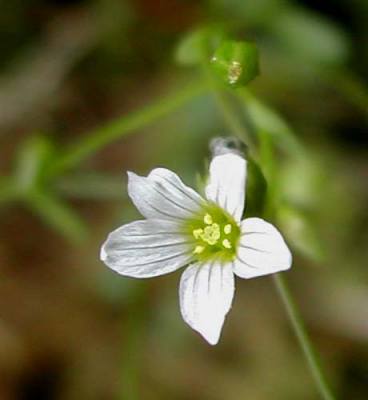
Photo: No machine-readable author provided. Aroche assumed (based on copyright claims)., CC BY-SA 2.5 · source

Herbaceous plant · Flax family (Linaceae)
Fairy flax
Linum catharticum
In other languages: Geelhartje (Nederlands) · Lin purgatif (Français)
Grows wild in Belgium.
Fairy flax is a very slender annual or biennial with thread-thin stems and small white flowers with a yellow centre. It grows in poor, open grassland on chalky or loamy soil: chalk and limestone grassland, dunes and dune slacks, dykes and poor hay meadows. In Belgium it is fairly common in the dunes and on the limestone of the south, but rather rare elsewhere. You can recognise it by its small, opposite leaves, a feature found in no other native flax, and by its nodding flower buds. It is a good indicator of poor, unfertilised soil and a little gem for anyone with a short, flower-rich grassland.
Caution: Fairy flax is strongly laxative if eaten and can be poisonous. Don’t eat it or use it as a remedy; take particular care with young children.
Light
Full sun
warm and bright
Moisture
Dry to normal
no wet feet
Hardiness
Fully hardy
down to -25 °C
Size
0.15 m
tall, 0.05 m wide
Flowering
June–August
| Pruning months | March and September |
|---|---|
| Height | 0.15 m |
| Native to Belgium | Yes |
| Flowering | June–August |
Identify
How to recognise it
- Growth habit
- Slender, upright little plant 5–25 cm tall, with one or a few thread-thin stems that fork near the top.
- Leaf
- Small, oblong to lance-shaped, 5–12 mm, hairless, with a single vein; the leaves are opposite, which is the case in no other native flax.
- Flower
- White, 4–6 mm across, with five petals and a yellow centre, in loose clusters; the buds nod before opening.
- Fruit/Seed
- Round capsules 2–3 mm across with small, flat, shiny seeds.
- Roots
- A fine, short taproot.
- Confusion with
- Common chickweed and other stitchworts and mouse-ears also have small white flowers, but with deeply split petals and no yellow centre. Heath bedstraw has leaves in whorls and flowers with four petals. Fairy flax: five undivided white petals, a yellow centre and opposite leaves.
Flowering: June–August · Pruning: March and September
In your garden
Why grow it?
- A typical plant of poor, chalky grassland: where fairy flax grows, the soil is low in nutrients and usually rich in other wild plants.
- Flowers from June to August with dozens of small white stars in short turf.
- The flowers are visited by small flies and beetles, but they also self-pollinate; for insects it is a modest plant.
- Perfect for a rock garden, a poor patch of lawn on chalky soil or a dune garden.
- It was used historically as a laxative, hence the name catharticum; today it is mainly a plant to enjoy.
Fairy flax: where does it grow best?
- In the wild in chalk and limestone grassland, grey dunes and dune slacks, on dykes, in poor hay meadows and on open chalky ground.
- Full sun and low, open vegetation: in tall grass it disappears.
- Poor, chalky or loamy soil, dry to moist; in the dunes also on sand enriched with lime from shells.
- In the garden: a poor, chalky spot with short grass, a gravel or rock garden or a patch of dune garden.
Goes well with
- Salad burnet: Another plant of chalk grassland, with finely divided leaves.
- Bird’s-foot trefoil: Yellow flowers in the same short turf and food plant of the common blue.
- Common centaury: Pink stars on the same poor, open ground.
- Harebell: Blue bells in short, poor grassland.
- Large thyme: A low, scented cushion that wants the same sun and poor soil, and attracts lots of bees.
Maintenance
Fairy flax: when and how to plant it?
- Buy seed of native origin from a wildflower nursery, possibly in a mix for chalk grassland.
- Sow in September–October so the seed spends the winter outdoors; sowing in March is also possible.
- Scatter the seed thinly on bare, poor soil or in open patches in short turf, and press it in without covering.
- Don’t feed or add compost: on rich soil fairy flax is soon overgrown by other plants.
- Keep the seedbed lightly moist for the first few weeks.
- Never dig up plants in the dunes or in nature reserves; they also survive transplanting poorly.
Care
- Watering
- Not needed, except during drought just after sowing.
- Feeding
- Never. Poor soil is essential for fairy flax.
- Mowing
- Mow late, in September, when the seeds are ripe, and remove the cuttings. In March you can give the turf one more short cut.
- Open patches
- The plant only germinates on bare soil. Rake out some moss and thatch after mowing.
- Self-seeding
- Leave the cuttings for a few days so that the seeds drop out.
Tip: Give fairy flax a patch of ground that never gets fertiliser, mow late and then rake a few open patches: it will self-seed year after year.
Pruning and mowing
Pruning months: March and September.
When: Mow in September, after the seed has set, and if needed give one more short cut in March.
How:
- Mow short and remove the cuttings after two or three days of drying.
- Rake out moss and thatch to create places for seeds to germinate.
- Keep the turf short in winter too, so the young plants get light.
Propagation
- Seed
- The only way. Collect the ripe capsules in your own garden in August and scatter the seed straight away on open, poor patches.
- Self-seeding
- In a suitable spot, fairy flax maintains itself year after year by self-seeding, as long as you mow late.
Fairy flax: how does it get through the winter?
Hardy to −25 °C.
- Annual plants die after setting seed.
- Autumn seedlings overwinter as small plants in the turf and flower the following summer.
- The seed is fully hardy.
Diseases and pests
- Disappears after a few years: Too many nutrients, grass too tall or too little bare soil. Impoverish the soil, mow late and rake open patches.
- Overgrown by grass: Give an extra cut in March and always remove the cuttings.
- Overlooked: The plant is so small that it is easily pulled up when weeding. Mark the spot where you sowed.
- No germination: Sown too deep or the soil dried out. Sow on the surface, press in and keep moist for the first weeks.
Through the year
- March: Mow the turf short. Sowing is still possible.
- April: Seedlings grow. Don’t feed.
- May: The plants shoot up.
- June: Flowering begins.
- July: Full flower: dozens of white stars in the short grass.
- August: Last flowers. Collect ripe capsules and seed.
- September: Mow and remove the cuttings. Sow.
- October: Sow in open patches. Seedlings appear.
You and this species
Did you know?
- The name catharticum means ‘cleansing’ or ‘laxative’: the plant was once used as a laxative and was also called purging flax in English.
- It is related to the flax from which linen is made, but it is much smaller and, unlike our other flaxes, has opposite leaves.
- The Dutch name geelhartje, little yellow heart, refers to the yellow centre of the white flowers; the English name fairy flax to its delicate slenderness.