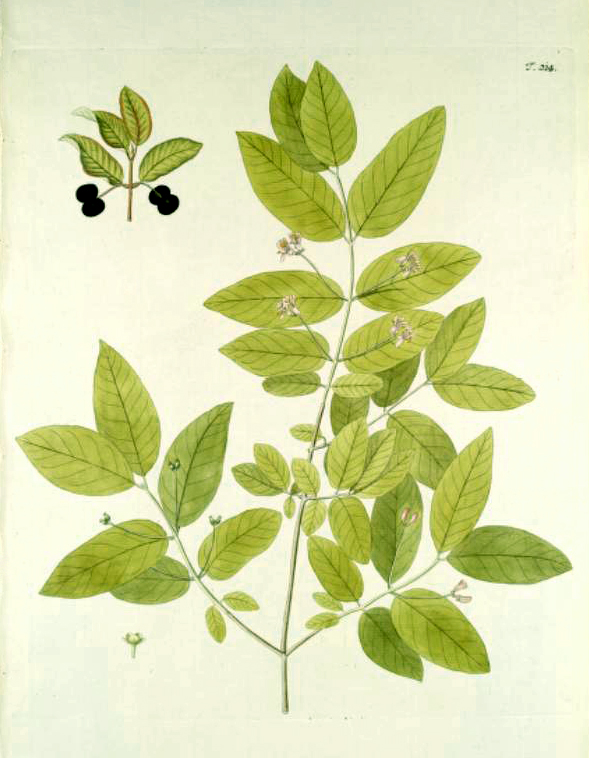
Photo: Nicolás Joseph Jacquin, Public domain · source

Shrub · Honeysuckle family (Caprifoliaceae)
Black-berried honeysuckle
Lonicera nigra
In other languages: Zwarte kamperfoelie (Nederlands) · Camérisier noir (Français)
Grows wild in Europe, but not in Belgium.
Black-berried honeysuckle is a deciduous shrub from the mountains of central and southern Europe, such as the Alps, the Pyrenees, the Jura, the Vosges and the Carpathians. There it grows in the understorey of beech and conifer forests, in clearings and along woodland edges, usually in cool, moist places. It does not grow wild in Belgium; you occasionally see it in gardens and arboreta. It looks nothing like the familiar climbing honeysuckle: it is an upright shrub with small, pale pink flowers borne in pairs on long stalks, followed in summer by glossy black berries, also in pairs. Bumblebees and bees visit the flowers and birds eat the berries. In a shady wildlife garden it is a modest but delicate shrub.
Caution: The black berries are not edible and are mildly poisonous: they can cause stomach ache, vomiting and diarrhoea. Children may confuse them with bilberries or with the edible honeyberry. Teach children the difference and do not let dogs eat them.
Light
Partial shade or shade
tolerates little sun
Moisture
Normal
no wet feet
Hardiness
Fully hardy
down to -30 °C
Size
1.5 m
tall, 1.5 m wide
Flowering
May–June
| Pruning months | February–March |
|---|---|
| Height | 1.5 m |
| Native to Belgium | No, planted |
| Flowering | May–June |
Identify
How to recognise it
- Growth habit
- Upright, open, deciduous shrub of 1–1.5 m, sometimes up to 2 m, with thin grey-brown branches. Not a climber.
- Leaf
- Opposite, elliptic to oblong, 3–7 cm, with a smooth edge and a short stalk; slightly hairy underneath when young, later hairless and matt green.
- Flower
- Small (about 1 cm), two-lipped, pale pink to pinkish white, always in pairs at the end of a long, thin stalk of 2–4 cm; in May–June.
- Fruit
- Glossy blue-black berries of 6–8 mm, in pairs joined at most at the base; ripe in July–August.
- Roots
- Finely branched and fairly shallow; it likes a cool soil rich in humus.
- Confusion with
- Fly honeysuckle (Lonicera xylosteum) has soft, hairy leaves, yellowish-white flowers on short stalks and red berries. Alpine honeysuckle (Lonicera alpigena) has large red berries that are almost completely fused. The edible honeyberry (Lonicera caerulea) has blue berries with a bloom, fully fused into a single fruit.
Flowering: May–June · Pruning: February–March
In your garden
Why grow it?
- The small, pale pink flowers in May–June give nectar and pollen to bumblebees and bees.
- The glossy black berries in July–August feed blackbirds, thrushes, robins and blackcaps.
- One of the few flowering shrubs that does well in fairly deep shade under trees.
- Stays compact, about 1–1.5 m: suited to a small shady garden or as understorey along a woodland edge.
- A little-known relative of our wild honeysuckle, fascinating for anyone who collects European mountain plants.
Black-berried honeysuckle: where does it grow best?
- In the wild: broadleaved and coniferous mountain forests, clearings, woodland edges and scrub, in cool, moist places.
- In the garden: partial to full shade. In full sun it dries out and its leaves suffer in the heat.
- Humus-rich, moisture-retentive but free-draining soil, slightly acid to chalky.
- Lovely as understorey beneath tall trees, along a woodland edge or in a shady hedge for birds.
Goes well with
- Sweet woodruff: A fragrant, white-flowered carpet in the same cool shade.
- Lady fern: Fine, fresh green fronds as ground cover.
- Wood anemone: Flowers in March–April, before the trees above come into leaf.
- Yellow archangel: Ground cover for shade with early nectar for bumblebees.
- Hazel: A taller shrub for the back of a shady hedge for birds.
Maintenance
Black-berried honeysuckle: when and how to plant it?
- Buy it from a nursery specialising in unusual shrubs or wild European shrubs. Never take plants from the wild, not even in the mountains on holiday.
- Plant in October–November or in March, when the soil is neither frozen nor waterlogged.
- Dig a planting hole twice as wide as the root ball and mix in some leaf mould.
- Set the plant at the same depth as in its pot, firm the soil well and give it a full watering can.
- Allow 1–1.5 m of space per plant; in a mixed hedge, plant 80 cm apart.
- Mulch around the base with leaf mould or wood chips and water in dry spells during the first year.
Care
- Water
- Weekly in dry weather during the first year. Later only in long, dry summers: it likes cool, moist soil.
- Feeding
- Not needed. Leaving its own fallen leaves or adding some leaf mould in spring is enough.
- Mulching
- A layer of leaves or wood chips keeps the soil cool and moist, as in a mountain forest.
- Position
- Protect it from fierce midday sun: in heat and drought its leaves soon droop.
- Berries
- Leave them for the birds; pick only a few if you want to sow your own.
Tip: Plant it where you can see it from the window: in July, blackbirds and blackcaps come to pick the black berries one by one.
Pruning and mowing
Pruning months: February–March.
When: Little needed. Thin out in February–March, before the leaves come out.
How:
- Every few years, remove one or two of the oldest branches at the base: this keeps the shrub young and open.
- Cut out dead, weak and crossing branches.
- Do not trim the whole outside of the shrub: this keeps its natural shape and its flower buds.
Caution: It flowers on last year’s wood: if you cut everything back in winter, you will have few flowers and berries that year.
Propagation
- Seed
- In summer, take the seeds out of ripe berries, rinse them and sow them outdoors in a pot in autumn. They need a cold period and germinate in spring.
- Cuttings
- Semi-ripe cuttings of 10 cm in June–July, under plastic in moist cutting compost. Or hardwood cuttings of 20 cm in December–January, outdoors in the ground.
- Layering
- In spring, peg a low branch down into the soil; after a year it has roots and you can cut it free.
Black-berried honeysuckle: how does it get through the winter?
Hardy to −30 °C.
- Drops its leaves in autumn and stays bare all winter.
- Very hardy, down to about −30 °C: a true mountain plant that needs no protection.
- The fallen leaves beneath the shrub shelter insects, spiders and hedgehogs: leave them be.
- Comes into leaf early in spring, while the trees above are still bare.
Diseases and pests
- Aphids: On young shoots in spring. Ladybirds, lacewings and birds usually clear them up.
- Drought: Drooping or brown leaves in hot summers. Water, mulch the soil and, if needed, choose a cooler spot.
- Powdery mildew: White powder on the leaves in dry summers. Leave space around the shrub, water at the base and cut out badly affected shoots.
- Berries and children: Children may mistake the black berries for bilberries. Teach them the difference or plant it where young children do not play.
Through the year
- February: Thin out: remove a few old branches at the base.
- March: Plant. Mulch. Last pruning.
- April: Leaves come out. Watch for aphids.
- May: In flower: bumblebees and bees on the pale pink blossoms.
- June: Last flowers. Take semi-ripe cuttings.
- July: The berries turn black; blackbirds and thrushes come to feed.
- August: Ripe berries. Collect and rinse seed. Water in dry spells.
- October: Plant. Sow seed in a pot outdoors.
- November: Plant. Leave the fallen leaves in place.
- December: Take hardwood cuttings.
You and this species
Did you know?
- In the shrubby honeysuckles the flowers always come in pairs, and two berries form side by side: that is how you recognise the group at a glance.
- The genus Lonicera is named after Adam Lonicer, a sixteenth-century German physician and botanist.
- In German, shrubby honeysuckles are called Heckenkirsche, ‘hedge cherry’, after their glossy berries that look like small cherries.