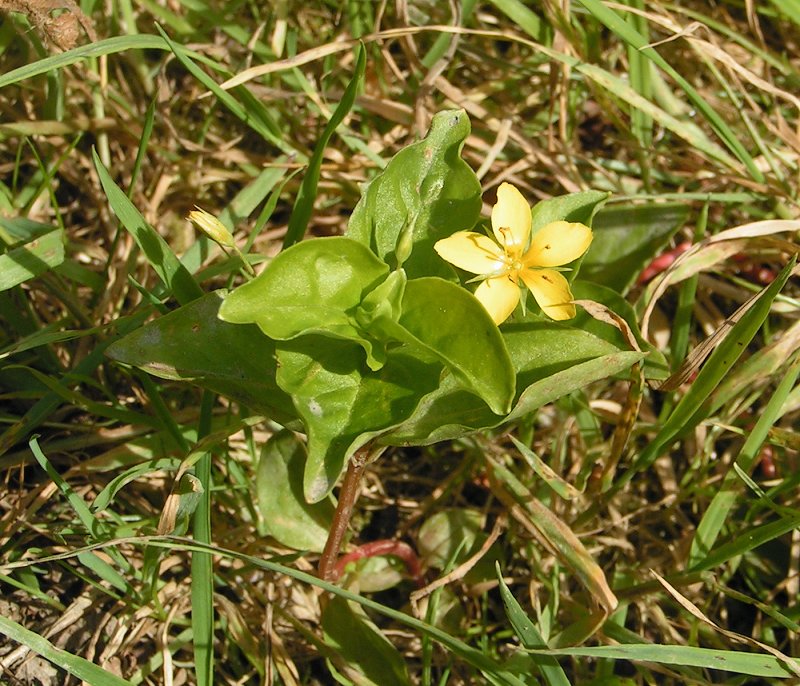
Photo: Wikimedia Commons, CC BY-SA 3.0 · source

Herbaceous plant · Primrose family (Primulaceae)
Yellow pimpernel
Lysimachia nemorum
In other languages: Boswederik (Nederlands) · Lysimaque des bois (Français)
Grows wild in Belgium.
Yellow pimpernel is a small, creeping perennial of damp woods, with glossy, opposite leaves and loose, star-shaped yellow flowers on long, thread-thin stalks. The trailing stems grow 10–40 cm long and creep over the woodland floor, along woodland paths and ditches. It grows in damp, fairly rich deciduous woods on loam and in spring-fed woodland; in Belgium it is fairly common in the Ardennes and locally in the loam region, but rather rare in the rest of Flanders. You can recognise it by the flowers that appear one by one from the leaf axils, from May to August. It is a typical plant of ancient woodland and, in the garden, a dainty ground cover for a damp, shady corner.
Light
Partial shade or shade
tolerates little sun
Moisture
Normal to wet
must not dry out
Hardiness
Fully hardy
down to -25 °C
Size
0.1 m
tall, 0.4 m wide
Flowering
May–August
| Pruning months | March |
|---|---|
| Height | 0.1 m |
| Native to Belgium | Yes |
| Flowering | May–August |
Identify
How to recognise it
- Growth habit
- Low, creeping perennial with trailing stems of 10–40 cm that root at the nodes; the flowering tips rise a little, to 10–15 cm.
- Leaf
- Opposite, oval with a pointed tip, 2–4 cm long, short-stalked, hairless and glossy green.
- Flower
- Loose, star-shaped yellow flowers of 1–1.5 cm with five pointed petal lobes, one in each leaf axil on a thread-thin stalk longer than the leaf. From May to August.
- Fruit/Seed
- A small, round capsule with a few seeds, on a curved stalk.
- Roots
- Fine roots from the stem nodes; no thick rhizome.
- Confusion with
- Creeping-Jenny has round, blunt leaves and larger, cup-shaped flowers on short stalks; it often grows in grassland and along ditches. Tormentil has divided leaves and usually four petals. Yellow loosestrife is an upright plant about 1 m tall.
Flowering: May–August · Pruning: March
In your garden
Why grow it?
- Flowers for a long time, from May to August, in shady places where few other plants flower for so long.
- Small insects such as hoverflies and other little flies visit the flowers.
- A typical plant of old, damp woodland: in the garden it gives a shady corner an instantly natural, woodland feel.
- Stays green in mild winters and covers the ground, so unwanted plants have less chance.
- Low and modest: it creeps but rarely smothers its neighbours, and it looks lovely with ferns and spring flowers.
Yellow pimpernel: where does it grow best?
- In the wild: damp deciduous woods, spring-fed woodland, stream banks, along woodland paths, in wheel ruts and ditches, often on loam.
- Part shade to shade; in full sun it dries out.
- Moist to wet, humus-rich soil, acid to neutral, fairly rich but not fertilised.
- In the garden: as ground cover under shrubs, beside a shady pond or stream, or among ferns in a woodland garden.
Goes well with
- Lady fern: A fresh, tall fern above the low yellow mats.
- Wood anemone: Flowers in spring, before the yellow pimpernel gets going.
- Opposite-leaved golden saxifrage: Grows in the same wet, seepage spots in woodland.
- Bugle: Blue flower spikes in spring, in the same moist part shade.
Maintenance
Yellow pimpernel: when and how to plant it?
- Buy plants from a nursery that grows native wild plants; they are usually sold in pots.
- Plant in March–April or September–October, 25–30 cm apart, in moist, humus-rich soil.
- Mix some leaf mould into the soil if it is very sandy, and firm the plant in well.
- Water straight away and keep the soil moist for the first few weeks; spread a thin layer of leaves around the plant.
- To sow: scatter the seed in autumn in a pot of moist compost and leave it outside over winter. Many woodland plants germinate better after a cold spell.
- Never dig up plants from the wild: buy them from a nursery or ask for a cutting from someone who already has it in their garden.
Care
- Watering
- Not needed in moist woodland soil. During a long summer drought, do water, or it will soon dry out.
- Feeding
- Not needed. A layer of leaf mould or fallen leaves in autumn keeps the soil rich enough.
- Leaf litter
- Leave fallen leaves in place; the stems simply grow through them.
- Spreading
- It creeps but seldom smothers other plants. Stems that wander too far are easy to pull up.
- Competition
- Keep strong growers such as nettle, bramble and ground-ivy in check, or it will be overgrown.
Tip: To help it spread faster, peg a few long stems to the ground with a bent piece of wire: within a few weeks they root and you have new plants.
Pruning and mowing
Pruning months: March.
When: Hardly ever needed; if you like, shorten bare or overlong stems in March.
How:
- In March, cut overlong or bare stems back to close to the base.
- Leave everything for the rest of the year: the plant stays low and compact by itself.
- No need to mow it; route a path beside the plant rather than over it.
Propagation
- Rooted stems
- In spring or summer, detach a piece of stem that has already rooted at the nodes and replant it elsewhere. It almost always takes.
- Division
- In March–April or September, split a clump into a few pieces, each with roots.
- Seed
- Sow in autumn in a pot of moist compost and leave it outside over winter.
Yellow pimpernel: how does it get through the winter?
Hardy to −25 °C.
- In mild winters the leaves stay green; in hard frost part of the plant dies back above ground and it regrows in spring.
- Hardy: the creeping stems lie sheltered under the leaf litter.
- The green mats give shelter to small soil creatures such as woodlice and ground beetles.
Diseases and pests
- Drying out: In a spot that is too dry or sunny it wilts and disappears. Move it to a moist, shady place.
- Slugs and snails: They nibble the young leaves. Damage usually stays limited; hedgehogs, thrushes and ground beetles help.
- Being overgrown: Among nettles, bramble or tall grasses it disappears. Weed out strong competitors.
- Few flowers: In deep shade it flowers sparsely; light shade under deciduous trees is ideal.
Through the year
- March: Shorten overlong or bare stems. Plant.
- April: New growth. Take rooted pieces of stem.
- May: First flowers.
- June: Full flower. Water in dry spells.
- July: Flowering. Root trailing stems.
- August: Last flowers. Water in dry spells.
- September: Plant or divide.
- October: Leave fallen leaves. Sow in pots.
- December: Dormant; in mild winters the leaves stay green.
You and this species
Did you know?
- According to the Roman writer Pliny, the genus Lysimachia is named after King Lysimachus, one of Alexander the Great’s generals.
- The species name nemorum means ‘of the woods’: a fitting name for a plant you find almost only in woodland.
- The name ‘yellow pimpernel’ refers to its likeness to scarlet pimpernel, a close relative in the same family.