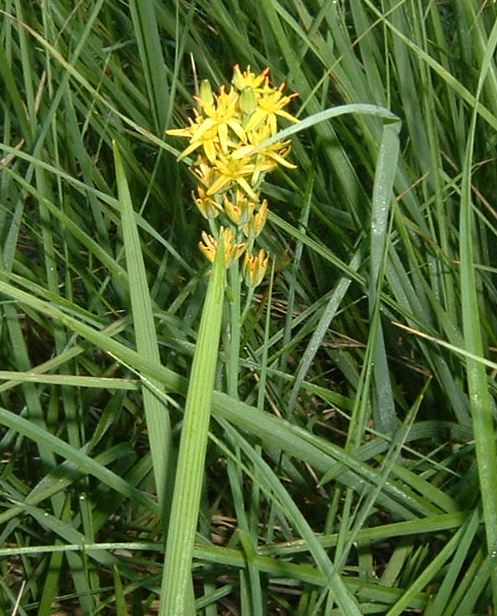
Photo: R.J. Casimir (= user Casimir), CC BY-SA 3.0 · source

Herbaceous plant · Bog asphodel family (Nartheciaceae)
Bog asphodel
Narthecium ossifragum
In other languages: Beenbreek (Nederlands) · Narthécie ossifrage (Français)
Grows wild in Belgium.
Bog asphodel is a low perennial of wet heath and bog, with little fans of narrow, sword-shaped leaves that look like a miniature iris. In July and August an upright spike appears with star-shaped, bright yellow flowers with strikingly woolly stamens and orange-red anthers. After flowering the whole plant, capsules and all, turns orange to coppery red, so that its sites stand out from afar in late summer. In Belgium bog asphodel is rare: you can still find it on a few wet heaths in the Campine and in the High Fens, always on acid, nutrient-poor, wet ground. Its name refers to an old belief that sheep that ate the plant developed brittle bones.
Caution: Bog asphodel is rare and declining in Belgium and mostly grows in protected nature reserves. Never pick or dig it up and don’t trample its sites; only buy cultivated plants from a specialist nursery. The plant is poisonous to grazing animals: sheep and cattle that eat a lot of it can suffer liver or kidney damage.
Light
Full sun
warm and bright
Moisture
Moist to wet
must not dry out
Hardiness
Fully hardy
down to -30 °C
Size
0.2 m
tall, 0.2 m wide
Flowering
July–August
| Pruning months | March |
|---|---|
| Height | 0.2 m |
| Native to Belgium | Yes |
| Flowering | July–August |
Identify
How to recognise it
- Growth habit
- Perennial of 10–30 cm in loose little groups from a creeping rhizome.
- Leaf
- Sword-shaped, flat and slightly curved, 5–20 cm long and 2–5 mm wide, in fans as on an iris; often tinged orange.
- Flower
- An upright spike of 6–20 star-shaped, bright yellow flowers of 1–1.5 cm, with six tepals. The stamens have densely woolly filaments and orange-red anthers. In July and August.
- Fruit/Seed
- Narrow, upright capsules of about 1 cm, bright orange to red. The small seeds have a long, thread-like appendage at each end.
- Roots
- A creeping rhizome in peat or wet, acid sand.
- Confused with
- When not in flower, bog asphodel looks like a tiny iris, but yellow flag is much larger and grows in richer water. In flower, with its yellow stars and woolly stamens, it is unmistakable.
Flowering: July–August · Pruning: March
In your garden
Why grow it?
- A characteristic plant of healthy wet heath and bog: where it grows, the site is still wet, acid and nutrient-poor.
- Two seasons of colour: bright yellow flowers in July–August and then orange to coppery red fruiting stems into autumn.
- The flowers mainly offer pollen to flies, hoverflies and small bees.
- A special plant for anyone making a bog garden or a wet heath garden kept wet with rainwater.
- A plant with a story: its name and the old folk belief about brittle bones in sheep.
Bog asphodel: where does it grow best?
- In the wild on wet heath, in bogs, along heathland pools and in wet, peaty spots where acid, nutrient-poor water seeps up.
- Full sun; in the shade of birch or purple moor-grass it disappears.
- Permanently wet, acid, very nutrient-poor soil: peat or peaty sand, kept wet with rainwater.
- In the garden only in a bog garden or wet heath garden, filled with lime-free sand and sphagnum moss and kept wet with rainwater.
Goes well with
- Round-leaved sundew: Grows in the same wet, acid spots and suits the same bog garden.
- Cross-leaved heath: Pink bells on the same wet heath.
- Cotton grass: White tufts in spring, on the same wet peat.
- Marsh gentian: Blue bells in late summer on wet heath; a rare partner, only from a nursery.
Maintenance
Bog asphodel: when and how to plant it?
- Only buy bog asphodel as a cultivated plant from a specialist nursery for native or bog plants; it is not easy to find.
- Make a bog garden: a tub or pond liner without drainage holes, or a hole lined with plastic sheeting, filled with a mix of sphagnum moss and lime-free sand.
- Plant in April–May in full sun, 15–20 cm apart, with the rhizome just below the surface.
- Keep everything soaking wet with rainwater. Never use tap water: the lime and salts in it will kill the plant in time.
- Never give fertiliser or compost.
- Never pick or dig up bog asphodel in the wild: it is rare, and dug-up plants almost never survive.
Care
- Water
- Always keep it wet with rainwater, also in summer. Drying out is fatal.
- Feeding
- Never. Any feeding lets grasses and mosses smother the plant.
- Seedlings
- Pull out seedlings of birch, pine and purple moor-grass before they grow big: they take light and water.
- Sphagnum
- Sphagnum moss may grow along with it, but trim it back if it overgrows the plants.
- Leave standing
- Leave the orange fruiting stems until spring; they look lovely and the seed can drop.
Tip: Collect rainwater in a butt next to your bog garden: then you can top up in a dry summer without tap water, which will eventually kill bog asphodel.
Pruning and mowing
Pruning months: March.
When: In March, if you want to clear the old fruiting stems; otherwise no pruning is needed.
How:
- Leave the orange fruiting stems standing over winter.
- In March cut them just above the leaf fans, before the new leaves grow.
- Only pull away dead leaves gently if they come loose by themselves.
Caution: Don’t step on the rhizomes in a bog garden or on wet heath: they are fragile.
Propagation
- Division
- In April gently split a well-grown cultivated clump into pieces of rhizome with a leaf fan, and replant them straight away in wet peat.
- Seed
- In autumn scatter fresh seed from cultivated plants on wet sphagnum moss, don’t cover it, and leave it outside through the winter cold. It is slow.
Bog asphodel: how does it get through the winter?
Hardy to −30 °C.
- The leaves turn orange-brown and largely die back; the rhizome overwinters in the wet peat.
- The orange fruiting stems stay standing for a long time and colour the wet heath in autumn.
- Fully hardy, to about −30 °C, as long as the roots don’t dry out.
Diseases and pests
- Drying out: A dry summer or a leak in the bog garden is fatal. Check the water level and top up with rainwater.
- Lime or fertiliser: Tap water, compost or fertiliser make the soil too rich and not acid enough. Only use rainwater and never feed.
- Overgrowth: Purple moor-grass, birch and sphagnum moss can crowd it out. Weed carefully every year.
- Hard to find: Few nurseries stock it. Ask specialist growers of native or bog plants, and be patient.
Through the year
- March: Cut off old fruiting stems. Pull out birch seedlings.
- April: Plant or divide in a bog garden. Check the water level.
- May: New leaf fans grow.
- June: Keep the water level high with rainwater.
- July: Flowering: bright yellow stars with woolly stamens.
- August: Flowering. In dry weather check the water level daily.
- September: The plant turns orange. Sow seed on wet sphagnum moss.
- October: Coppery red fruiting stems. Leave them standing.
You and this species
Did you know?
- Ossifragum means ‘bone-breaker’. Farmers believed sheep got brittle bones from it; in reality this was caused by the calcium-poor grazing on the acid heaths and bogs where the plant grows.
- In Norway bog asphodel is known as the cause of a disease in lambs that damages the liver and makes the skin very sensitive to sunlight.
- The seeds have a long, thread-like tail at each end; this helps them float and spread by water and wind.