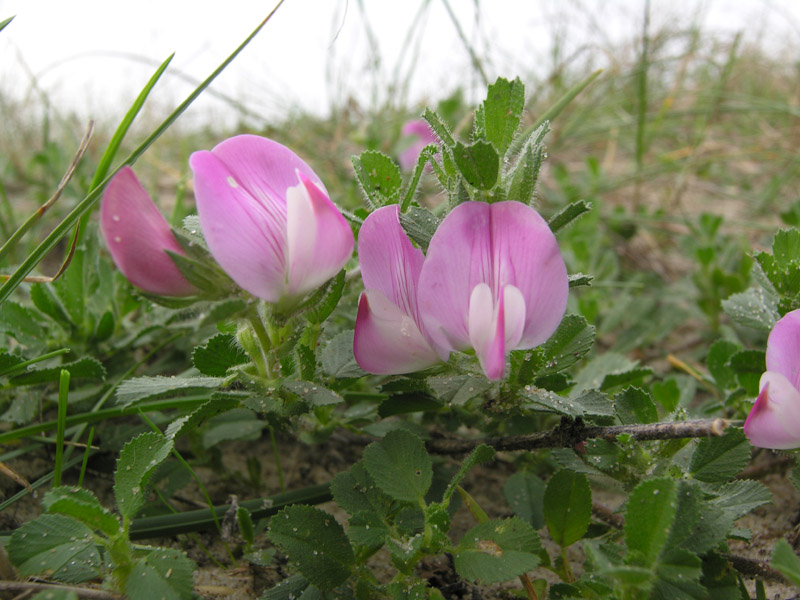
Photo: Mieoli, CC BY-SA 3.0 · source

Dwarf shrub · Pea family (Fabaceae)
Spiny restharrow
Ononis spinosa
In other languages: Kattendoorn (Nederlands) · Bugrane épineuse (Français)
Grows wild in Belgium.
Spiny restharrow is a prickly dwarf shrub, woody at the base, with pink pea flowers from June to September. It grows in sunny places with poor, often limy soil: dykes, unimproved grassland, verges and limestone slopes. In Belgium it is fairly rare, with sites on dykes and in poor grassland in Flanders and in limestone grassland in the south of the country. You recognise it by its upright, hairy stems full of sharp spines, the small, sticky leaves and the pink flowers with a large, veined standard petal. Bumblebees and large wild bees visit the flowers for their pollen.
Light
Full sun
warm and bright
Moisture
Dry to normal
no wet feet
Hardiness
Fully hardy
down to -25 °C
Size
0.5 m
tall, 0.5 m wide
Flowering
June–September
| Pruning months | March and September |
|---|---|
| Height | 0.5 m |
| Native to Belgium | Yes |
| Flowering | June–September |
Identify
How to recognise it
- Habit
- Upright to ascending dwarf shrub 30–60 cm tall, woody at the base, often in a loose clump.
- Stem
- Reddish to brownish, hairy in one or two lines, with many sharp spines, often in pairs.
- Leaf
- Small, with three leaflets low down and single higher up, finely toothed and covered in glandular hairs; slightly sticky to the touch.
- Flower
- Pink to purplish-pink pea flower 1–2 cm long with a large, veined standard, single or in pairs in the leaf axils, from June to September.
- Fruit
- Small, hairy pod 6–10 mm long, as long as or longer than the calyx, with a few seeds.
- Roots
- Long, tough taproot that goes deep into the soil.
- Confusion with
- Common restharrow is lower, creeps and roots along its stems, is hairy all round and has few or soft spines.
Flowering: June–September · Pruning: March and September
In your garden
Why grow it?
- Flowers all summer, from June to September, with pink flowers for bumblebees and large wild bees. The flowers have no nectar, but plenty of pollen.
- Food plant for the caterpillars of the common blue, among others.
- A typical plant of flowery dykes and limestone grassland that you can help preserve in a garden with poor soil.
- Grazing animals leave it alone because of its spines, so in grazed grassland it is a safe haven for insects.
- Fixes nitrogen from the air with the bacteria in its root nodules.
Spiny restharrow: where does it grow best?
- In the wild on dykes, in poor and limy grassland, on verges and on sunny slopes.
- Full sun; in shade it flowers poorly and eventually disappears.
- Poor soil: limy loam or clay, or some sand. Copes with both drought and heavy clay.
- In the garden: in a flowery hay meadow, on a sunny bank or in a dry border with wild plants.
Goes well with
- Wild marjoram: Flowers at the same time on the same dry, limy soil and attracts butterflies.
- Bird’s-foot trefoil: A yellow pea flower that is also a food plant for blue butterflies.
- Common knapweed: Purple flowers for butterflies in a poor hay meadow.
- Salad burnet: A low, lime-loving plant for the front.
- Lady’s bedstraw: Yellow sprays in summer on poor, dry soil.
Maintenance
Spiny restharrow: when and how to plant it?
- Buy plants or seed from a nursery specialising in native plants, preferably of regional origin.
- Sowing: roughen the hard seeds with sandpaper or soak them overnight, then sow in autumn or in March–April, in pots or directly on bare ground.
- Plant young plants in October–November or March–April; because of its deep taproot it transplants badly later on.
- Space plants 30–40 cm apart, or put three to five together in a hay meadow.
- Water only during the first weeks in dry spells. No compost or fertiliser.
- Never dig up plants from a dyke or anywhere else in the wild.
Care
- Watering
- Not needed once established: its taproot draws water from deep in the soil.
- Feeding
- Avoid: on poor soil it stays compact and flowers profusely.
- Mowing
- In a hay meadow, mow once a year in September, after flowering, and remove the cuttings.
- Weeding
- Keep vigorous grasses and tall weeds away so it gets enough light.
- Gloves
- Wear sturdy gloves when weeding and mowing: the spines are sharp.
Tip: Sow spiny restharrow on a sunny bank or a poor slope in your garden, just like on a dyke: the poorer and sunnier the spot, the more it flowers.
Pruning and mowing
Pruning months: March and September.
When: Mow in September, after flowering; in a border, cut away dead stems in March.
How:
- In September, mow or cut the stems to 5–10 cm above the ground and remove the cuttings.
- In a border you can leave the dead stems until March for insects, then cut them just above the new shoots.
- In a hay meadow, leave a small patch uncut every year for overwintering insects.
Caution: Wear gloves: the spines easily break off in the skin.
Propagation
- Seed
- Roughen or soak the seeds, then sow in autumn or spring. Move seedlings early into deep pots.
- Self-seeding
- On bare, poor soil it sometimes self-seeds; move the seedlings while they are still small.
Spiny restharrow: how does it get through the winter?
Hardy to −25 °C.
- The stems largely die back; the woody base and the taproot survive the winter.
- If you leave the dead, spiny stems standing, they give insects a place to shelter.
- Fully hardy.
- In spring, new shoots grow from the woody base.
Diseases and pests
- Disappearing: On rich soil, grasses and tall weeds smother it. Mow every year and remove the cuttings.
- Too much shade: Few flowers and floppy stems. Move young plants to a sunny spot.
- Spines: Painful when weeding and for children at play. Do not plant it next to a path or play area.
- Hard to move: Because of its deep taproot, an older plant re-establishes poorly. Plant it young.
Through the year
- March: Cut away dead stems. Sow.
- April: New shoots. Plant.
- June: Flowering begins.
- July: Full flower: bumblebees and bees.
- August: Flowering and the first ripe pods.
- September: Last flowers. Mow and remove the cuttings.
- October: Sow in pots outdoors. Plant.
- November: Plant.
You and this species
Did you know?
- The name restharrow means ‘stops the harrow’, and in French it is also called arrête-bœuf, ‘ox-stopper’: its tough roots used to catch in harrows and ploughs.
- When a bumblebee lands on the flower, it pushes the keel down and the pollen is squeezed out as if from a little pump.
- Spiny restharrow and common restharrow are closely related: some botanists treat them as a single species, and they also hybridise.