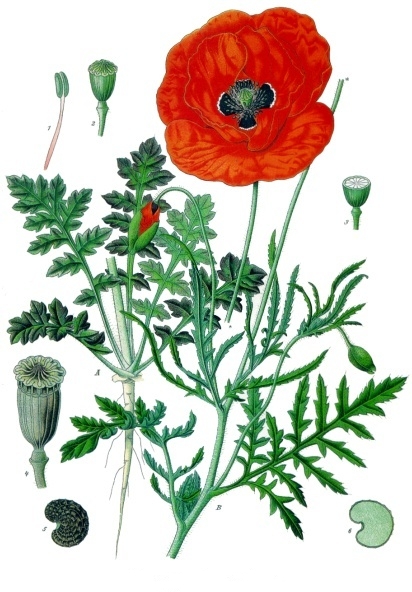
Photo: Franz Eugen Köhler, Köhler's Medizinal-Pflanzen, Public domain · source

Herbaceous plant · Poppy family (Papaveraceae)
Common poppy
Papaver rhoeas
In other languages: Grote klaproos (Nederlands) · Coquelicot (Français)
Grows wild in Belgium.
The common poppy is the familiar red poppy of fields, verges and waste ground. It is an annual that germinates on disturbed, bare soil: field margins, road verges, building sites, dykes and banks. It is common in Belgium. Recognise it by its large, scarlet, slightly crumpled flowers with four petals, often with a black blotch at the base, by its nodding, hairy buds and by its smooth, rounded seed capsule with a flat lid. Bumblebees and bees gather large amounts of pollen from it. Since the poem ‘In Flanders Fields’ it has also been the symbol of remembrance of the First World War.
Caution: The whole plant, and especially the latex and the unripe capsules, contains alkaloids and is mildly poisonous. Keep young children and pets away from the plants and do not let grazing animals such as horses and cattle eat them.
Light
Full sun
warm and bright
Moisture
Dry to normal
no wet feet
Hardiness
Fully hardy
down to -20 °C
Size
0.6 m
tall, 0.2 m wide
Flowering
May–August
| Pruning months | August |
|---|---|
| Height | 0.6 m |
| Native to Belgium | Yes |
| Flowering | May–August |
Identify
How to recognise it
- Habit
- Annual of 30–80 cm with a taproot and branched stems.
- Leaves
- Deeply divided into toothed segments, rough and hairy; first in a rosette, later along the stem.
- Flowers
- Four scarlet, thin, crumpled petals, 5–10 cm across, often with a black blotch at the base, and a ring of dark stamens. Each flower lasts only a day or two, but many follow; May to August.
- Fruit
- A smooth, almost round capsule of 1–2 cm with a flat lid bearing 8–12 rays. The tiny seeds escape through pores under the rim, like a pepper pot.
- Stem
- With rough, spreading hairs; when broken it oozes white latex.
- Confusion with
- Long-headed poppy has paler orange-red flowers and a long, narrow capsule. Prickly poppy has smaller flowers and a bristly capsule. Opium poppy has blue-grey leaves clasping the stem and large lilac or white flowers.
Flowering: May–August · Pruning: August
In your garden
Why grow it?
- A rich source of pollen for bumblebees, honeybees and solitary bees, from May to August.
- Turns a field margin or a newly made border scarlet in a single season.
- The seed stays viable in the soil for decades: after the ground is disturbed it often appears by itself.
- The seed capsules are decorative, fresh or dried.
- Inseparable from the remembrance of the First World War in the Westhoek of Flanders.
Common poppy: where does it grow best?
- In the wild: arable fields and margins, road verges, dykes, building sites and other places where the soil has just been disturbed.
- In the garden: full sun.
- Ordinary to dry, free-draining soil, preferably slightly chalky; not wet soil.
- Ideal in a cornfield-flower strip, a newly sown wildflower meadow or among vegetables; in closed turf it disappears.
Goes well with
- Cornflower: Blue next to red: the classic picture of a field margin.
- Scented mayweed: Small white flowers with yellow centres in the same strip.
- Corn marigold: Golden yellow flowers, another annual cornfield flower.
- Corncockle: Purple stars among the poppies.
- Oxeye daisy: A perennial that takes over in a wildflower meadow when the poppies fade out.
Maintenance
Common poppy: when and how to plant it?
- Sow in September–October or March–April where it is to flower: poppies dislike being transplanted.
- Make the soil bare and loose, without fertiliser, and rake it fine.
- Mix the tiny seed with some sand, scatter it thinly and barely cover it; just press it in.
- Thin the seedlings to 15–20 cm so each plant can branch well.
- Only water if there is a long dry spell just after sowing.
- Do not collect seed in nature reserves and never dig up plants from the wild; seed of native origin is sold by specialist seed suppliers.
Care
- Water
- Not needed, except in long droughts just after germination.
- Feeding
- Not needed. On rich soil the plants grow tall and fall over.
- Cultivating
- Poppies need some bare soil every year. Rake or dig over part of the strip in autumn, and the seed in the soil will germinate again.
- Spent flowers
- Cut them off for a longer display, or leave them for seed and attractive capsules.
- Letting it seed
- Let some capsules ripen and shake them out where you want poppies next year.
Tip: For poppies every year, keep a patch of bare soil: rake or dig over a strip in autumn, and the seed in the soil will do the rest.
Pruning and mowing
Pruning months: August.
When: In August, when the capsules are ripe and dry, clear the plants.
How:
- Cut off spent flowers to prolong flowering.
- At the end of summer let some capsules ripen until they are grey-brown and the pores under the lid are open.
- Shake the capsules over the spot where you want poppies next year, then pull up the plants.
- Mow a cornfield-flower strip after seed set, in August–September, then lightly cultivate the soil.
Caution: Cut poppies wilt quickly. Pick them in bud and dip the cut end in hot water for a few seconds: they will last longer.
Propagation
- Seed
- Sow in September–October or March–April where it is to flower on bare soil, barely covered. Autumn sowing often gives the earliest and strongest plants.
- Self-seeding
- Let the capsules ripen; with some bare soil they come back every year.
Common poppy: how does it get through the winter?
Hardy to −20 °C.
- After autumn sowing the plant overwinters as a small leaf rosette that copes well with frost.
- The seed overwinters in the soil and can lie there for decades until the ground is disturbed.
- The old plants die after setting seed, so in winter there is little to see above ground.
Diseases and pests
- Disappearing: After a year or two the grass closes up and the poppies stop coming. Cultivate a patch of soil every autumn or sow again on bare ground.
- Flopping: On rich soil or after heavy rain the plants fall over. Do not feed, and sow a little more densely so the plants support each other.
- Aphids: Black bean aphids on stems and buds. Hose them off with water and let ladybirds do their work.
- Downy mildew: Yellow patches on the leaves with grey fungal fuzz underneath, especially in damp weather. Pull up affected plants and sow in a different spot next year.
Through the year
- March: Sow on bare, loose soil. Autumn rosettes are growing.
- April: Thin seedlings to 15–20 cm.
- May: Flowering begins on autumn-sown plants.
- June: Full flower. Bumblebees and bees on the flowers.
- July: Flowering. Cut off spent flowers or let them ripen.
- August: Capsules ripen. Shake out the seed and clear the plants.
- September: Lightly cultivate the soil and sow for next year.
- October: Last chance for autumn sowing.
- November: Young rosettes overwinter. On 11 November the poppy is at the heart of First World War remembrance.
You and this species
Did you know?
- The poem ‘In Flanders Fields’, written near Ypres in 1915 by the Canadian army doctor John McCrae, made the poppy the symbol of the soldiers who died in the First World War.
- Poppy seed can survive in the soil for decades: on the churned-up battlefields of the Westhoek, poppies flowered in huge numbers during and after the war.
- Each flower lasts only a day or two, but a plant produces many in succession, and each capsule holds hundreds of seeds.