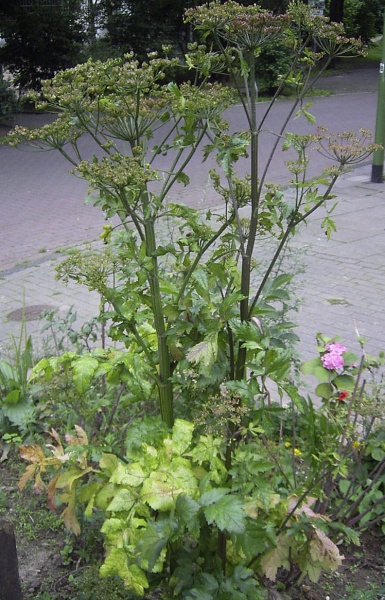
Photo: Denis Barthel, CC BY-SA 3.0 · source

Herbaceous plant · Carrot family (Apiaceae)
Wild parsnip
Pastinaca sativa
In other languages: Pastinaak (Nederlands) · Panais (Français)
Grows wild in Belgium.
Wild parsnip is a sturdy biennial umbellifer with yellowish-green flower heads, growing wild on verges, dykes and railway embankments, in rough grassland and on waste ground. In Belgium it is fairly common on clay, loam and chalky soils and scarcer on acid sand. You can recognise it by its hollow, sharply grooved stem, its once-pinnate leaves with broad, toothed leaflets and its flat yellow umbels, usually without bracts. It is the same species as the cultivated parsnip, an old winter vegetable with a sweet, nutty root. The umbels are a busy insect café, but take care: the sap makes skin sensitive to sunlight and can cause painful blisters.
Caution: The sap of the stems and leaves contains substances (furanocoumarins) that make skin sensitive to sunlight. Bare skin that touches the sap and is then exposed to the sun can develop painful red patches and blisters, sometimes followed by brown marks that last for months. This applies to everyone: children playing with the hollow stems, walkers in shorts and gardeners with a strimmer. Wear gloves and long sleeves, do not let children play with the stems, and wash skin that has touched the sap straight away with soap and water. Never eat wild umbellifers you cannot identify with certainty: poisonous species such as hemlock look similar.
Light
Full sun
warm and bright
Moisture
Dry to normal
no wet feet
Hardiness
Fully hardy
down to -25 °C
Size
1 m
tall, 0.5 m wide
Flowering
July–September
| Pruning months | August–September |
|---|---|
| Height | 1 m |
| Native to Belgium | Yes |
| Flowering | July–September |
Identify
How to recognise it
- Growth form
- Biennial: a leaf rosette in the first year, a flowering stem of 30–150 cm in the second, after which the plant dies. The stem is hollow, hairy and sharply grooved.
- Leaf
- Once pinnate, with 2–7 pairs of oval, lobed and toothed leaflets; slightly hairy, with a strong smell of parsnip when rubbed.
- Flower
- Flat umbels of 5–15 cm with 5–20 rays and small yellowish-green to yellow flowers, usually without bracts. Flowers from July to September.
- Fruit/Seed
- Flat, oval, winged fruits of 5–8 mm that are carried away by the wind.
- Roots
- Whitish taproot; in wild plants much thinner and woodier than in the vegetable.
- Confusion with
- Hogweed has white umbels and large, palmately lobed leaves; its sap is phototoxic too. Wild carrot has white umbels and finely divided leaves. Fennel and dill are also yellow but have thread-like leaves. Dangerous poisonous umbellifers such as hemlock and hemlock water-dropwort have white flowers.
Flowering: July–September · Pruning: August–September
In your garden
Why grow it?
- From July to September the open yellow umbels are full of hoverflies, flies, beetles, parasitic wasps and solitary bees: the nectar is easy to reach.
- Can serve as a food plant for swallowtail caterpillars, which also feed on other umbellifers such as wild carrot.
- In winter the hollow stems shelter small insects, and the dry umbels stay attractive for a long time.
- A characteristic plant of flowery verges and dykes that fits well into a dry, sunny wildflower meadow.
- The same species as the cultivated parsnip, an old winter vegetable that is easy to sow yourself.
Wild parsnip: where does it grow best?
- In the wild on verges, dykes and railway embankments, in rough grassland, chalk grassland and on waste ground.
- Full sun.
- Dry to moderately moist, chalky or neutral soil: clay, loam or limy sand, even somewhat fertile.
- In the garden: in a sunny, rough wildflower meadow or a wild edge, away from paths and play areas because of the sap.
Goes well with
- Wild carrot: White umbels next to the yellow ones, on the same sunny verge; also a swallowtail food plant.
- Knapweed: Purple flowers for butterflies and bumblebees in the same rough grassland.
- Wild marjoram: Pink flowers covered in bees and butterflies, on the same dry, chalky soil.
- Chicory: Sky-blue flowers on the same verges, from July to September.
- Common bird’s-foot-trefoil: Yellow pea flowers in the lower layer, food plant of the common blue.
Maintenance
Wild parsnip: when and how to plant it?
- Sow where it is to grow in September–October or March–April: with its taproot it does not transplant well.
- Use fresh seed, as parsnip seed loses much of its viability after a year or two. Seed of wild origin is available from nurseries or seed suppliers specialising in native plants.
- Scatter the seed on bare patches in the turf or on loosened soil, 1–2 cm deep, and thin the seedlings to 30–40 cm.
- Water only in dry spells until the seedlings are up; germination can take 3–4 weeks.
- For the vegetable: sow in March–April in rows 30 cm apart, in deep, loose soil without fresh manure, and thin to 10–15 cm within the row.
- Never dig up plants from the wild, and wear gloves when handling it.
Care
- Water
- Not needed; the taproot draws water from deep down.
- Feeding
- Not needed for the wild plant. For the vegetable a little compost is enough; fresh manure makes the roots fork.
- Mowing
- Mow a wildflower meadow in September, after seed set, and remove the cuttings. As a biennial it needs to set seed somewhere every year.
- Spreading
- Self-seeds freely. Where you no longer want it, cut off the umbels before the seed ripens, wearing gloves and long sleeves.
- Harvesting
- Harvest the vegetable from October to March; after a few frosty nights the root tastes sweeter. It can simply stay in the ground. Delicious roasted, or in soup and mash.
Tip: Handle wild parsnip on a cloudy day or in the evening, with gloves and long sleeves, and wash your hands before going back out into the sun.
Pruning and mowing
Pruning months: August–September.
When: In August–September: after flowering if you want to limit self-seeding, or after seed set.
How:
- In a wildflower meadow, leave some of the stems with seed standing into winter: the hollow stems shelter insects.
- If you want fewer seedlings, cut off the umbels as soon as they have finished flowering, before the seeds turn brown.
- Mow the rest of the meadow in September and remove the cuttings.
- Always work with gloves and long sleeves, ideally on a cloudy day or in the evening.
Caution: The sap makes skin sensitive to sunlight. Never cut it with a strimmer without protective clothing: it sprays sap onto arms, legs and face.
Propagation
- Seed
- The only way, as it is biennial. Sow fresh seed where it is to grow in September–October or March–April; in a wildflower meadow it also self-seeds.
Wild parsnip: how does it get through the winter?
Hardy to −25 °C.
- In its first year it overwinters as a leaf rosette with a taproot; fully hardy.
- After flowering in the second year the plant dies; the dry stems and umbels stay standing.
- Small insects overwinter in the hollow stems: leave some standing until spring.
- The vegetable can stay in the ground all winter; frost makes it sweeter.
Diseases and pests
- Blisters from the sap: Skin that comes into contact with the sap can burn and blister in the sun. Wear gloves and long sleeves, and wash your skin straight away with soap and water.
- Carrot fly: The larvae tunnel into the roots of cultivated parsnip. Sow thinly and cover the rows with fine insect mesh.
- Celery fly: The larvae make brown blotches with mines in the leaves. Remove affected leaves; the damage usually stays limited.
- Parsnip canker: Brown, sunken patches on the root of the vegetable. Rotate every year, do not sow too early and choose a less susceptible variety.
- Too many seedlings: In a small garden it can self-seed heavily. Cut off the umbels before the seed ripens.
Through the year
- March: Sow, both wild and vegetable forms. Harvest the last roots.
- April: Thin the seedlings. Rosettes start growing again.
- June: Second-year plants send up their flowering stems.
- July: Flowering begins, full of insects. Take care with the sap.
- August: Full flower. Cut off umbels where you do not want seed.
- September: Seed ripens. Mow and remove the cuttings, leaving some standing. Sow.
- October: Sow. Harvest the first roots of the vegetable.
- December: Harvest the vegetable after frost. Leave the dry stems standing.
You and this species
Did you know?
- Before the potato became widespread, parsnip was an important winter vegetable in much of Europe.
- In frost the root converts some of its starch into sugars: that is why parsnips taste sweeter after a cold spell.
- Its sap contains the same kind of substances as giant hogweed: furanocoumarins, which damage the skin under UV light.