Photo: Wezy at Dutch Wikipedia, CC BY-SA 3.0 · source

Herbaceous plant · Buttercup family (Ranunculaceae)
Creeping buttercup
Ranunculus repens
In other languages: Kruipende boterbloem (Nederlands) · Renoncule rampante (Français)
Grows wild in Belgium.
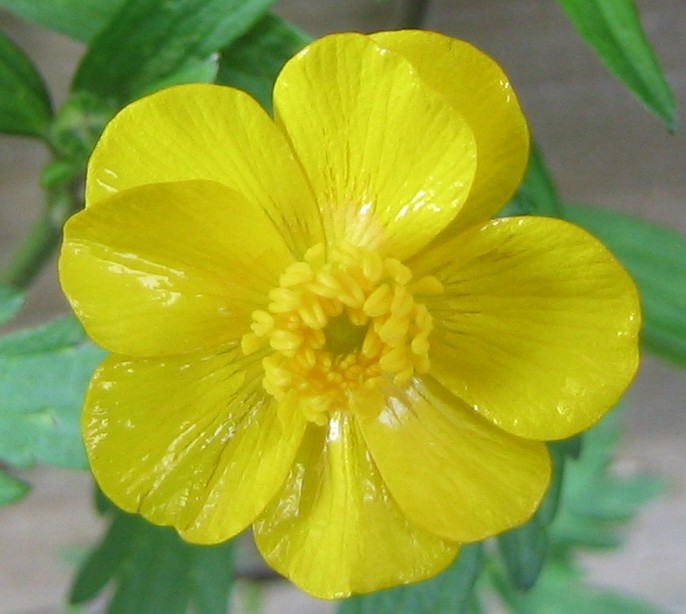
Creeping buttercup is a perennial buttercup that spreads across the ground with long, overground runners. It grows throughout Belgium in damp grassland and pastures, along ditches and woodland paths, in fields and in almost every garden. You can recognise it by the glossy yellow flowers of 2–3 cm, the leaves made of three leaflets with the middle one on its own little stalk, and the runners that root every few centimetres. From May to September wild bees, hoverflies and beetles find pollen and nectar on it. In a border it is a troublesome spreader, but in a wet corner or under a hedge it makes a green, flowering ground cover.
Caution: Poisonous to people and animals: the sap contains substances that irritate the mouth, stomach and skin. Children should not eat it, and horses, cattle and rabbits should not be given fresh cuttings. Dried in hay it is harmless.
Light
Sun or partial shade
preferably some sun
Moisture
Normal to wet
must not dry out
Hardiness
Fully hardy
down to -30 °C
Size
0.3 m
tall, 0.6 m wide
Flowering
May–September
| Pruning months | July and September |
|---|---|
| Height | 0.3 m |
| Native to Belgium | Yes |
| Flowering | May–September |
Identify
How to recognise it
- Habit
- Perennial, 10–50 cm tall, with long, creeping runners that root at the nodes and form new rosettes.
- Leaf
- Made of three deeply cut, toothed leaflets, the middle one on a distinct stalk. Dark green, often with pale blotches, slightly hairy.
- Flower
- Glossy golden yellow, 2–3 cm, with five petals; the sepals spread outwards and are not turned down. Flower stalk furrowed. May to September.
- Fruit/Seed
- A small ball of flattened achenes, each with a short, curved beak.
- Roots
- Strong, white fibrous roots; every rooted node of a runner becomes a new plant.
- Confusion with
- Meadow buttercup is taller, has no runners, palmately divided leaves without a stalked middle lobe and round, unfurrowed flower stalks. Bulbous buttercup has a swollen stem base and sepals turned down. Lesser celandine flowers earlier, in March–April, with 8–12 narrow petals and glossy, heart-shaped leaves.
Flowering: May–September · Pruning: July and September
In your garden
Why grow it?
- Long flowering season from May into September: pollen and nectar for wild bees, bumblebees, hoverflies and beetles.
- The large scissor bee (Chelostoma florisomne) collects pollen only from buttercups, including this species.
- It grows where the ground is wet and trodden and many other plants give up: a fast, green ground cover for damp spots.
- The glossy flowers brighten damp grassland, ditch banks and wild corners.
- It reveals wet, compacted soil: a handy indicator as you get to know your garden.
Creeping buttercup: where does it grow best?
- In the wild: damp pastures and hay meadows, ditch banks, riversides, woodland paths, fields, road verges and waste ground.
- Likes moist to wet, fertile soil, preferably clay or loam; tolerates trampling, compaction and temporary flooding.
- Sun to partial shade; it also grows under hedges and along woodland edges.
- In the garden: a wet corner, a pond edge, under shrubs or in a damp flowery meadow. Not in a border or vegetable bed, where it spreads too much.
Goes well with
- Ragged-robin: Ragged pink flowers in the same damp grassland, in May–June.
- Cuckooflower: Flowers early on wet soil and is a food plant of the orange-tip butterfly.
- Water forget-me-not: Sky-blue flowers along the pond edge all summer.
- Meadowsweet: Tall, fragrant plumes along the ditch in summer.
Maintenance
Creeping buttercup: when and how to plant it?
- Creeping buttercup usually turns up by itself. If you want it in a particular spot, buy plants from a native plant nursery or ask someone who has it in their garden for a few runners.
- Plant in March–April or September–October, 30–40 cm apart; after one season the ground is covered.
- Sow in autumn, outdoors on moist, bare soil, so the seed goes through a cold spell and germinates in spring.
- Water after planting until the runners have rooted; on wet soil this is rarely needed.
- Choose a place where it may spread, or hold it back with a board edging or a path.
- Never dig up plants from the wild: use nursery plants or runners from a garden.
Care
- Water
- Only in long dry spells after planting. On dry soil it stays small or disappears.
- Feeding
- Not needed. On poor soil it flowers just as well and spreads less.
- Mowing
- In a damp hay meadow, mow in July and September and remove the cuttings. In a lawn it simply survives under the mower.
- Spreading
- Pull out runners in spring and summer, roots and all; a hand fork easily loosens the rooted nodes. Loose soil and a mulch make the job easier.
- Self-seeding
- It self-seeds a little but spreads mainly by runners. Mowing after flowering limits the seed.
Tip: Let creeping buttercup have its way in the wettest corner of your garden, but pull it out of the border every spring: weed early and you keep it in check with little effort.
Pruning and mowing
Pruning months: July and September.
When: Mow or cut back in July and September, as for a damp hay meadow.
How:
- Mow at 5–8 cm and rake up the cuttings: this makes the soil poorer and gives other flowers a chance.
- In a border, cut the flower stems after flowering to limit self-seeding.
- Leave part unmown until autumn as shelter for insects and frogs.
Caution: The fresh plant is poisonous to livestock; dried in hay it is harmless. Do not give fresh cuttings to horses, cattle or rabbits.
Propagation
- Runners
- From spring to autumn: cut a rooted rosette from the runner and plant it elsewhere. It almost always takes.
- Seed
- Collect ripe seed in July–August and sow it outdoors in autumn; it germinates after the winter.
- Division
- Split large clumps with a spade in spring.
Creeping buttercup: how does it get through the winter?
Hardy to −30 °C.
- In mild winters the leaf rosettes stay green; in hard frost they partly die back and regrow in March.
- Fully hardy, down to about −30 °C.
- In a wet corner it keeps the soil covered in winter; small soil creatures shelter under the rosettes.
Diseases and pests
- Spreading: Takes over borders and vegetable beds with its runners. Pull it out regularly, avoid compacting the soil and put a path or edging between the wild corner and the border.
- Powdery mildew: White powder on the leaves in dry summers. Harmless; mow or cut off affected parts.
- Rust: Brown or orange spots on the leaves. Leave it; if badly affected, remove the affected leaves.
- Poisonous to grazing animals: Horses and cattle usually leave the fresh plant alone, but hungry animals may eat it. Keep buttercups short by mowing in a horse paddock.
- Wet, compacted soil: Lots of creeping buttercup in the lawn points to wet, compacted ground. Aerating and working in sand helps more than weeding.
Through the year
- March: New rosettes start growing. Plant or move plants.
- April: Pull out runners where they are not wanted.
- May: First flowers. Bees and hoverflies on the blooms.
- June: Full flower. Look for scissor bees in the flowers.
- July: First cut in a damp hay meadow. Remove the cuttings.
- August: Late flowers. Cut off rooted runners to replant.
- September: Second cut. Planting time again.
- October: Sow outdoors. The rosettes stay green.
- December: Dormant. The rosettes keep the ground covered.
You and this species
Did you know?
- Ranunculus means ‘little frog’ in Latin: many buttercups grow in wet places, just like frogs.
- The glossy yellow comes from a smooth top layer of cells with a layer of starch beneath, which reflects light like a mirror. That is why you see a yellow glow when you hold a buttercup under someone’s chin.
- The name refers to the butter-yellow colour. An old belief held that cows eating buttercups gave yellow butter, but cattle actually avoid the acrid fresh plant.