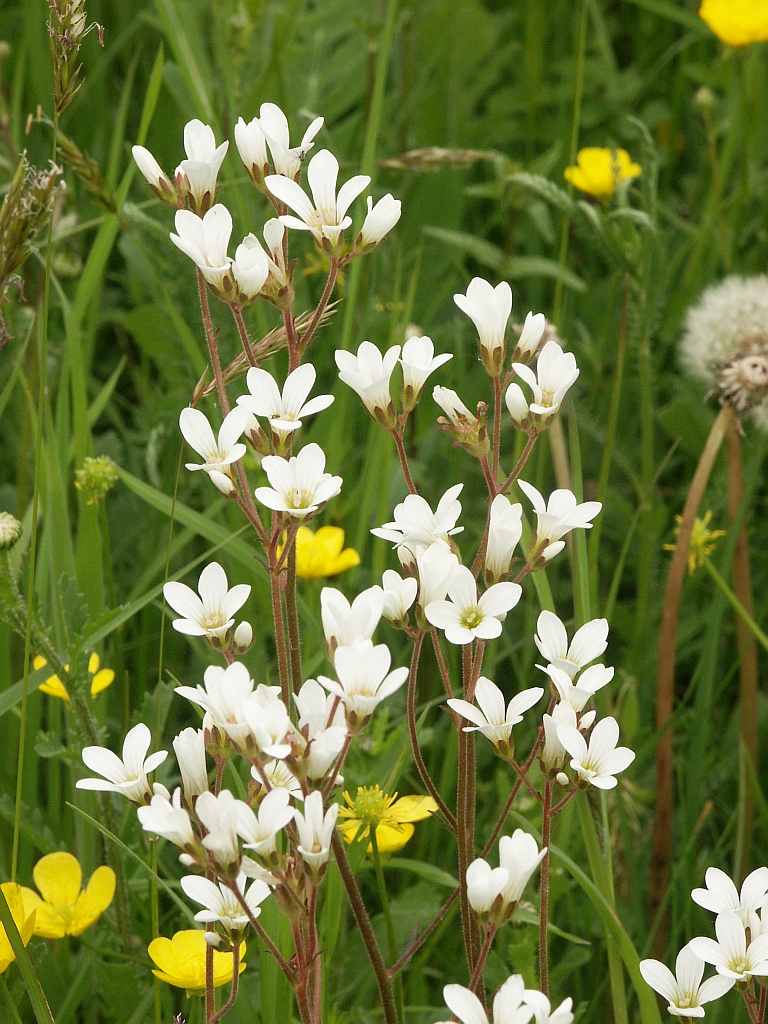
Photo: Bernd Haynold, CC BY-SA 3.0 · source

Herbaceous plant · Saxifrage family (Saxifragaceae)
Meadow saxifrage
Saxifraga granulata
In other languages: Knolsteenbreek (Nederlands) · Saxifrage granulée (Français)
Grows wild in Belgium.
Meadow saxifrage is a graceful perennial of thin grassland, with sprays of pure white flowers on slender, sticky stems. In the wild it grows on dry to moderately damp, poor soil: on old dykes, in thin verges and hay meadows, in churchyards and along light woodland edges. In Belgium it is fairly rare and has declined in many places because of fertilisation and the loss of old grassland. You can recognise it by its rosette of kidney-shaped, scalloped leaves and the small brown bulbils at the base of the stem, which give it its scientific name. It flowers in April–June and then goes dormant until autumn.
Caution: Meadow saxifrage is rare: do not pick it and never dig it up from the wild. Buy plants, bulbils or seed from a nursery.
Light
Sun or partial shade
preferably some sun
Moisture
Dry to normal
no wet feet
Hardiness
Fully hardy
down to -30 °C
Size
0.3 m
tall, 0.15 m wide
Flowering
April–June
| Pruning months | July and September |
|---|---|
| Height | 0.3 m |
| Native to Belgium | Yes |
| Flowering | April–June |
Identify
How to recognise it
- Habit
- Perennial of 10–40 cm with a rosette of basal leaves and one or a few slender, sparsely leafy flower stems.
- Leaf
- Basal leaves kidney-shaped, 1–3 cm wide, with a scalloped edge, hairy and stalked; they die back in summer.
- Flower
- Pure white, 1.5–2 cm across, with five broad petals, in loose sprays, from April to June.
- Stem
- Upright, branched near the top and densely covered with sticky glandular hairs.
- Roots
- At the stem base a cluster of small brown bulbils, from pinhead to pea size; each bulbil can grow into a new plant.
- Look-alikes
- Lesser stitchwort and field mouse-ear also have white spring flowers, but their petals are deeply notched and their leaves narrow. Rue-leaved saxifrage is much smaller, annual and has three-lobed leaves.
Flowering: April–June · Pruning: July and September
In your garden
Why grow it?
- White flowers in spring, with nectar for bees, hoverflies and butterflies.
- A characteristic plant of old, thin grassland and dykes; where it grows, the grass has often not been fertilised for a long time.
- Graceful and airy: the white sprays seem to float above the grass.
- It rests in summer, so it fits perfectly into a flowery meadow that is mown from July.
- It multiplies easily from its bulbils, so a fine group can build up.
Meadow saxifrage: where does it grow best?
- In the wild: old dykes, thin verges and hay meadows, sandy or loamy banks, churchyards and light woodland edges.
- Poor, free-draining soil, slightly acid to neutral; sandy or loamy.
- Sun to light partial shade; in spring, light must reach the ground.
- In the garden: in a thin flowery meadow, on a sunny bank or in a sandy strip that is never fed.
Goes well with
- Bulbous buttercup: Yellow flowers on the same thin dykes, also with a summer rest.
- Sweet vernal-grass: A low, early-flowering grass typical of thin grassland.
- Field wood-rush: A low, early-flowering wood-rush in the same grassland.
- Harebell: Blue bells later in summer, on the same poor soil.
- Yellow rattle: Weakens the grasses and keeps the meadow open.
Maintenance
Meadow saxifrage: when and how to plant it?
- Buy plants or bulbils from a nursery for native wild plants. Never dig up plants from the wild: meadow saxifrage is rare.
- Plant the bulbils in August–September 1–2 cm deep, in groups of five to ten, 10 cm apart.
- Or sow in autumn: scatter the fine seed on poor seed compost in a tray, press it in and do not cover it, as it needs light to germinate. Leave the tray outside all winter.
- Plant pot-grown plants in autumn, 15 cm apart, where the grass is short and open.
- Water when planting; after that only in long dry spells in autumn or spring.
Care
- Watering
- Not needed, except for young plants in a dry spring.
- Feeding
- Never: fertiliser is the main reason it disappears.
- Mowing
- Mow from July, once the seed is ripe, and again in September if you like. Always remove the cuttings.
- Competition
- Keep the grass short in autumn so the rosette gets enough light in spring.
- Summer rest
- After flowering the plant dies back above ground. Do not worry: the bulbils live on in the soil.
Tip: Plant meadow saxifrage where the grass stays naturally short, such as on a sandy bank: it will last there for years with little work.
Pruning and mowing
Pruning months: July and September.
When: Mow in July, after seed set; a second cut in September is fine.
How:
- Leave the flower stems until the seed capsules are brown and dry.
- Cut at 5–8 cm and rake off the cuttings.
- Rake lightly over the ground at the same time: this spreads the bulbils and gives them room.
Caution: Do not mow in April–June: you would lose the flowers and the seed.
Propagation
- Bulbils
- In summer or early autumn, detach the bulbils from the stem base and plant them separately.
- Seed
- Surface-sow in autumn in a tray left outdoors; it germinates in spring.
- Division
- In autumn, split a group of rosettes with their bulbils.
Meadow saxifrage: how does it get through the winter?
Hardy to −30 °C.
- In autumn a new rosette of kidney-shaped leaves appears and stays green over winter.
- Fully hardy.
- Keep the grass short in autumn so the rosette does not disappear under a thick layer.
Diseases and pests
- Crowding out: In fertilised or tall grass it disappears within a few years. Reduce fertility by mowing and removing cuttings.
- Slugs: They sometimes eat the young rosettes in autumn and spring.
- Soil too wet: On wet, heavy soil the bulbils rot. Choose a free-draining spot.
- Gone after flowering: That is normal: the plant rests in summer. Mark the spot so you do not dig it up by mistake.
Through the year
- March: The rosette grows. Keep the grass around the plants short.
- April: Flower stems shoot up; flowering begins.
- May: Full flower.
- June: End of flowering. The seed ripens; the plant dies back.
- July: Mow after seed set and remove the cuttings.
- August: Summer rest. Plant bulbils.
- September: Second mowing. Plant bulbils and pot-grown plants.
- October: New rosettes appear. Sow in a tray outdoors.
- November: The rosette overwinters.
- December: Resting.
You and this species
Did you know?
- Saxifraga means ‘stone-breaker’. Many saxifrages grow in rock crevices, and because the bulbils looked like kidney stones, people once believed the plant helped against them.
- The bulbils at the stem base gave the species its name granulata, ‘with little grains’.
- It is called meadow saxifrage because, unlike most saxifrages, it grows in grassland.