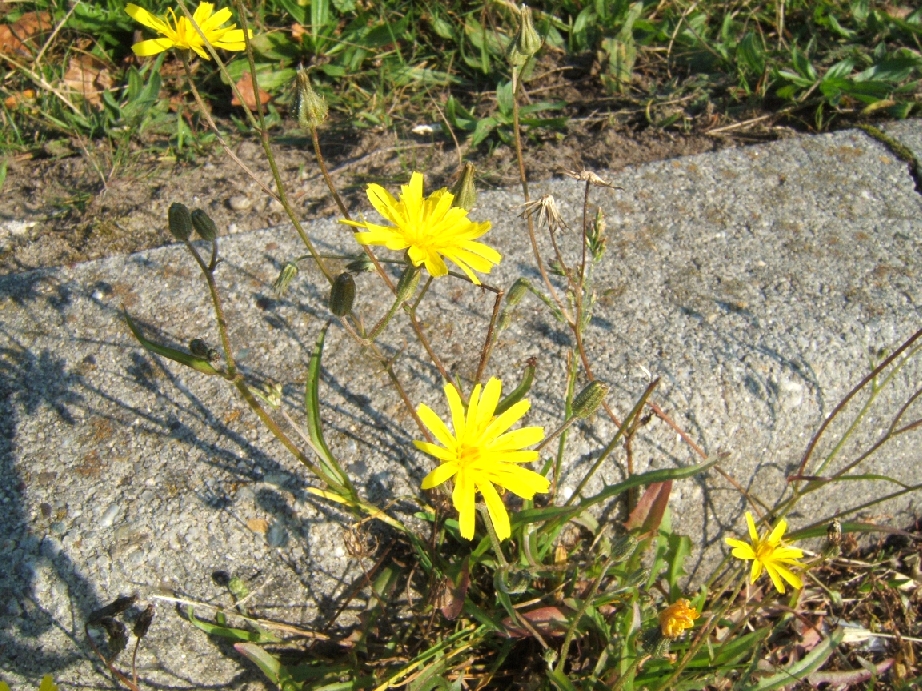
Photo: Algont at Dutch Wikipedia, CC BY-SA 3.0 · source

Herbaceous plant · Daisy family (Asteraceae)
Autumn hawkbit
Scorzoneroides autumnalis
In other languages: Vertakte leeuwentand (Nederlands) · Liondent d’automne (Français)
Grows wild in Belgium.
Autumn hawkbit is a perennial of the daisy family that you will see flowering from July into October in almost every grassland. It grows in pastures, hay meadows, lawns, verges, on dykes and even at the edge of salt marshes, and it is common throughout Belgium. You can recognise it by its rosette of deeply cut, almost hairless leaves and its thin, branched stems, each carrying a yellow flower head that looks like a small dandelion. Because it flowers so late, it is an important source of nectar and pollen in late summer and autumn for bees, bumblebees, hoverflies and butterflies. It tolerates mowing and trampling, which makes it ideal for a flowering lawn.
Light
Full sun
warm and bright
Moisture
Normal
no wet feet
Hardiness
Fully hardy
down to -30 °C
Size
0.3 m
tall, 0.2 m wide
Flowering
July–October
| Pruning months | June and October |
|---|---|
| Height | 0.3 m |
| Native to Belgium | Yes |
| Flowering | July–October |
Identify
How to recognise it
- Habit
- Perennial rosette plant with branched, almost hairless flowering stems of 10–40 cm, sometimes taller.
- Leaf
- Long and narrow, deeply cut into narrow lobes, hairless or with a few hairs. All leaves grow in a basal rosette.
- Flower
- Golden yellow ray florets in heads of 2–3 cm, the outer ones striped reddish underneath; from July to October. Below the head the stem gradually thickens and carries small scales.
- Fruit/Seed
- Nutlet with an off-white pappus of feathery hairs. All the seeds in a head are alike.
- Roots
- Short rootstock that looks bitten off, with many fibrous roots; no deep taproot. Like dandelion, it contains white milky sap.
- Confusion with
- Dandelion has an unbranched, hollow stem with a single head. Cat’s-ear has rough, hairy, less deeply cut leaves and chaffy scales between the florets. Rough hawkbit has unbranched, hairy stems.
Flowering: July–October · Pruning: June and October
In your garden
Why grow it?
- One of the last yellow flowers in grassland: nectar and pollen until October.
- Visited by honeybees, bumblebees, hoverflies, butterflies and solitary bees that specialise in yellow composites, such as the pantaloon bee.
- Tolerates mowing, grazing and trampling: an ideal species for a flowering lawn or grass path.
- The ripe seed heads with their pappus are food for seed-eating birds.
- Grows on almost any soil, even heavy clay, and even in slightly salty spots.
Autumn hawkbit: where does it grow best?
- In the wild: pastures, hay meadows, lawns, verges, dykes, grass paths and the edges of salt marshes.
- Full sun; in half shade it flowers less.
- Almost any soil: sand, loam and clay, from fairly dry to moist; preferably not too rich.
- In the garden: a flowering lawn, hay meadow, grass path or verge that is not mown too often.
Goes well with
- Cat’s-ear: Another yellow composite that flowers a little earlier in the same grassland.
- Oxeye daisy: White flowers in June in the same hay meadow.
- Red clover: Nectar for bumblebees in the same sward.
- Selfheal: Purple flowers low down in the flowering lawn.
- Daisy: Together the backbone of a flowering lawn.
Maintenance
Autumn hawkbit: when and how to plant it?
- Buy seed or plug plants from a nursery for native plants, preferably of Belgian origin. Never dig plants up from the wild.
- Sow in September–October or March–April on an open, raked spot and press the seed down well without covering it.
- In an existing lawn, make bare patches of 20 × 20 cm in autumn and sow or plant there, so the grass does not take over straight away.
- Set plug plants 20–30 cm apart, in small groups.
- Keep the soil moist until the seedlings are well established.
- Do not mow too short in the first months, so the young rosettes can take hold.
Care
- Water
- Not needed after the first year.
- Feeding
- Do not: fertiliser makes the grass strong, and that crowds out the flowers.
- Mowing
- In a hay meadow, mow in June and again in October and remove the cuttings each time. In a flowering lawn, mow every 3–4 weeks at 6–8 cm.
- Flowering
- Mow less often in late summer so that it can flower fully.
- Letting it seed
- Let some of the heads finish flowering and set seed before you mow.
Tip: From July to September, mow your lawn every 3–4 weeks instead of every week: you will get a yellow sea of autumn hawkbit for the bees, just when little else is in flower.
Pruning and mowing
Pruning months: June and October.
When: Mow in June and in October; in a flowering lawn every few weeks.
How:
- Mow in June, before the main flowering: the plant then regrows and flowers abundantly in late summer.
- Mow again in October and remove the cuttings so the soil stays poor.
- In a lawn, mow at 6–8 cm: the rosettes and often some of the flowers are spared.
- Leave a strip unmown until spring as shelter for insects.
Propagation
- Seed
- Ripe seed from August to October. Sow straight away or keep it until spring.
- Division
- An older clump with several rosettes can be split with a spade in March or September.
Autumn hawkbit: how does it get through the winter?
Hardy to −30 °C.
- In mild winters the leaf rosette stays partly green, pressed flat to the ground.
- Fully hardy, down to about −30 °C.
- An unmown strip with old stems offers shelter to overwintering insects.
Diseases and pests
- Crowded out by grass: On rich soil the grass wins. Make the soil poorer by removing cuttings and not feeding.
- Mowing too often: Mown every week, it hardly flowers. Mow every 3–4 weeks in late summer.
- Aphids: Sometimes on the stems; ladybirds and hoverfly larvae clear them up.
- Powdery mildew: White powder on the leaves in dry late summers. Harmless.
- Weeded by mistake: People digging out dandelions often remove hawkbit too. Learn to tell them apart by the branched stem.
Through the year
- March: Sow on bare patches. The rosettes grow.
- April: Set out plug plants. Let the grassland grow.
- June: Mow the hay meadow and remove the cuttings.
- July: Flowering begins.
- August: Full flower: bees and hoverflies on the flowers.
- September: Flowers and first seed. Sow.
- October: Last flowers. Mow the hay meadow and remove the cuttings.
- November: Rosettes in the grass. Leave a strip unmown.
You and this species
Did you know?
- It used to be called Leontodon autumnalis. ‘Leontodon’ means lion’s tooth and refers to the toothed leaves.
- The species name ‘autumnalis’ means ‘of autumn’: it flowers later than most other yellow composites in grassland.
- It occurs across almost all of Europe, as far as Iceland and the far north of Scandinavia.