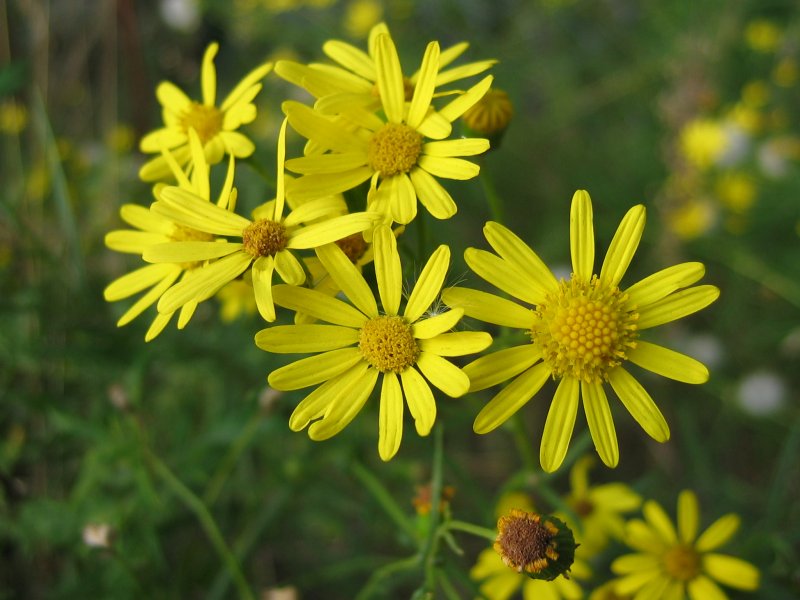
Photo: Kristian Peters -- Fabelfroh 12:31, 25 November 2006 (UTC), CC BY-SA 3.0 · source

Herbaceous plant · Daisy family (Asteraceae)
Narrow-leaved ragwort
Senecio inaequidens
In other languages: Bezemkruiskruid (Nederlands) · Séneçon du Cap (Français)
Grows wild in Belgium.
Narrow-leaved ragwort is a bushy, perennial ragwort from South Africa. It reached Belgium in the 20th century with imported sheep’s wool, among other places at the wool-washing works around Verviers, and spread quickly in the second half of the century along motorways, railways and canals. It is now common on road verges, railway land, industrial sites, waste ground, in quarries and in the dunes, and it also turns up in gardens and pastures. You can recognise it by its broom-like habit, its narrow, linear leaves and its many bright yellow flower heads, which appear from June into November. It is on the Belgian list of invasive species: it crowds out native plants in dry, open places and is poisonous to livestock and horses. So never plant or sow it, and do not spread it.
Caution: Invasive alien species on the Belgian list of invasive species: never plant, sow or spread it. The whole plant is poisonous because of its pyrrolizidine alkaloids, even when dried in hay or silage: dangerous to grazing animals, especially horses and cattle, and also to people and pets if eaten. Keep children and pets away, wear gloves when pulling it up and dispose of flowering plants and seed in a sealed bag with general household waste, never on the compost heap.
Light
Full sun
warm and bright
Moisture
Dry
tolerates drought
Hardiness
Fully hardy
down to -20 °C
Size
0.6 m
tall, 0.5 m wide
Flowering
June–November
| Pruning months | May–October |
|---|---|
| Height | 0.6 m |
| Native to Belgium | No, an invasive alien species |
| Flowering | June–November |
Identify
How to recognise it
- Habit
- Bushy, much-branched plant of 40–80 cm, sometimes up to 1 m, with a hairless stem that becomes woody at the base. It looks like a small yellow broom and lives for several years.
- Leaf
- Narrow and linear, 4–10 cm long and only 2–6 mm wide, hairless, with an untoothed or finely toothed edge; the base clasps the stem with two small lobes. Alternate.
- Flower
- Bright yellow heads 1.5–2.5 cm across, with a ring of yellow ray florets around a yellow centre, in loose clusters at the tips of the branches. From June into November, and later still in mild winters.
- Fruit/Seed
- Small, elongated seeds with a white pappus, together forming a fluffy ball like a small dandelion clock that blows away on the wind.
- Roots
- A taproot with many side roots. Young plants pull up easily; loosen old, woody plants with a garden fork first.
- Look-alikes
- Common ragwort is native, has deeply cut, pinnate leaves and flowers in a flat-topped cluster. Groundsel has no or hardly any ray florets. Narrow-leaved ragwort is recognised by its narrow, undivided leaves combined with a bushy, broom-like habit.
Flowering: June–November · Pruning: May–October
In your garden
What you need to know
- It is poisonous: like common ragwort it contains pyrrolizidine alkaloids, which damage the liver of horses and cattle, even when the plant is dried in hay or silage.
- Each plant produces thousands of fluffy seeds that travel far on the wind, in the slipstream of cars and trains and in moved soil: recognising it early saves a lot of work.
- In dry, open places such as dunes, thin grassland and rocky slopes it crowds out the native plants of these rare habitats.
- A young plant pulls up in no time; an old, woody plant has already been spreading seed for years.
- Bees and hoverflies do visit the flowers, but native yellow flowers such as bird’s-foot trefoil and lady’s bedstraw do the same job without taking over.
Narrow-leaved ragwort: where does it grow best?
- In the wild: road verges and central reservations, railway land, canal banks, industrial sites, waste ground, quarries, tips and dunes.
- Dry, open, sparsely vegetated ground: sand, gravel, rubble and railway ballast, poor to moderately fertile.
- Full sun; in shade it grows poorly.
- It turns up in gravel gardens, driveways, on imported soil and in vegetable plots, and in open, dry pastures and horse paddocks, where it is a risk to grazing animals.
Plant these instead
- Bird’s-foot trefoil: Native alternative with yellow flowers for dry, sunny ground, and food plant of the common blue butterfly.
- Lady’s bedstraw: Fragrant yellow sprays in summer, on the same dry, poor soil.
- Biting stonecrop: Low yellow stars on gravel and sand, ideal for a gravel garden.
- Wild marjoram: Purple flowers for butterflies and bees on dry, sunny ground.
- Harebell: Blue bells in thin, dry grassland.
Maintenance
How to remove it
- Never plant or sow narrow-leaved ragwort and never pass on seed or plants: it is on the Belgian list of invasive species.
- Pull up every plant as early as possible, preferably before it flowers, roots and all. Wear gloves; loosen larger plants with a garden fork first.
- If the plant is already flowering, first carefully snip the flower heads into a bag, then pull up the plant. Even pulled plants can still ripen their flowers into seed.
- Put flowering plants and seed heads in a sealed bag with general household waste. Never on the compost heap, in the green waste bin or dumped in the countryside.
- Come back every 3–4 weeks from June to November: it flowers for months and new seedlings keep appearing. Keep this up for several years.
- Sow or plant native species on bare ground so new seedlings have less chance. Report large stands on verges or in pastures to your local council.
Control
- Pulling
- The best method: pull or dig up the whole plant with its root before it sets seed. After a shower of rain the root comes out more easily.
- Mowing
- Mowing alone does little: the plant regrows and flowers again lower down. If you do mow, do it before flowering, repeat it and remove the cuttings.
- Waste
- Flowering plants and seed heads in a sealed bag with general household waste. Do not compost and never dump them in the countryside.
- Pasture and hay
- Remove plants from horse paddocks and hay meadows before mowing. Never feed hay or silage that contains narrow-leaved ragwort.
- Follow-up
- Check the spot until November and in the following years for seedlings. A closed cover of native plants keeps new seedlings out.
Tip: Pull up every plant you see in or around your garden straight away, even if there is only one: that way a single plant from the verge does not become a stand of hundreds. Look especially along gravel paths and on bare ground.
Pruning and mowing
Pruning months: May–October.
When: From May to November: not to look after the plant, but to stop it setting seed.
How:
- Pull or dig up the plants before the first flowers open.
- For flowering plants: first carefully snip the flower heads into a bag, then pull up the plant.
- Do not shake a pulled plant: ripe seeds blow away at once.
- Come back every 3–4 weeks, as new flowers and seedlings keep appearing.
Caution: Cutting or mowing without removing the root makes the plant regrow and flower again. Always remove the whole plant.
How it spreads
- Seed
- The main route: each plant produces thousands of fluffy seeds every year, which blow away on the wind and are carried along roads and railways in the slipstream of cars and trains.
- Soil and vehicles
- Seeds travel with imported soil, gravel, tyres, shoes and mowers. Clean tools, shoes and machines after the job.
- Long flowering
- Because it flowers from June into November, it sets seed for months. A single check a year is therefore not enough.
Narrow-leaved ragwort: how does it get through the winter?
Hardy to −20 °C.
- In mild winters it stays green and sometimes keeps flowering. In hard frost the branches partly die back, but the woody base reshoots in spring.
- Dig up large, woody plants in winter and check that no ripe seed heads are left on them.
- Even dead, dry plants remain poisonous: do not leave them lying in a pasture or hay meadow.
Diseases and pests
- Poisonous to livestock: The alkaloids damage the liver, even in small amounts that build up over time. Remove the plant from pastures and hay meadows.
- Seed from the verge: Fluffy seeds blow from road verges and railways into gardens and pastures. Check your garden regularly, especially gravel paths and bare ground.
- Regrowth: A cut or half-pulled plant regrows. Remove the root completely.
- Mistaken identity: Do not pull up native yellow daisy-family plants by mistake. Look for the narrow, undivided leaves and the bushy habit.
- Skin contact: Wear gloves when pulling up a lot of plants and wash your hands afterwards.
Through the year
- March: Check verges, gravel paths and bare ground for plants that survived the winter and for seedlings.
- April: Dig up large, woody plants before they start flowering again.
- May: Pull up seedlings and young plants; it is still easy now.
- June: Flowering begins. Pull up plants before they set seed.
- July: Check and pull every 3–4 weeks. Flowering plants in a sealed bag with household waste.
- August: Full flower and seed set: keep checking, also in pastures and hay meadows.
- September: Keep pulling and watch for new seedlings.
- October: Still in full flower: remove flowering plants before the seed ripens.
- November: Final round: remove the last flowering plants.
- December: In mild winters some plants are still in flower. Note where it grew so you can watch out next year.
You and this species
Did you know?
- Narrow-leaved ragwort is a well-known wool alien: its seeds travelled in sheep’s wool from South Africa and escaped into the wild near wool-washing works and spinning mills in Europe.
- Along motorways it travels with the traffic: the slipstream of passing cars and lorries carries the fluffy seeds along the verge.
- In its homeland it grows in the highland grasslands of South Africa and Lesotho, which is why it can also cope with frost here.