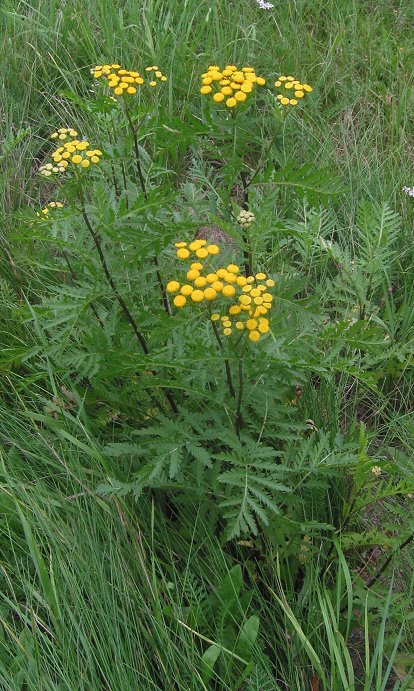
Photo: The original uploader was Rasbak at Dutch Wikipedia., CC BY-SA 3.0 · source

Herbaceous plant · Daisy family (Asteraceae)
Tansy
Tanacetum vulgare
In other languages: Boerenwormkruid (Nederlands) · Tanaisie commune (Français)
Grows wild in Belgium.
Tansy is a robust perennial with fern-like, strongly scented leaves and flat heads of golden-yellow buttons. It grows throughout Belgium along river and canal banks, on dykes, road verges and railway banks and in rough, sunny places with fertile soil. You can recognise it by the flower heads without ray florets, which look like yellow buttons barely 1 cm across, and by the camphor-like smell of a crushed leaf. From July to September the flowers swarm with hoverflies, beetles, wasps and wild bees. The plant is poisonous and was once used against worms and vermin, which explains its Dutch name.
Caution: Poisonous: all parts contain thujone. Do not eat it or use it as a tea. Dangerous for children, pets, horses and livestock. The sap can irritate sensitive skin: wear gloves.
Light
Sun or partial shade
preferably some sun
Moisture
Normal
no wet feet
Hardiness
Fully hardy
down to -30 °C
Size
1 m
tall, 0.6 m wide
Flowering
July–September
| Pruning months | March and September |
|---|---|
| Height | 1 m |
| Native to Belgium | Yes |
| Flowering | July–September |
Identify
How to recognise it
- Habit
- Perennial, 60–120 cm, with upright, sturdy stems in dense clumps that spread by rhizomes.
- Leaf
- Dark green, up to 20 cm long, pinnately divided with toothed lobes, like a fern frond. Strong camphor-like smell when crushed.
- Flower
- Flat golden-yellow flower heads of 0.5–1 cm without ray florets, like buttons, in broad, flat-topped clusters; July to September.
- Stem
- Sturdy, ridged, often reddish, branched near the top.
- Fruit/Seed
- Small ribbed achenes without a parachute; they drop close to the plant.
- Confusion with
- Common ragwort has yellow flower heads with ray florets and is very poisonous to horses and cattle. Scented and scentless mayweed have white rays around a yellow centre. Yarrow has white flower clusters and more finely divided leaves.
Flowering: July–September · Pruning: March and September
In your garden
Why grow it?
- Davies’ colletes collects pollen from daisy-family flowers, and above all from tansy; many other wild bees, hoverflies and beetles visit the flowers too.
- Long flowering in late summer, when many other wild flowers are already over.
- Aphid colonies tended by ants often live on the stems: food for ladybirds, hoverfly larvae and birds.
- The sturdy stems with dry buttons stay standing in winter as shelter for insects and look lovely with frost on them.
- The flowers keep their colour when dried: lovely in a dried arrangement.
- In the past the scented herb was hung up or strewn to keep flies and fleas away.
Tansy: where does it grow best?
- In the wild: river and canal banks, dykes, railway banks, road verges, field edges and waste ground.
- Sun to light partial shade, on moderately fertile soil, from fairly dry to moist; sand, loam or clay.
- In the garden: at the back of a sunny wild border, at the edge of a flower meadow, along a ditch or against a hedge.
- Give it space or put it in a contained corner: it spreads by rhizomes.
Goes well with
- Wild carrot: White umbels next to the yellow buttons, for the same hoverflies.
- Purple loosestrife: Purple spikes at the same time, on moist bankside soil.
- Knapweed: Purple flower heads for butterflies and bumblebees in late summer.
- Hemp-agrimony: Pink heads for butterflies, on banks and in wild corners.
Maintenance
Tansy: when and how to plant it?
- Buy pot-grown plants or seed of native origin from a nursery specialising in wild plants.
- Plant in March–April or September–October, 50–60 cm apart, in a place where it may spread.
- You can sow in spring or autumn: scatter the fine seed on loosened soil, press in and barely cover.
- Water in dry spells during the first few weeks, until the plants are well rooted.
- To limit spreading, plant it in a bottomless bucket or behind a 30 cm deep root barrier.
- Never dig up plants from the wild: nursery plants and seed establish better.
Care
- Water
- Only after planting; after that it copes well with drought.
- Feeding
- Not needed: on rich soil it grows too tall and flops.
- Spreading
- Every spring, slice off the edges of the clump with a sharp spade and remove runners that go too far.
- Self-seeding
- It self-seeds moderately. In September, cut off part of the faded heads if you don’t want seedlings.
- Support
- In a windy spot or on rich soil the stems may flop. Plant it among other tall plants so they hold each other up.
Tip: Plant tansy where it may spread, such as a ditch bank or the edge of a meadow, and leave the stems standing all winter: you get an insect hotel without building anything.
Pruning and mowing
Pruning months: March and September.
When: In March, cut the old stems back; in September, remove faded flower heads if you wish.
How:
- Leave the stems with their dry buttons through autumn and winter: insects overwinter in them and birds search them for food.
- In March, cut all old stems back to 10 cm above the ground, before the new shoots appear.
- If you don’t want seedlings, cut the heads off in September as soon as they turn brown.
- Wear gloves: the sap can irritate the skin.
Caution: Poisonous plant: wear gloves and do not throw cuttings into a field with cattle or horses.
Propagation
- Division
- Split a clump with a spade in March–April or October; each piece with rhizome and shoots takes easily.
- Rhizome pieces
- Pieces of rhizome with a bud, laid 5 cm deep in spring, soon become a new plant.
- Seed
- Collect seed in October and sow it on the surface in spring.
Tansy: how does it get through the winter?
Hardy to −30 °C.
- Dies back above ground; the brown stems with dry buttons stay standing.
- Small insects overwinter in the dry stems and between the flower heads; with frost on it the plant is a winter ornament.
- Fully hardy, down to about −30 °C.
Diseases and pests
- Spreading: Spreads by rhizomes into a large clump. Slice off the edges every year or install a root barrier.
- Aphids: Large, dark colonies on the stems, often tended by ants. Leave them: they feed ladybirds and birds, and the plant hardly suffers.
- Flopping: On rich soil or in shade the stems become weak. Do not feed, and choose a sunnier spot.
- Poisonous: Poisonous to people and animals. Do not plant it in or next to a horse paddock and keep small children away from it.
- Skin irritation: In some people the sap causes a rash. Wear gloves.
Through the year
- March: Cut old stems back. Divide or trim clumps.
- April: New shoots. Plant or sow.
- May: Slice off runners at the edges.
- June: Stems grow tall; ants and aphids appear.
- July: First flowers. Hoverflies and wild bees on the flower heads.
- August: Full flower. Pick flowers for drying, wearing gloves.
- September: Last flowers. Cut off faded heads if you wish.
- October: Collect seed. Plant or divide.
- December: Dormant. Leave the brown stems for insects.
You and this species
Did you know?
- The Dutch name boerenwormkruid, ‘farmers’ worm herb’, refers to its former use against intestinal worms in people and livestock; given its toxicity, that has long been abandoned.
- The name tansy goes back via Old French ‘tanesie’ to the Greek ‘athanasia’, immortality, possibly because the dried flowers keep their colour for so long.
- Ants tend the aphids on tansy and ‘milk’ their honeydew; some aphid species live only on this plant.